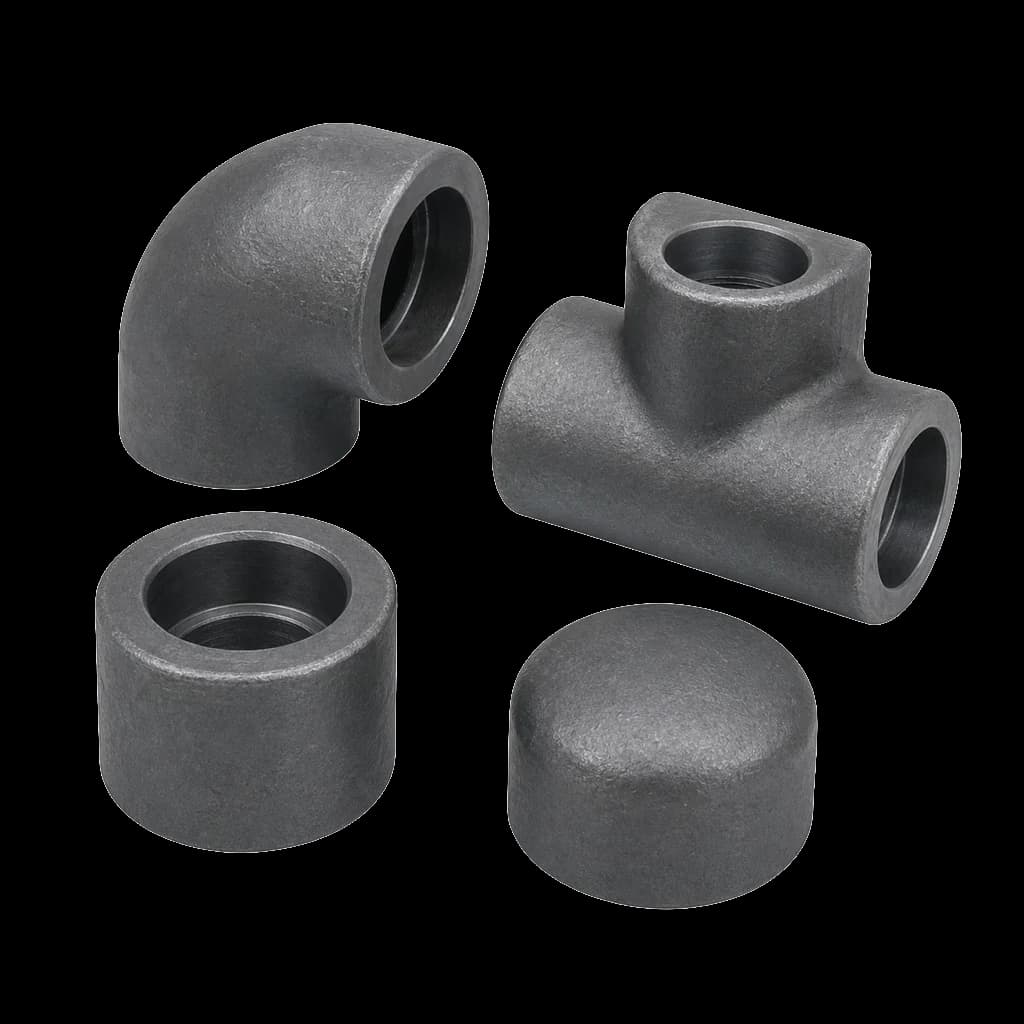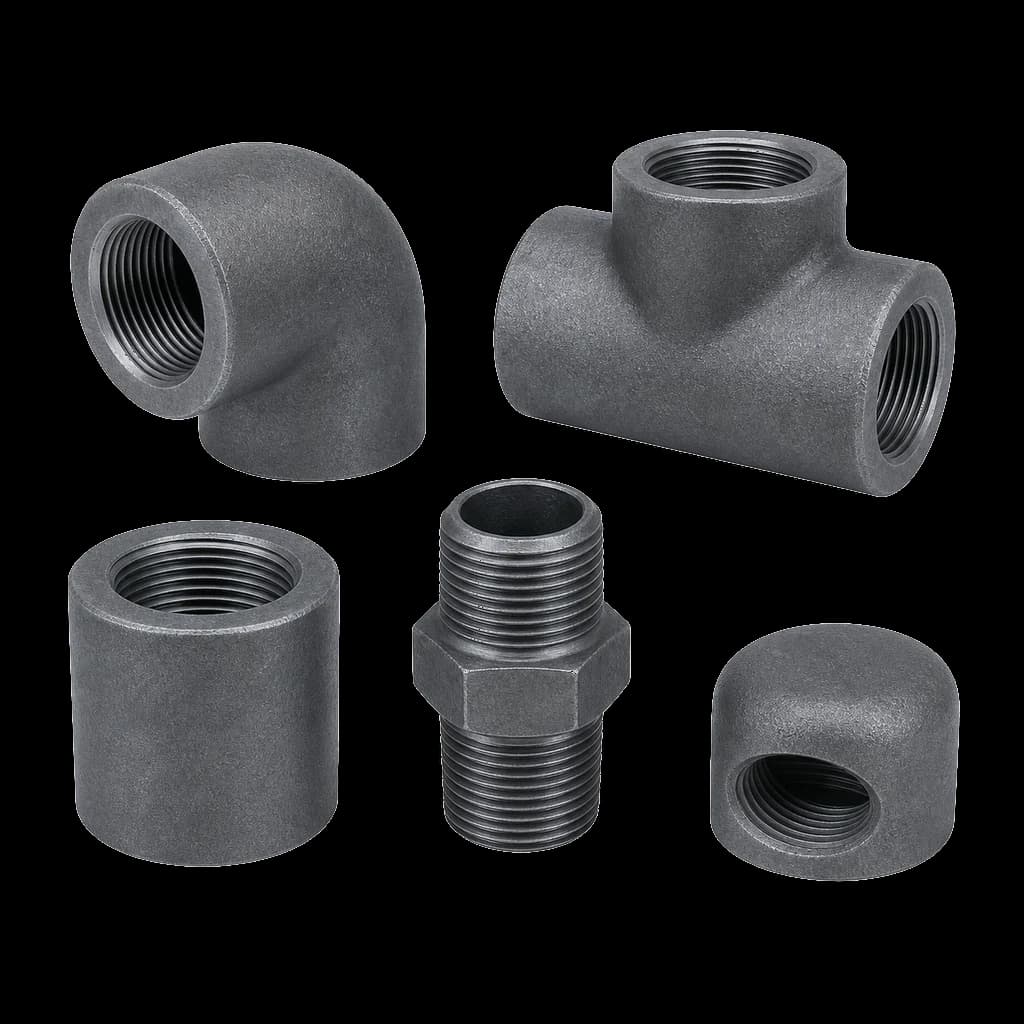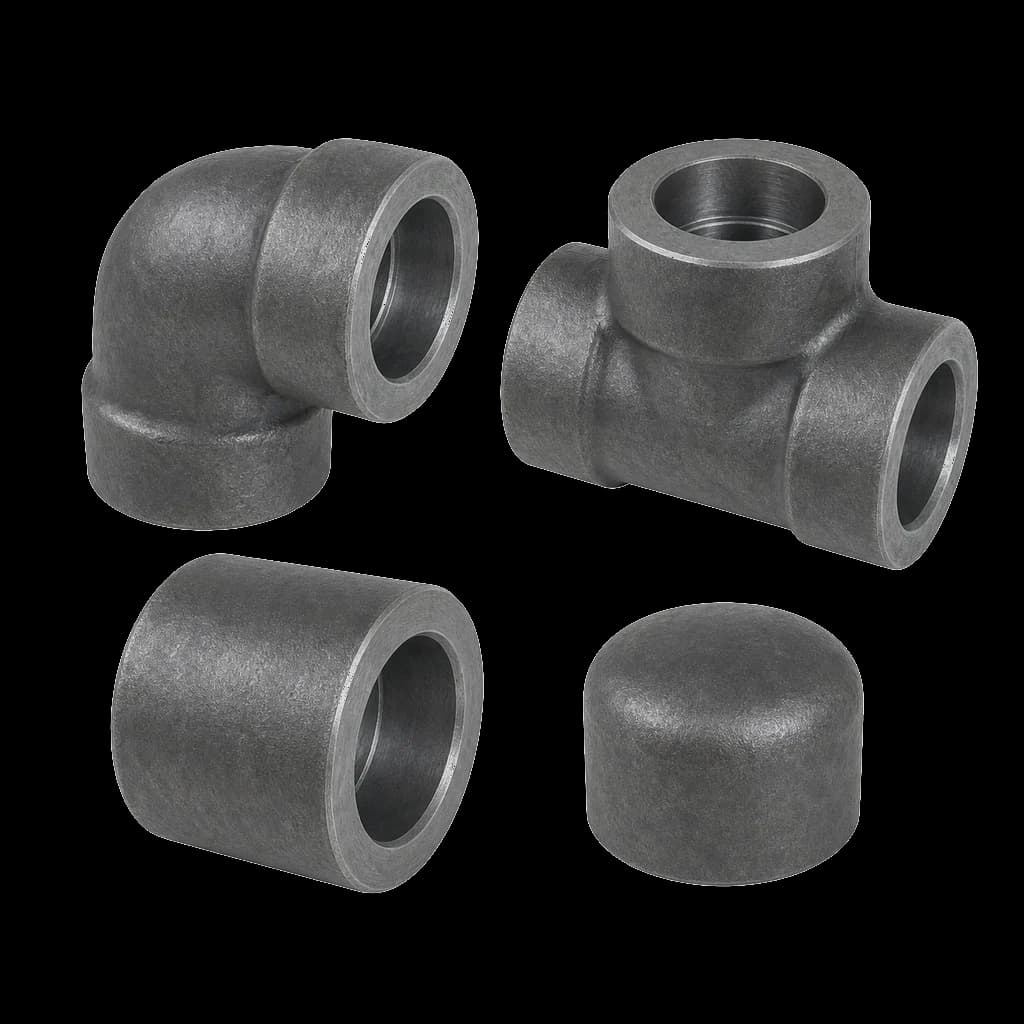
If you buy forged pipe fittings in India, two standards appear on virtually every purchase order: ASME B16.11, the American standard for forged socket-welding and threaded fittings, and IS:4712, its Indian counterpart. They overlap heavily — deliberately so — but they are not interchangeable on paper, and a PO that names the wrong one can stall at inspection. This guide explains what each standard actually governs and how to specify them correctly.
What ASME B16.11 covers
ASME B16.11 — *Forged Fittings, Socket-Welding and Threaded* — is the globally dominant dimensional standard for small-bore forged fittings: elbows, tees, crosses, couplings, half-couplings, caps, unions, plugs and bushings. It defines dimensions, tolerances, marking requirements and pressure–temperature capability for fittings typically used on piping NPS ½ through 4.
The standard's pressure designations are the familiar class numbers: 2000, 3000 and 6000 for threaded fittings, and 3000, 6000 and 9000 for socket-weld fittings. Crucially, B16.11 does not assign a standalone pressure rating to the fitting — it ties each class to a pipe wall schedule. A fitting is rated for the same service as seamless pipe of the schedule it corresponds to, in the equivalent material.
| Class | End type | Corresponding pipe schedule |
|---|---|---|
| 2000 | Threaded | Sch 80 / XS |
| 3000 | Threaded | Sch 160 |
| 6000 | Threaded | XXS |
| 3000 | Socket weld | Sch 80 / XS |
| 6000 | Socket weld | Sch 160 |
| 9000 | Socket weld | XXS |
Materials come from the ASTM system — most commonly A105 (carbon steel), A182 F304/F316/F11/F22 (stainless and alloy), and A350 LF2 for low-temperature service. The material standard, not B16.11 itself, controls chemistry, mechanical properties and heat treatment.
What IS:4712 covers
IS:4712 is the Bureau of Indian Standards specification for forged steel fittings — socket-welding and screwed — developed to give Indian industry a domestic reference aligned with international practice. Dimensionally it tracks the B16.11 system closely: the same fitting families, the same class structure, and the same schedule-correlation logic.
Where it matters commercially is procurement context. Public-sector tenders, state utilities and many Indian consultants specify IS standards as the primary reference, with the ASME equivalent accepted as an alternative. Boiler-connected piping certified under the Indian Boiler Regulations also sits more naturally on an IS paper trail — see our guide to IBR Form III-C for how that certification works.
The differences that matter at inspection
| Aspect | ASME B16.11 | IS:4712 |
|---|---|---|
| Issuing body | ASME (USA) | Bureau of Indian Standards |
| Typical material refs | ASTM A105 / A182 / A350 | IS or ASTM grades as specified |
| Threading reference | NPT per ASME B1.20.1 | BSPT per IS:554 common; NPT on request |
| Marking | Manufacturer, material, class, size, heat code | BIS-pattern marking incl. IS reference |
| Where specified | Oil & gas, refineries, international EPC specs | PSU tenders, IBR jobs, Indian consultants |
The threading line deserves attention. An A105 elbow to B16.11 with NPT threads will not mate with a BSPT-threaded Indian pipe nipple — the thread forms differ (60° vs 55° flank angle). Mixed-standard sites cause more leaks through thread mismatch than through any metallurgical issue. Always state the thread form explicitly on the PO.
Which should you specify?
- International EPC or licensor spec governs the project — specify ASME B16.11 with ASTM materials, NPT threads. This is the default for refinery, petrochemical and cross-country gas work.
- PSU or state tender written around IS codes — specify IS:4712, and confirm thread form (usually BSPT).
- IBR-certified steam piping — either dimensional standard can be used, but the fitting must come with IBR Form III-C certification from an IBR-approved manufacturer.
- Dual compliance — most reputable Indian forges, including the VS range VKS supplies, produce fittings dimensionally compliant with both standards, so a "B16.11 / IS:4712" dual callout is safe and common.
Documentation to demand with every lot
- EN 10204 3.1 material test certificate correlating heat numbers to the supplied lot
- Dimensional compliance declaration naming the standard and class
- Hydrostatic/proof test documentation where the PO requires it
- IBR Form III-C when the fittings serve boiler-connected steam lines