Butterfly valves win on weight, face-to-face length and price per inch of bore — no other isolation valve comes close at 8" and above. But "butterfly valve" covers two fundamentally different sealing designs, and specifying the wrong one is the most common butterfly mistake on procurement desks. The split is simple: concentric (resilient-seated) valves seal on rubber interference; double-offset (high-performance) valves seal on a cam action. Everything else follows from that.
Concentric: sealing by interference
In a concentric valve the stem passes through the centre of the disc, and the disc centre sits on the pipe axis. Sealing comes from interference: the disc edge compresses into an elastomer seat liner that lines the full bore, and that squeeze — not line pressure — makes the seal. The liner also isolates the body from the fluid, which is why a cast iron body with an EPDM liner is acceptable on potable water. The trade-off is built into the geometry: the disc edge rubs the seat through every degree of travel, near the closed position the rubbing is under full interference, and the elastomer sets the temperature and pressure ceiling of the whole valve.
| Seat elastomer | Typical max temp | Typical duty |
|---|---|---|
| EPDM | ~110–120 °C | Water, treated water, HVAC, air; not oils |
| NBR (nitrile) | ~80–90 °C | Oils, fuels, compressed air with oil carryover |
| FKM (Viton) | ~150–180 °C | Chemicals, hydrocarbons, hot air |
| PTFE-faced | ~180 °C | Corrosive chemical service, low torque |
Pressure ratings for concentric valves typically top out around PN 10/PN 16 (some designs PN 25), and shutoff is genuinely bubble-tight while the elastomer is healthy. On clean water at ambient temperature a resilient-seated valve is close to unbeatable on cost per year of service.
Double-offset: the cam action
A double-offset (high-performance) valve moves the stem twice: behind the disc sealing plane (first offset) and to one side of the pipe centreline (second offset). The result is a cam action — the disc lifts away from the seat within the first few degrees of opening instead of grinding across it. Seat contact happens only at the moment of closure, so seat wear drops dramatically and cycle life rises. Seats are typically PTFE/RPTFE in a metal retaining ring, or solid metal, which lifts the envelope to ASME Class 150 and 300 and to roughly 200 °C with polymer seats — well beyond any resilient liner. Fire-safe and low-emission variants are standard options in this family.
One step further sits the triple-offset valve: a third offset in the seat cone geometry gives metal-to-metal, torque-seated, rub-free closure — effectively a rotary globe valve. It belongs on steam, hot oil and other duties beyond soft-seat limits, at a correspondingly higher price. Worth knowing; not needed for most water and general process work.
A word on throttling
Butterfly valves are usable throttlers in a way gate valves are not, but within limits. Below roughly 20–30° open the disc gives poor, unstable control; above about 60–70° it stops adding capacity. Concentric valves throttle at the cost of seat life — the disc edge works against the elastomer continuously — so keep resilient-seated throttling to balancing duty on clean water. A double-offset valve, with the disc clear of the seat at every intermediate position, throttles without eating its seat and is the honest choice where regular modulation is part of the duty. For precise continuous control, neither replaces a control valve.
Wafer, lugged or double-flanged
- Wafer: the valve is clamped between two flanges with through-bolts. Cheapest and lightest — but the joint depends on both flanges. A wafer valve must never be used for dead-end service or downstream dismantling.
- Lugged: threaded lugs accept bolts from each flange independently, so downstream piping can be removed with the line live on the upstream side. Most lugged valves are rated for dead-end service, usually at a reduced pressure — check the manufacturer's figure, do not assume full rating.
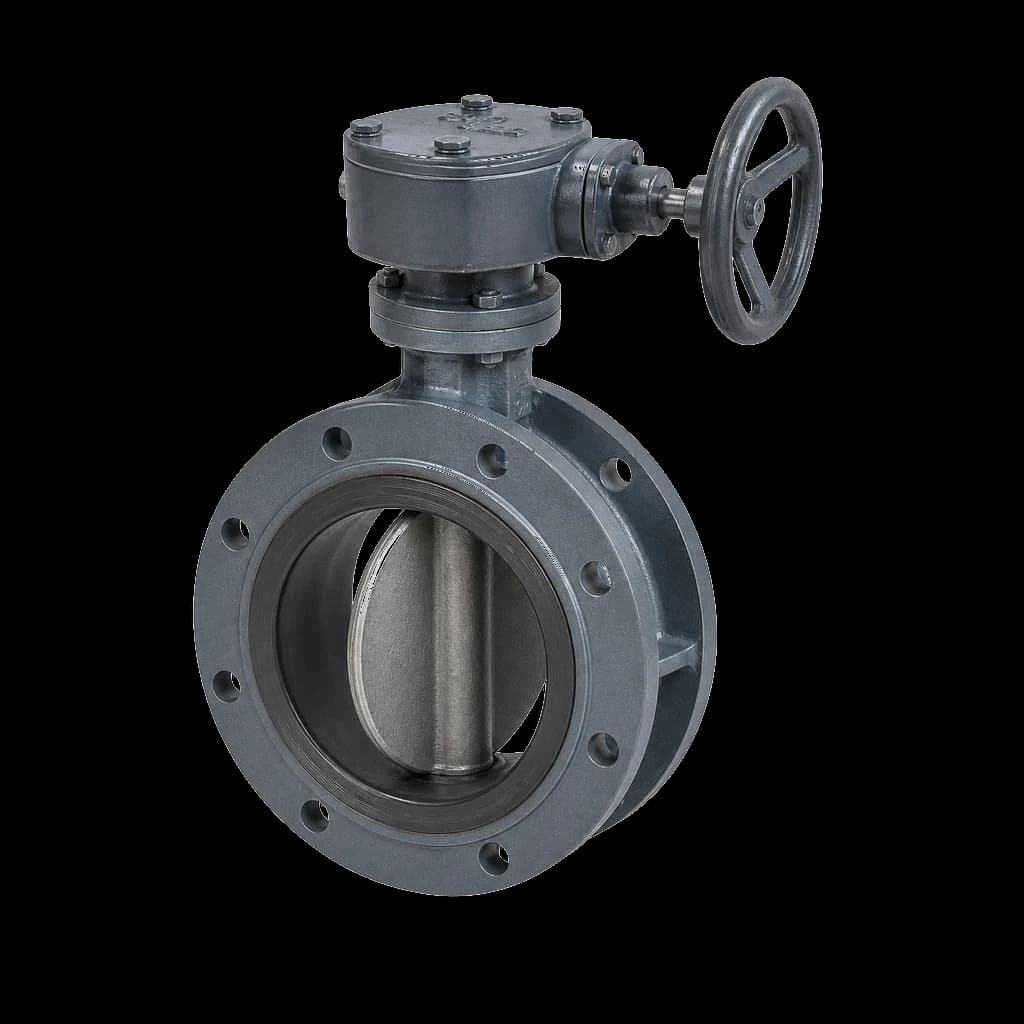
- Double-flanged: integral flanged ends, standard for large-diameter water transmission and buried service where the valve must behave as a piece of the pipeline.
Operator selection
Levers are acceptable only on small, low-pressure valves — typically up to about 6"–8" on PN 10 water duty — and they invite slam: a quarter-turn snapped shut on a moving liquid column is a water-hammer event. Gear operators solve both problems, multiplying torque and forcing slow closure, and are the sensible default from 8" upward or wherever surge matters. For automation, quarter-turn actuation is simple and cheap; size the actuator on the manufacturer's seating/unseating torque at your actual differential pressure, with margin — not on running torque.
Mapping valve to duty
- Water, HVAC, utility air: concentric with EPDM seat — the standard choice for water treatment and building services, in wafer or lugged pattern.
- Fire-water networks: concentric valves in lugged or double-flanged pattern, with gear operators; approvals and signal capability per the fire code apply — see our valves in fire-fighting service.
- Hydrocarbons, chemicals, hot condensate: double-offset with RPTFE or metal seat, Class 150/300, fire-safe certified where the line demands it.
- Steam and thermal oil beyond soft-seat limits: triple-offset metal-seated, or step back to a gate/globe solution.
If the duty sits near an elastomer's temperature ceiling, or the medium attacks the liner, move up to double-offset rather than hoping — a cooked seat fails as isolation exactly when you need it. Browse the range we supply under ZED butterfly valves for concentric and offset patterns.