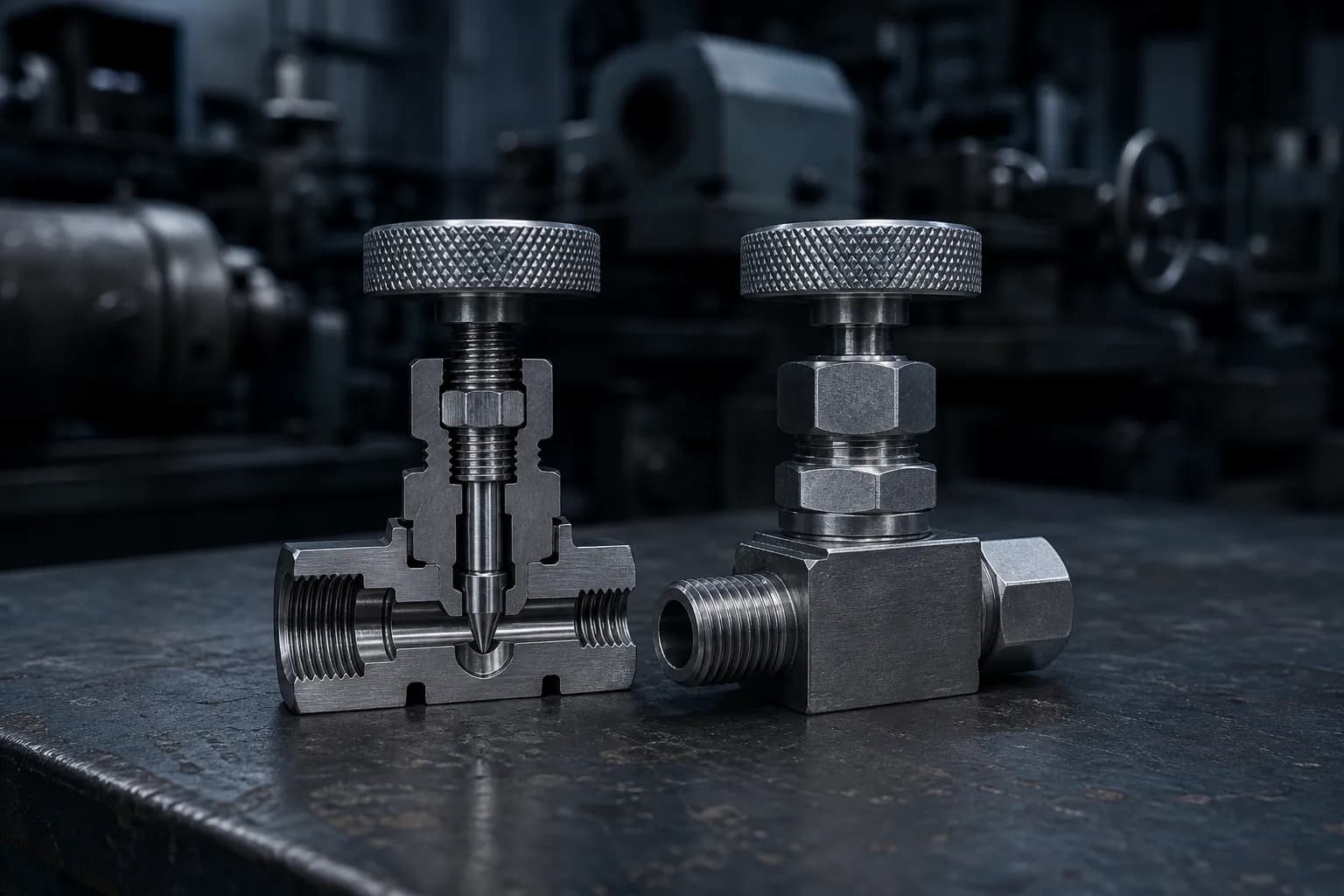
A gauge comes off for recalibration, a transmitter needs zeroing, an impulse line plugs — and the job rests on one small valve. That valve is almost always a needle valve: the lowest-value line on the instrument index, and the one most often bought on a one-line description — which is why so many arrive with a parallel BSP root that will not seal into an NPT gauge tee, weep at the gland inside a year, or gall shut on the third throttling.
What a needle valve is — and what it is not
A needle valve is a globe-valve derivative: flow turns through the body and a slender tapered stem tip closes into a matching conical seat. The taper is long and shallow, so each handwheel turn changes the annular flow area by very little, and a fine stem thread compounds that into the property the design exists for — resolution. Crack the valve a quarter turn and it admits a controlled trickle into a Bourdon gauge instead of full line pressure.
It is not a small ball valve
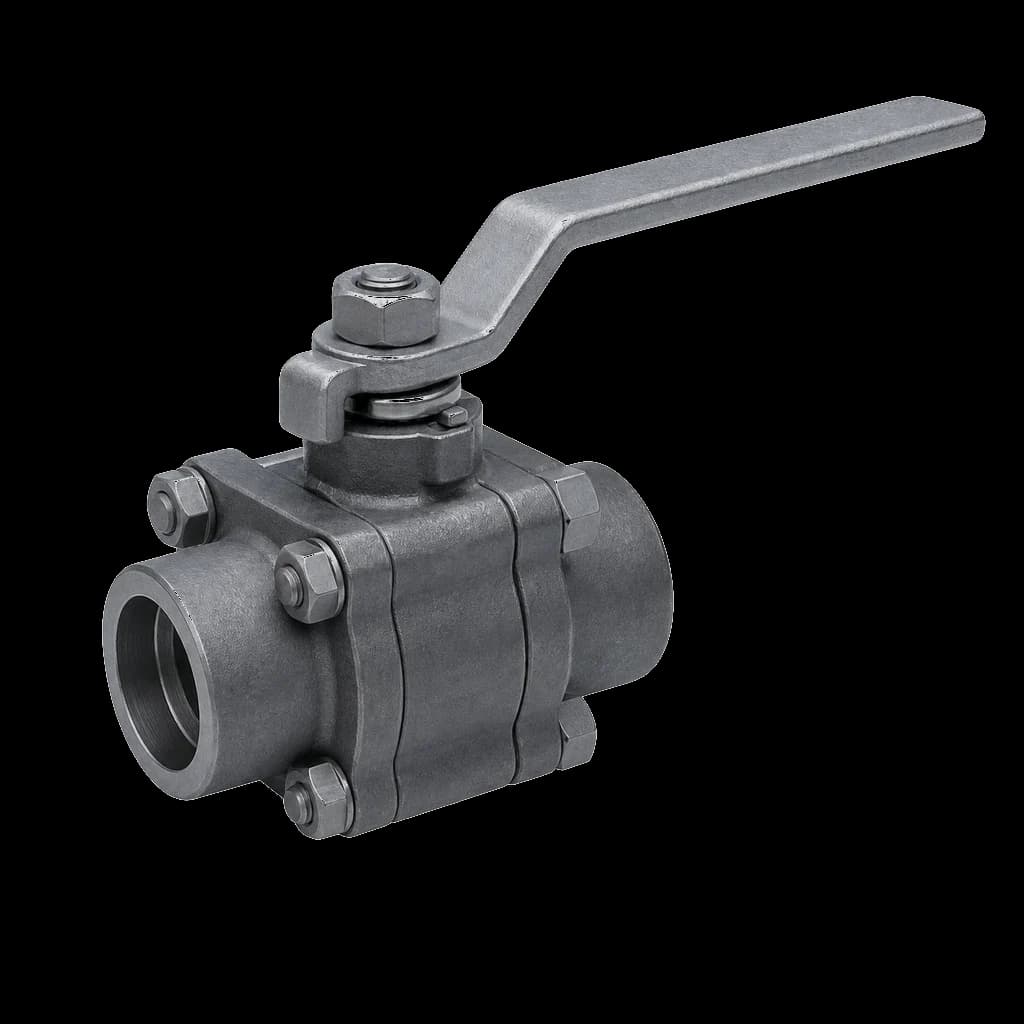
Multi-turn operation is the tell: nobody reads open-or-shut from three metres, and closing one under pressure takes seconds of winding. Where the duty is pure on-off — a sample point shut in a hurry, a drain worked in gloves — fit a quarter-turn valve; small-bore forged ball valves from 1/2" upward do it better. Reserve the needle valve for metering, damping, slow bleed-down and holding a setting.
It is not a class-rated isolation valve
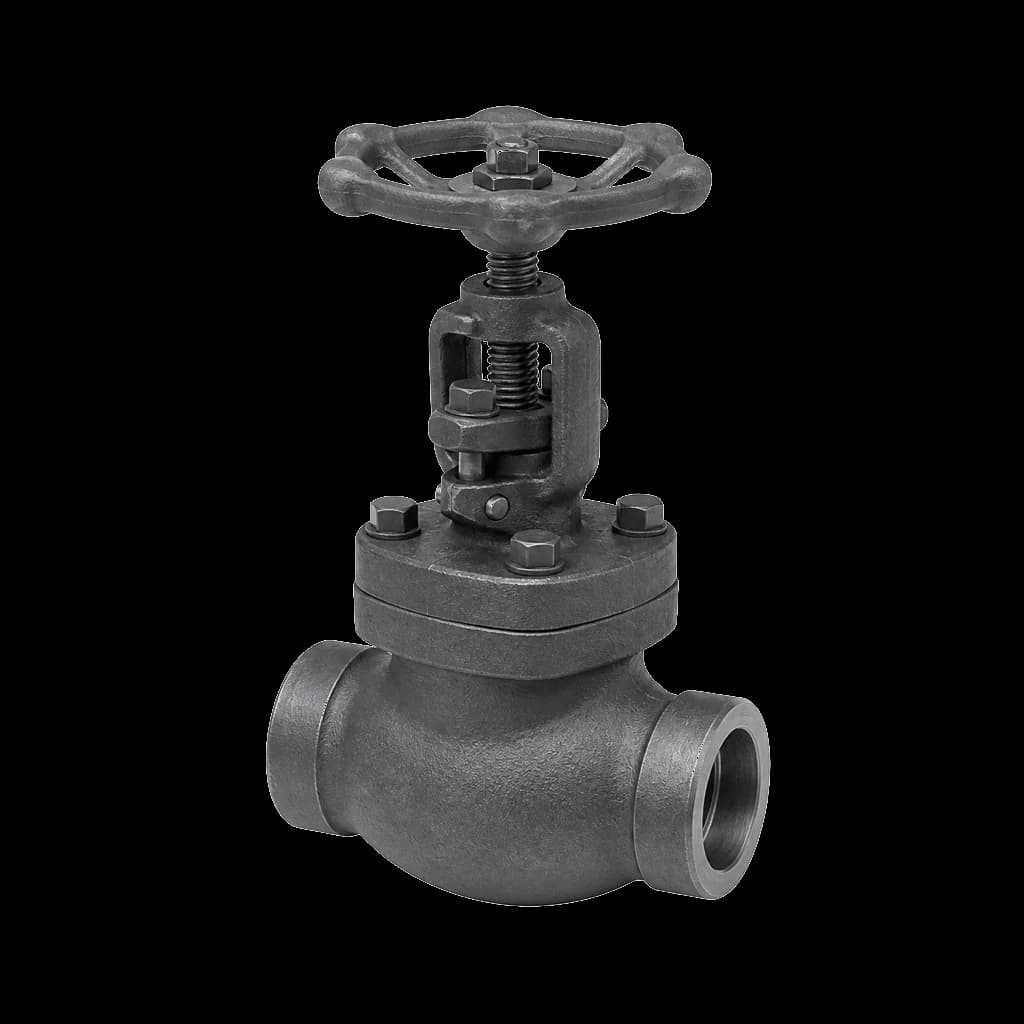
Process isolation on a piping class belongs to a forged gate or globe valve built to API 602 with the correct ASME class and end connection — API 600 vs API 602 gate valves sets out that boundary. Instrument needle valves answer to no equivalent product standard — nothing fixes their wall thickness, face-to-face or test regime — so the rating on the tag is the maker's own cold working pressure, not a class you can cross-check in a table.
Stem taper, seat contact and the failure you will actually see
Two tip geometries dominate. A fine, sharply tapered needle gives the best metering resolution and suits sampling, purge and calibration lines. A blunter regulating or plug tip trades resolution for robust seat contact and better shut-off tightness — what a gauge root wants. Ask which one you are being offered; catalogues list both under a single figure number.
The failure mode that matters is galling. Austenitic stainless galls against itself, so a plain 316 tip wound hard into a plain 316 seat picks up, tears and then leaks for good. Anything bought for repeated operation needs a hardened stem — 17-4 PH in a stated heat-treat condition, H1075 being the common one — or a non-rotating tip that seats without grinding. Wire drawing is the second failure: cracked open against a high differential with grit or wet steam passing, the seat erodes into a groove no handwheel torque will close.
- Never throttle permanently on solids or flashing condensate — this is a metering and isolation valve, not a control valve.
- Do not over-torque it shut. A needle seat is line contact; operators trained on gate valves wind it home and deform the taper.
- Keep a sharp metering taper off a gauge root — poor shut-off, damaged tip.
- Check the stem is retained so it cannot be wound out of the bonnet under pressure.
Materials and where the pressure rating comes from
The default instrument needle valve is machined from 316/316L stainless bar to ASTM A479, or forged to ASTM A182 F316; dual certification matters when the root is welded. Carbon steel to A105 is legitimate on utility duty, and A105 and A182 forged valve materials covers where each grade stops. Never accept an unmarked "SS" body — an ss needle valve on a purchase order means nothing without a grade, a specification and a certificate.
Ratings are published as a cold working pressure at ambient, then derated by a temperature curve. Typical 316 bar-stock instrument valves sit around 6,000 psi (roughly 410 bar), and high pressure needle valve ranges near 10,000 psi (roughly 690 bar) are widely catalogued. Both figures move with maker, end connection and packing — a compression end usually derates the assembly below the body itself. Take the rating from the pressure-temperature chart for that figure number, never from a family brochure.
| Body material | Typical instrument service | What to watch |
|---|---|---|
| 316/316L bar stock (ASTM A479) or A182 F316 | General process, steam and hydrocarbon; most refinery and CGD gauge and transmitter roots | Dual-certify if the root is welded; confirm stem grade separately from body grade |
| Carbon steel, A105 forged | Instrument air, utility water, non-corrosive hydrocarbon off carbon steel line pipe | Galvanic mismatch against stainless tubing; not for wet H2S without a sour-service review |
| Duplex F51, 6Mo, Alloy 400 | Seawater and chloride brine, sour gas, coastal and offshore utilities | NACE MR0175 / ISO 15156 compliance must cover stem hardness, not only the body |
| Brass and gunmetal | Low-pressure compressed air, water headers, panel gauge isolation | Never on ammonia; brass carries its own, much lower rating curve |
End connections: the detail that gets the order wrong
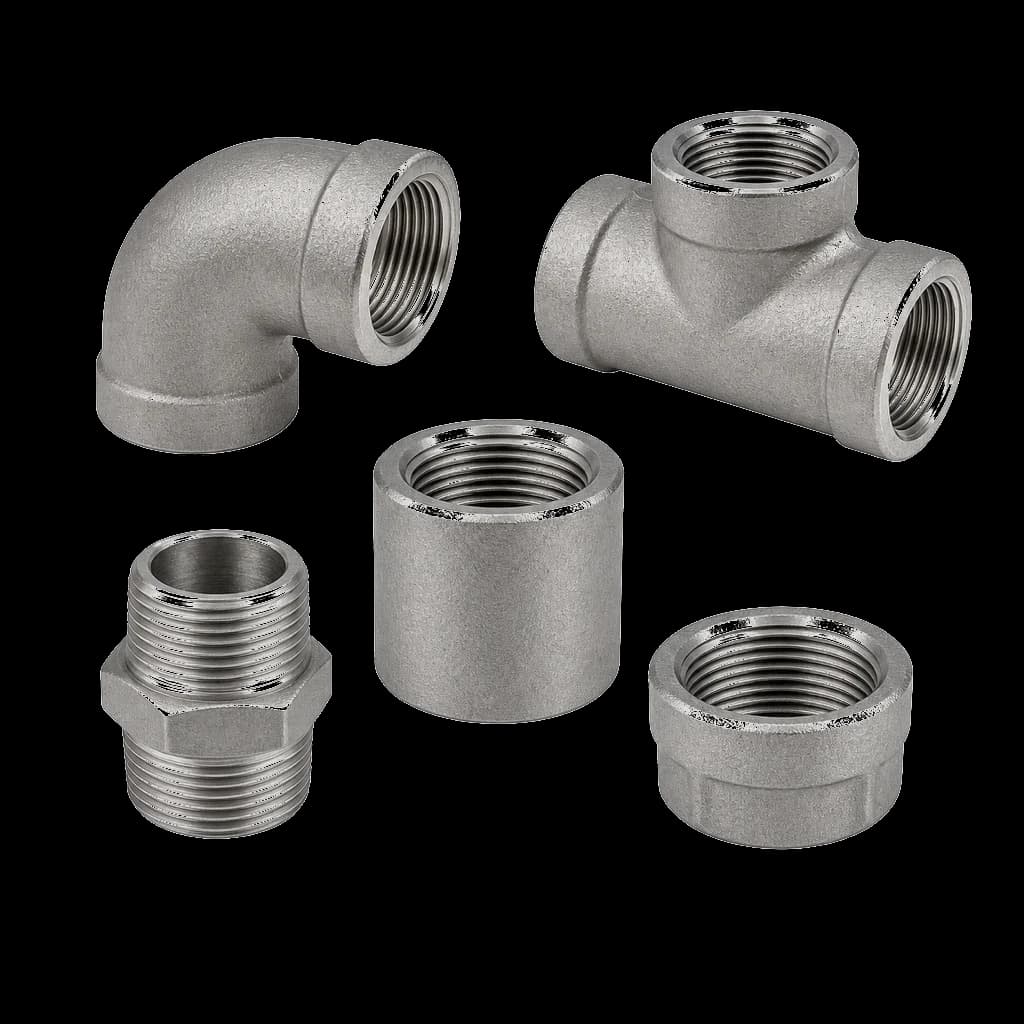
Female NPT both ends is the generic instrument valve. The gauge valve proper is male x female — the male end screws into the process tee, the female end takes the gauge. Beyond that you specify twin-ferrule compression ends for 1/2" OD or 12 mm impulse tubing, socket weld ends where the impulse line is welded, and occasionally a flanged process end off a class-rated line. Seal threaded roots with PTFE tape or an approved compound started clear of the first two threads, so nothing migrates into the gauge or the transmitter capsule. Get the pairing wrong and the valve is scrap on arrival.
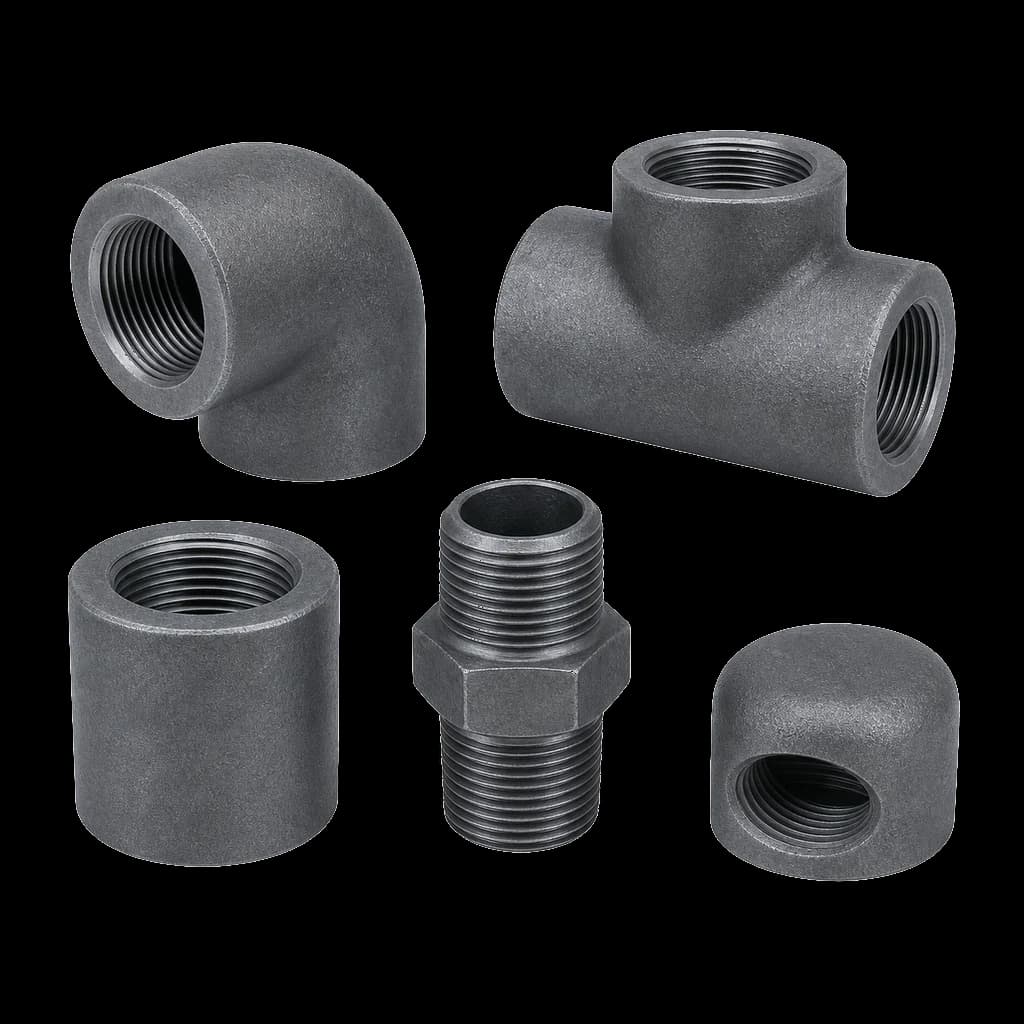
Threads do not interchange, and this is where Indian projects lose the most time. NPT is a 60-degree taper thread to ASME B1.20.1 that seals on the flanks. BSPT (marked R, to ISO 7-1 and its Indian equivalent IS 554) has a 55-degree form — it will start into an NPT port and then jam or leak. BSPP (marked G, to ISO 228-1) is parallel and seals on a bonded washer, not on the thread at all. Write the thread standard on every requisition line and keep root, nipple and valve in one family; the ASME B16.11 and IS 4712 forged fitting standards guide covers the fitting dimensions, and VKS supplies matching high-pressure threaded fittings.
Gauge valves, block-and-bleed roots and 2/3/5-valve manifolds
Instrument isolation is bought in recognised configurations. Name the one you want on the RFQ and most of the ambiguity goes.
| Configuration | Valves in the block | Typical use |
|---|---|---|
| Gauge (root) valve | One needle valve, male x female | Isolating a Bourdon tube gauge to IS 3624 at the process tee |
| Block-and-bleed gauge valve | One needle valve plus an integral bleed port | Where trapped pressure must be vented before the gauge comes off |
| Two-valve manifold | One block, one vent or test | Gauge-pressure and absolute transmitters |
| Three-valve manifold | Two block, one equalise | DP transmitters on flow, level and filter dP |
| Five-valve manifold | Two block, one or two equalise, one or two vent | DP transmitters needing in-situ zero check; configuration varies by maker |
One rule on a differential manifold belongs on the loop sheet: open the equalising valve before you close either block valve, and on the way back in leave it open until the high-pressure block is open again. Reverse that order once and you drive full static line pressure across one side of a capsule never rated for it. Route the vent to a hose or a collection point wherever the fluid is hot or hazardous — an open bleed port on a steam tap is an injury waiting to happen. Steam taps carry their own accessories too: a siphon ahead of the gauge, a snubber where a reciprocating pump pulses the line.
Packing, gland leakage and fugitive emissions
Gland leakage is the dominant field failure on instrument valves, and it is almost always a specification problem rather than a manufacturing one. PTFE chevron or V-ring packing is the standard fit, good to somewhere around 200-230 degrees C depending on the maker. Above that — steam headers, hot oil, superheated taps — the answer is graphite packing. Refuse a PTFE-packed valve on steam duty, however convenient the stock position.
Insist on two details. An adjustable gland comes first: the packing nut must be reachable and re-tightenable in situ, and on many low-cost valves it is not. A stem back-seat comes second — a safety feature that limits leakage if the packing is disturbed, not permission to repack a live valve. On hydrocarbon duty, ask whether the design is type-tested to ISO 15848-1 or the packing qualified to an API 622-style test; that certification is far rarer on instrument valves than on line valves, so confirm it rather than assume it.
Sizing a needle valve for the duty
Almost every instrument isolation point in an Indian plant lands on a needle valve 1/2 inch nominal, and that is usually right — it matches 1/2" NPS impulse pipe, 1/2" OD tube and the standard gauge connection. Nominal size tells you nothing about bore, though: the orifice is only a few millimetres, so the Cv sits an order of magnitude or more below a full-bore ball valve of the same nominal size.
- On gauge and transmitter isolation, flow is irrelevant but response time is not. Avoid an orifice smaller than the impulse line unless you want the damping — on waxy or hydrate-prone service that restriction is where the plug starts.
- On sampling, purge or bleed duty, Cv is the whole point. Ask for the flow coefficient against stem turns, and specify a metering taper for graduated control.
- On panel work, specify the mounting: bulkhead body with a locking nut, and a handle — bar, T-bar, knurled or lockable — that suits the operator.
- Match valve, tubing and ferrule materials. A 316 valve with brass ferrules on chloride service is a leak waiting for a shutdown.
All of that belongs on a datasheet, not in an email: body material with specification, stem and tip material, packing, both end connections with thread standard, CWP and design temperature, orifice or Cv, handle type, certification. How to read a valve datasheet applies the same discipline to larger valves; small-bore items need it more, because nobody double-checks a line this far down the index.
Documentation Indian buyers should ask for
On PSU, EPC and refinery orders the paperwork is part of the deliverable. Ask for EN 10204 3.1 material test certificates against body, bonnet and stem heat numbers — not a generic "316" declaration — and 3.2 where the specification calls for third-party endorsement. Positive material identification by XRF is cheap insurance and increasingly mandatory in refinery specifications. Because shell and seat testing follows the maker's own procedure rather than API 598, agree test pressures and acceptance criteria in writing before the order.
Two Indian specifics close the file. Valves classify under HSN heading 8481 for GST, instrument valves included, so settle the classification at quotation stage rather than at invoice. Where the impulse line comes off an IBR steam main, ask the inspecting authority in writing whether the valve falls inside the boiler-attachment scope and needs Form III-C cover; practice varies between state boiler inspectorates, and settling it before the order is far easier than settling it at site.