A line list that names duplex stainless steel is usually written after something failed: 316 pitted through a seawater header, or a chloride-bearing produced-water line cracked at a weld. Duplex answers that — but F51, F53 and F55 are three answers at three costs, and writing “super duplex” wherever duplex appears loads Indian EPC packages with money the duty never asked for. Here is the grade map, the number that decides it, and the window outside which duplex is wrong.
What duplex stainless steel actually is
316 is austenite, and its cast form CF8M carries only a minor fraction of ferrite. A duplex is balanced to hold half ferrite and half austenite, by trading nickel down and chromium, molybdenum and nitrogen up. Ferrite brings strength and high resistance to chloride stress-corrosion cracking; austenite brings toughness and weldability. The result carries double the yield strength of 316 — 450 MPa minimum for the 22Cr grades and 550 MPa for 25Cr, against 205 MPa for wrought 316. It is also ferromagnetic: a pocket magnet is a five-second check against austenitic substitution.
Where 316 runs out
316 fails on chlorides two ways, and it matters which one drove the upgrade. Pitting and crevice attack occur wherever chloride concentrates — under gaskets, beneath deposits, in a seat pocket. Chloride stress-corrosion cracking is different: 300-series austenitics turn vulnerable above about 60 °C under tensile stress, cracking with almost no metal loss to warn you. Duplex raises both thresholds.
F51, F53 and F55 decoded
The F-numbers come from ASTM A182, for forged stainless flanges, fittings and valve parts. Each is shorthand for a UNS number, and UNS is what the mill certificate reports against.
F51 and F60: the 22Cr workhorses
F51 (UNS S31803) is the original 2205: 21–23 % Cr, 4.5–6.5 % Ni, 2.5–3.5 % Mo, 0.08–0.20 % N. F60 (UNS S32205) is the same alloy with the window tightened at the bottom — minimum 22 % Cr, 3.0 % Mo, 0.14 % N. That is not cosmetic: a heat of S31803 supplied legally at the low end of every range is a weaker valve than one at the top. On new specifications, ask for S32205, not S31803.
F53 and F55: the 25Cr super duplex pair
F53 (UNS S32750) — 2507 — runs 24–26 % Cr, 6–8 % Ni, 3–5 % Mo, 0.24–0.32 % N. F55 (UNS S32760) sits in the same chromium and nickel band with narrower molybdenum, plus 0.5–1.0 % each of tungsten and copper: tungsten aids pitting resistance much as molybdenum does, copper helps in reducing acids. A182 requires F55 to certify a minimum PREN of 40 — that, not the tungsten, is why offshore specifications name F55 so often.
| Forged grade | UNS | Common name | Typical PREN | Cast equivalent |
|---|---|---|---|---|
| F316 | S31600 | 316 austenitic (reference) | 24–26 | A351 CF8M |
| F51 | S31803 | 2205, original window | 31–35 | A995 Gr 4A (CD3MN) |
| F60 | S32205 | 2205, tightened window | 34–36 | A995 Gr 4A (CD3MN) |
| F53 | S32750 | 2507 super duplex | 41–43 | A995 Gr 5A (CE3MN) |
| F55 | S32760 | 25Cr super duplex, W and Cu | 40 min by spec | A995 Gr 6A (CD3MWCuN) |
| F44 | S31254 | 6Mo austenitic (reference) | 42–44 | A351 CK3MCuN |
PREN: the number that decides it
Grade names are marketing; PREN — the pitting resistance equivalent number — is arithmetic: PREN = %Cr + 3.3 × %Mo + 16 × %N, with the tungsten variant PREN = %Cr + 3.3 × (%Mo + 0.5 × %W) + 16 × %N. Nitrogen carries a weight of sixteen, which is why mills are so insistent about it.
Run the bottom of the S31803 range — 21 Cr, 2.5 Mo, 0.08 N — and PREN is 30.5. The bottom of S32205 — 22 Cr, 3.0 Mo, 0.14 N — gives 34. Those three and a half points separate a duplex that survives brackish service from one that does not, and they are invisible if the order says only “duplex”. The convention is firm: super duplex means PREN 40 or above.
- Specify the UNS number, not the family name — the certificate and the inspector both work to UNS.
- State a minimum PREN where the service is marginal. “PREN 40 min, calculated per A182 and reported on the MTC” ends a class of argument at inspection.
- Compute PREN yourself from the certificate — the only check that catches a heat at the weak end of its range.
Cast, forged and fitting equivalents
A valve is never one material: cast body, forged bonnet, bar-stock stem, wrought fittings either side — the weakest link sets the service life. Cast duplex lives in ASTM A995 for pressure-containing parts — Gr 4A (CD3MN) is cast 2205, Gr 5A (CE3MN) cast 2507, Gr 6A (CD3MWCuN) the counterpart of F55. Pipe comes from A790 and A928, wrought fittings from A815. Pair them the way you pair ordinary cast valve body materials with their forged counterparts: a Gr 4A body belongs with F60 forgings, a Gr 5A body with F53.
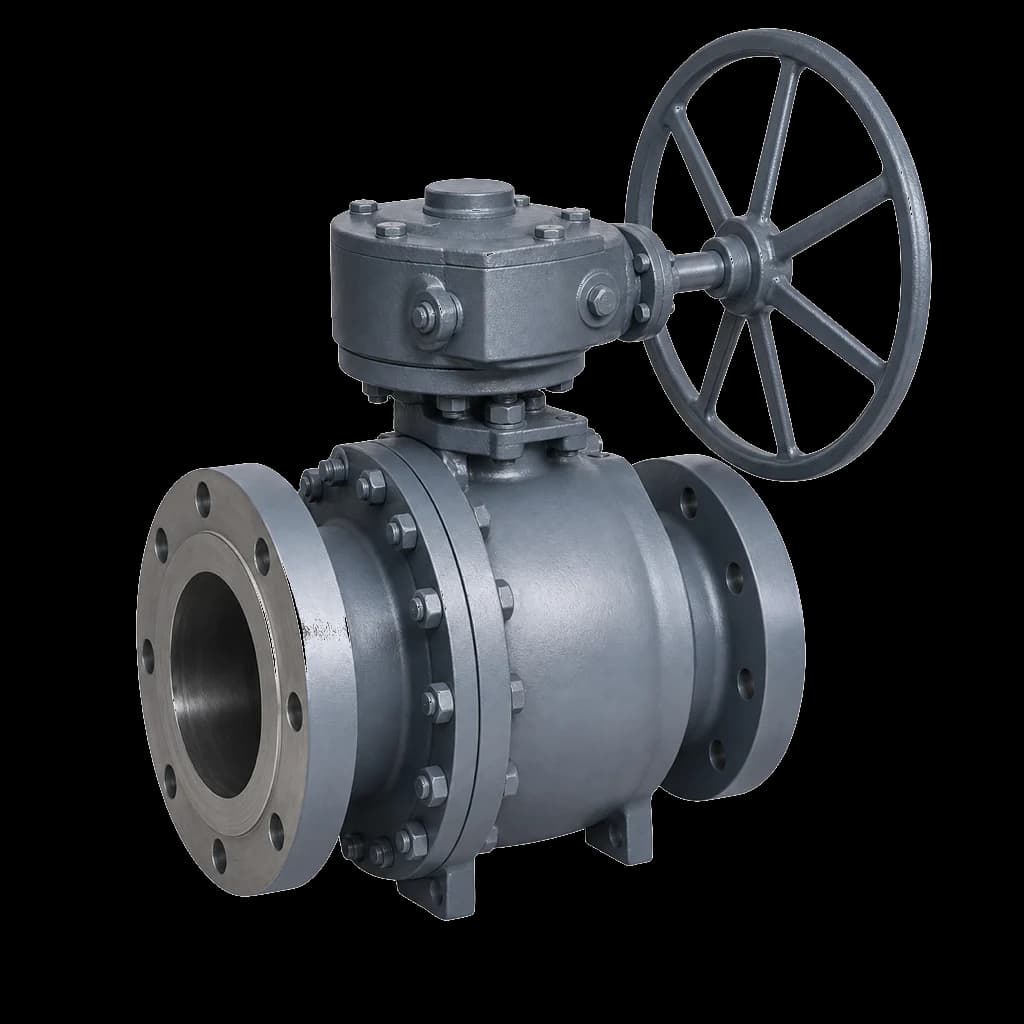
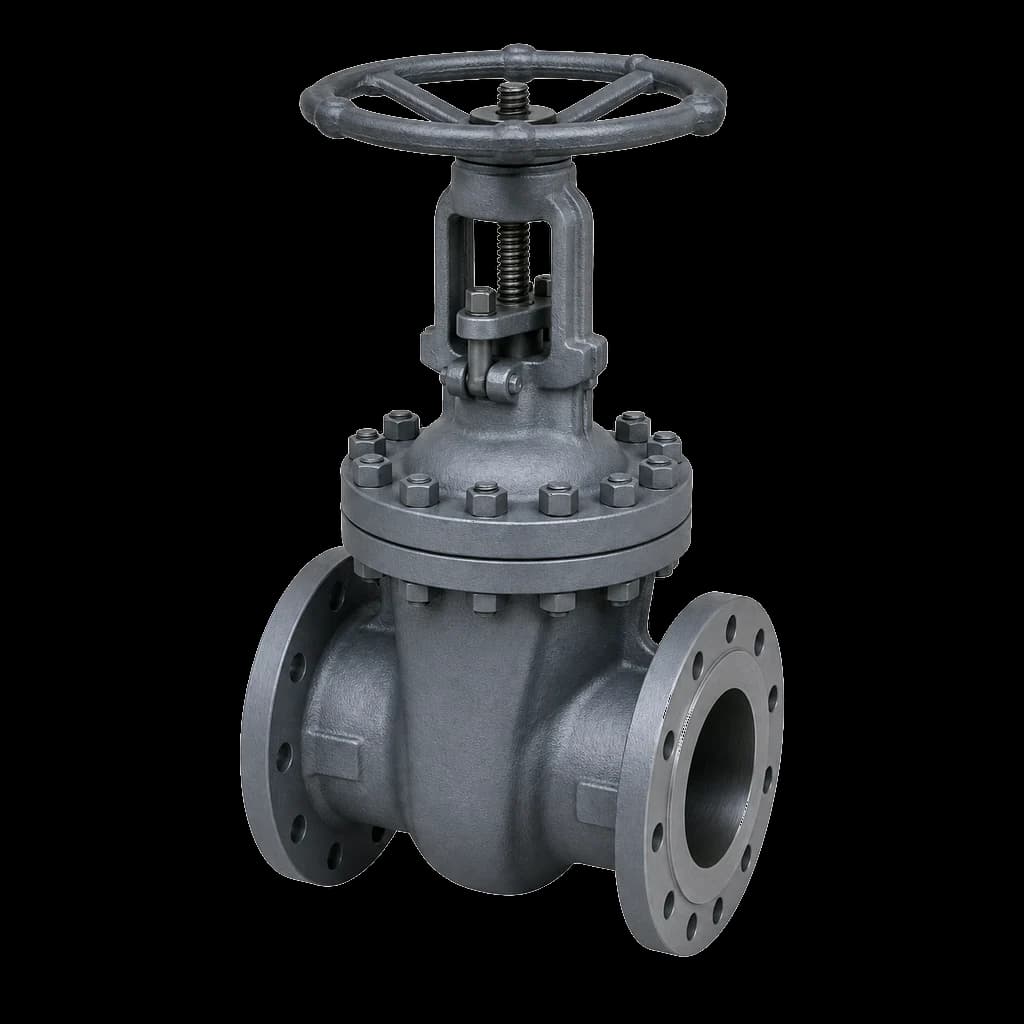
Trim is where duplex packages get quietly degraded. A 410 stainless stem inside a super duplex body is not a saving — it is the failure point pre-installed. Specify stem and internals in the same grade or higher, and hardface or nitride the seat and stem contacts, because duplex galls against itself. On Indian projects duplex shows up at the large-bore end: gate valves on seawater headers and trunnion-mounted API 6D ball valves on hydrocarbon and produced-water duty, bodies poured in A995 rather than WCB.
The temperature window duplex will not leave
Duplex does not cover 316's temperature range, and the restriction runs both ways. At the hot end the ferrite decomposes: alpha-prime precipitates at 300–500 °C — 475 °C embrittlement — stripping impact toughness with nothing visible to warn you, and sigma and chi phases form at 600–1000 °C, taking corrosion resistance with them. ASME B31.3 lists allowable stresses for 22Cr duplex only to 315 °C, and a code ceiling is not a recommendation. Keep continuous duty below about 250 °C; above it, use carbon steel, chrome-moly or austenitic.
At the cold end the same ferrite has a ductile-to-brittle transition: duplex is normally impact-qualified to −50 °C and no further. It is not a cryogenic material — LNG duty belongs to austenitic 304L/316L or 9 % nickel steel.
Heat treatment, ferrite balance and proof
Duplex is only duplex if it was heat treated correctly. Every casting and forging must be solution annealed — above about 1020 °C for 22Cr grades, higher for 25Cr — then water quenched fast enough to freeze the phase balance. A slow cool or an unqualified weld repair puts sigma phase into a perfectly correct chemistry, and the chemical analysis will not show it. That is how a valve arrives right on paper and wrong in metal.
- Ferrite content. Typically 35–65 % in base metal, 30–70 % in weld metal. Ask for the measured figure and the method — magnetic gauge or point count to ASTM E562.
- ASTM A923. The test for detrimental intermetallic phase: Method A, sodium hydroxide etch; B, Charpy impact; C, ferric chloride corrosion. Method A can clear a heat but never condemn one — a suspect structure has to go to B or C for the rejection.
- ASTM G48 Method A. Ferric chloride pitting at a grade-keyed temperature — commonly 22–25 °C for 22Cr and 40–50 °C for 25Cr — accepting no pitting at 20× and weight loss under 4.0 g/m². Confirm it against the specification.
- PMI has a blind spot. Portable XRF reads Cr, Mo and Ni but cannot read nitrogen — it catches a 316 substitution instantly, yet cannot tell S31803 from S32205.
None of it is verifiable without paperwork tied to the heat in front of you, so specify certification: an EN 10204 3.1 or 3.2 certificate traceable to the casting, plus solution-annealing records, the ferrite reading and the A923 or G48 result.
When super duplex is overkill
Super duplex earns its cost where chloride and temperature demand PREN 40; natural seawater, at 19,000 ppm chloride, is the classic case. Brackish water, blowdown and RO reject vary enormously, so get a water analysis — the same plant can justify F60 on one line and F53 on the next, and there is a ceiling above which even super duplex is the wrong answer.
| Service | Sensible material | Reason |
|---|---|---|
| Utility water, dilute chemicals under 60 °C | 316 / CF8M | Duplex buys a problem you do not have |
| Brackish water, RO reject | F60 / A995 Gr 4A | Mid-30s PREN covers brackish chemistry |
| Produced water, mildly sour | F51 / F60 to ISO 15156 | Strength and chlorides inside sour limits |
| Ambient seawater, coastal intakes | F53 / F55 super duplex | 19,000 ppm chloride needs PREN 40 |
| Warm chlorinated seawater | 6Mo austenitic, 625 or titanium | Crevice corrosion outruns 25Cr duplex |
| Above 250 °C, or cryogenic | Carbon, Cr-Mo, austenitic or 9 % Ni | Duplex ferrite embrittles hot and cold |
Sour service adds a second gate. ISO 15156-3 admits duplex only inside limits on PREN, hydrogen sulphide partial pressure, chloride, pH and temperature, with ferrite and hardness restrictions on top. “Duplex” and “sour-service qualified” are not synonyms — the grade must be shown compliant for your envelope, as our NACE MR0175 guide sets out.
Specifying duplex on an Indian RFQ
Duplex is never bought off a catalogue page. It arrives as an enquiry carrying a datasheet, a material clause and an inspection clause — a refinery revamp, a coastal intake, a desalination or water treatment package, an offshore or CGD scope under an EIL, ONGC or licensor specification. Consultants invoke NORSOK M-630 and M-601 even on Indian soil, and PSU tenders attach PMI clauses. Give the vendor this much:
- Fluid, chloride in ppm, pH, H2S partial pressure if sour, and both design and operating temperature.
- UNS numbers for body, bonnet, stem, seat and internals separately — not one word for the whole valve.
- Size, class, end connection, face-to-face standard, and whether the valve is manual, geared or actuated.
- Minimum PREN, ferrite range and the corrosion test required — A923 Method C, G48 Method A or both.
- EN 10204 3.1 or 3.2, solution-annealing records, hydro test report, and the gasket and bolting materials.