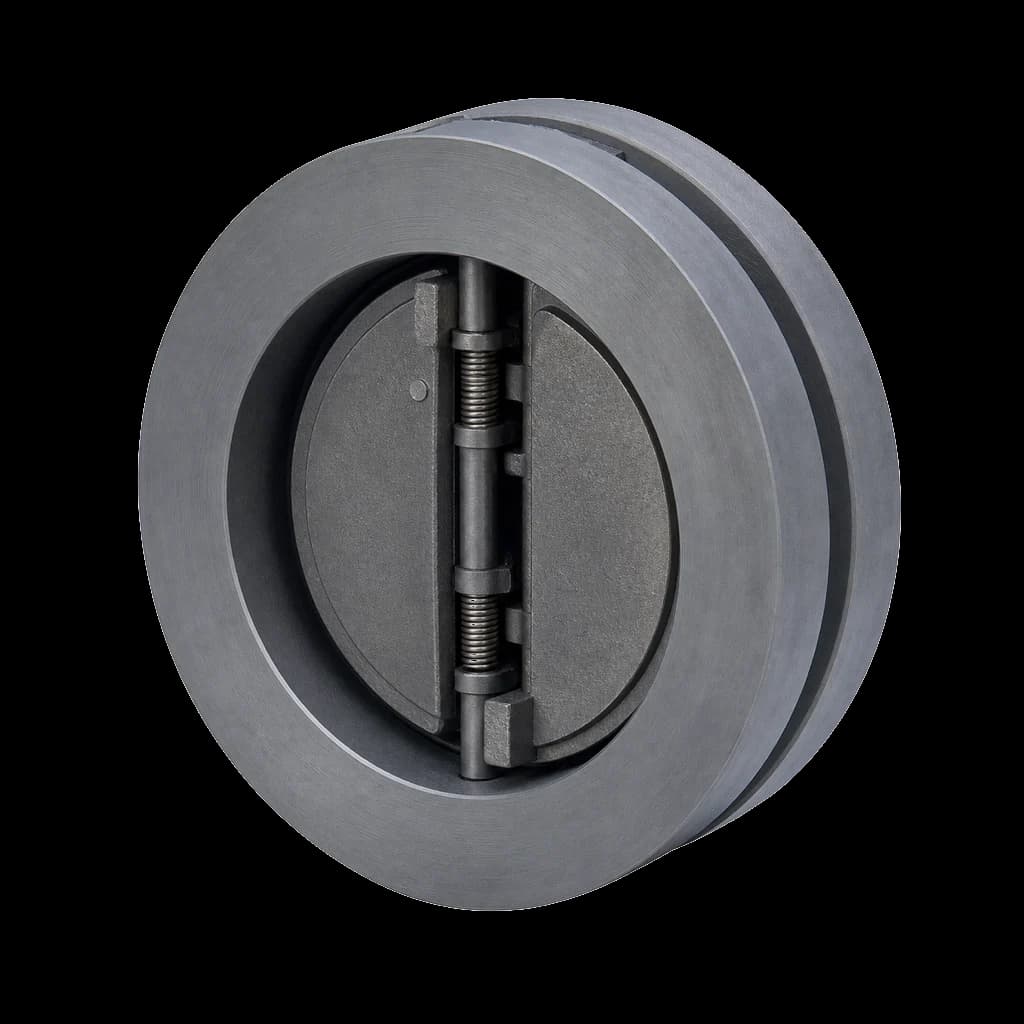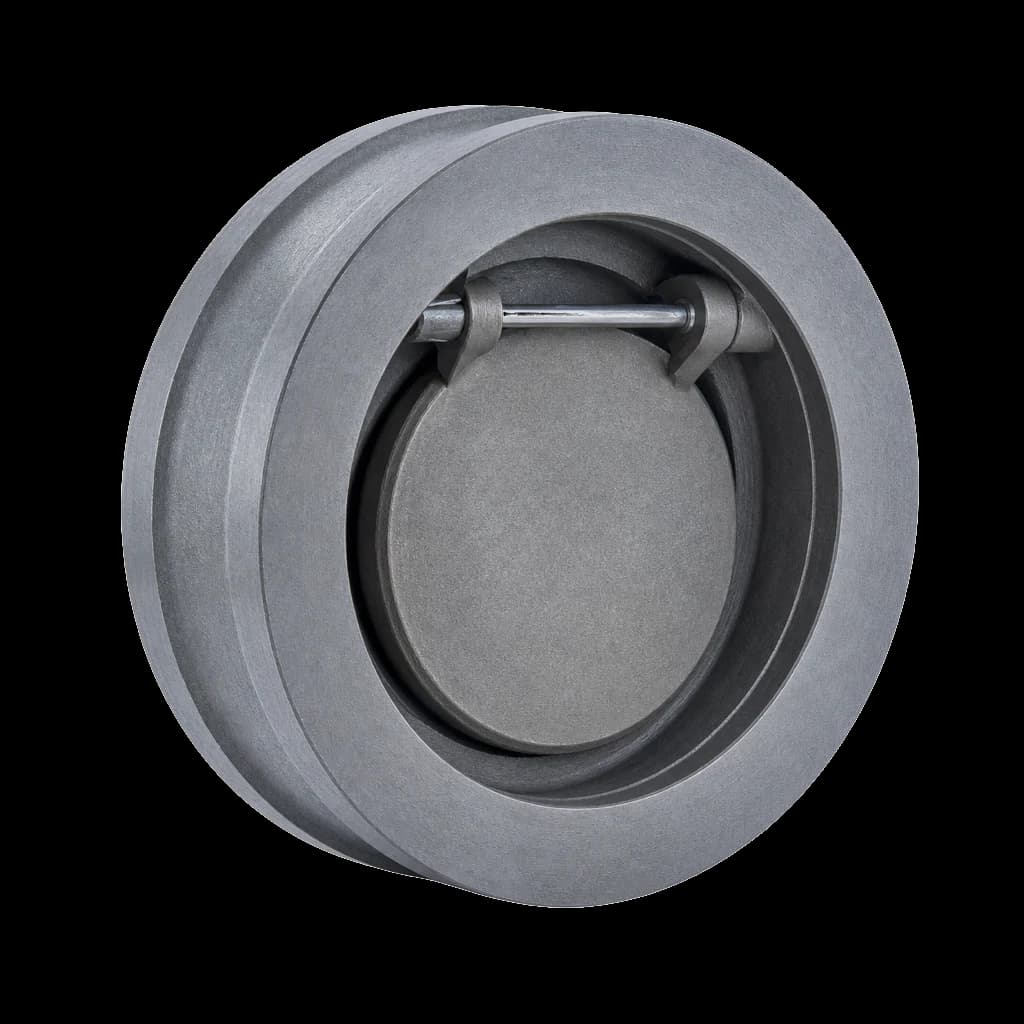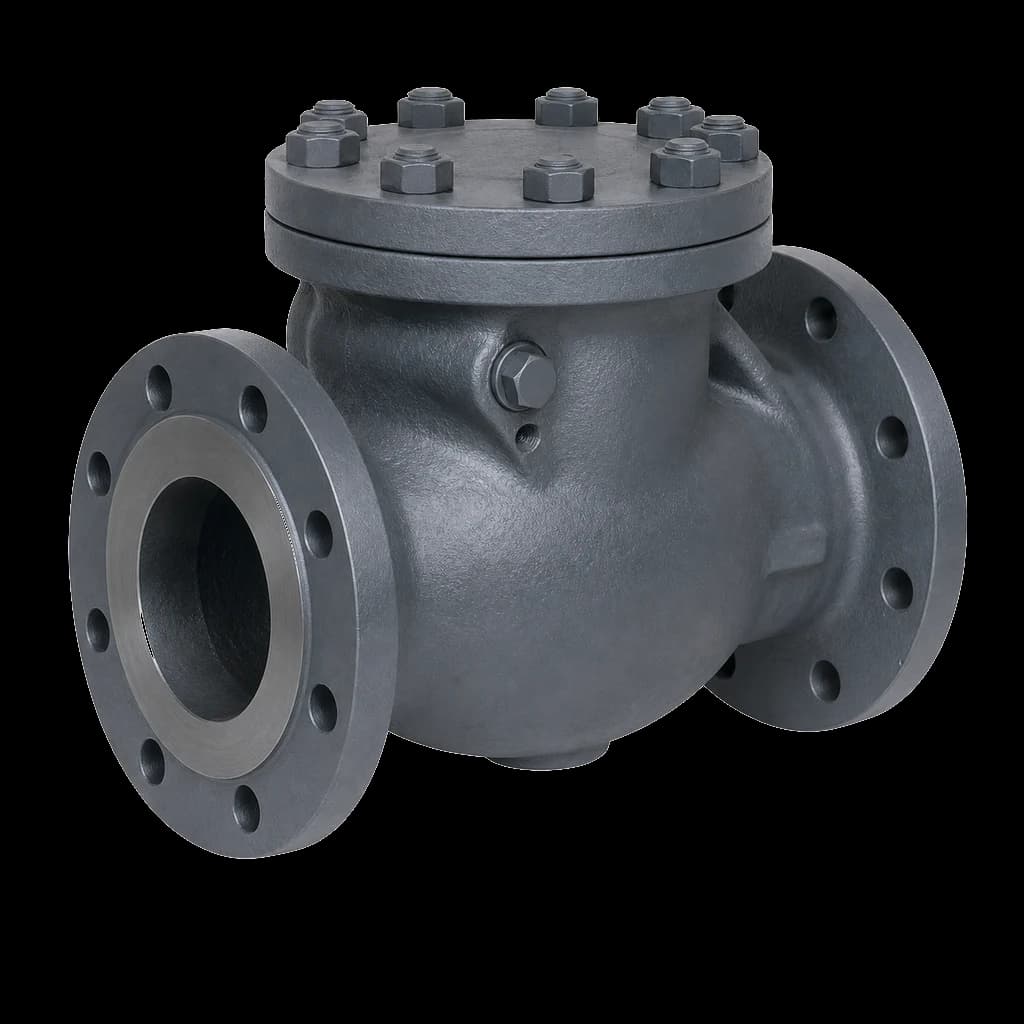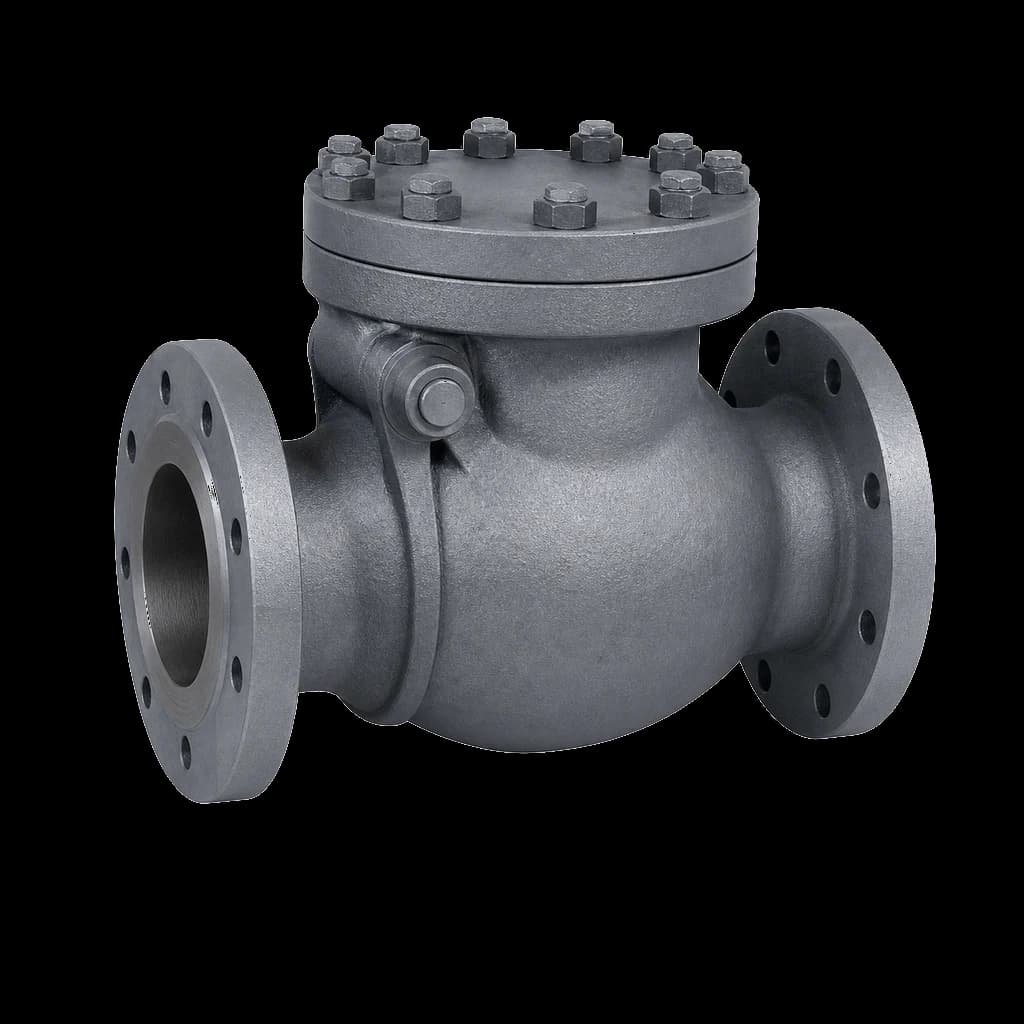
A dual plate check valve is bought on three numbers: size, class and face-to-face. API 594 fixes the third, and the letter that fixes it is the one most datasheets leave out. Type A is the short pattern the standard dimensions itself. Type B is the long pattern taken from ASME B16.10 — and it is not a dual plate valve at all, but a bolted-cover swing or pivoting-disc check. Get the letter wrong and the valve arrives fully compliant and the wrong length for the spool.
What API 594 actually covers
API 594 covers design, materials, face-to-face dimensions, ratings and testing for two families of check valve and no others: NPS 2 to 48, Classes 150 to 2500 in steel, Classes 125 and 250 in gray iron and 150 and 300 in ductile iron, iron being a Type A option only. Axial-disc, centre-spring, nozzle and lift check valves are written out of the scope, so "lift check to API 594" asks for something nobody can supply. Ratings, ends, testing and marking come from B16.34, B16.5, API 598 and MSS SP-25; the geometry is the standard's own. Our check valve type guide compares the constructions — this page is about fit.
Type A vs Type B under API 594
The two types differ by closure member as well as by length. A Type A valve is short pattern to Table 2 or Table 3 of API 594, in a wafer, lug or double-flanged body. A Type B valve is long pattern to ASME B16.10, flanged or butt-welding, with a swing or pivoting disc behind a bolted cover to ASME Section VIII. Every dual plate check valve is therefore a Type A, and a long-pattern dual plate is a special length allowed only by agreement with the manufacturer.
| Attribute | Type A — short pattern | Type B — long pattern |
|---|---|---|
| Face-to-face basis | API 594 Table 2, or Table 3 for double-flanged | ASME B16.10 long pattern |
| Body pattern | Wafer, lug or double-flanged | Flanged or butt-welding, bolted cover |
| Obturator allowed | Single plate, dual plate, swing or pivoting disc | Swing or pivoting disc only |
| Body materials | Gray and ductile iron, plus ASME B16.34 grades | ASME B16.34 grades only |
The rule is blunt. If the isometrics are being drawn now, take the Type A length saving: shorter spool, fewer supports, less bending load on the pump nozzle. If you are replacing a swing check in a running plant, the gap in the pipe is a B16.10 length, so buy a Type B. Packing that gap with spacers adds two gasket joints each — a leak path and a stud-length revision nobody issued.
Wafer, lug, double-flanged and butt-weld bodies
Wafer and lug
A wafer body has no bolt holes: it is clamped between the mating flanges and centred by the studs, so it cannot serve dead-end. A lug body carries lugs alongside the bore — but read 5.1.11 before assuming they are tapped, because API 594 supplies drilled clearance holes unless the order calls for threaded ones. If downstream dismantling with the valve bolted up is why you specified lug, write "tapped lug holes" into the line item, and treat any dead-end rating as a vendor figure, not the class rating.
Double-flanged and butt-welding
Double-flanged bodies suit large-bore water and effluent duty; Table 3 gives them an alternative face-to-face where fastener clearance demands it. Butt-welding ends belong to Type B and follow ASME B16.25 — two fewer flanged joints, at the price of never coming out without cutting pipe. Match the bore of the mating pipe, because a plate that cannot swing clear of the wall will hammer against it.
Through NPS 24 the mating flange is ASME B16.5; from NPS 26 up, API 594 calls for ASME B16.47 Series A, with Series B acceptable on a Type A only by agreement and not at all on a Type B. The series differ in outside diameter, bolt circle and bolt count, so a body centred for one will not centre on the other. Above NPS 24, name the series — our flange standards guide sets out the split.
Face-to-face dimensions and the fit-up failures they cause
Take the face-to-face from the current edition's tables or from a certified GA approved for construction, never off a catalogue illustration. The number does not move with every class change — wafer and lug bodies share a length across Classes 150 and 300 to NPS 12 and part at NPS 14, while Class 600 breaks away at NPS 4. Below NPS 2 there is no table at all, so a 1½ in. valve is built to the maker's own length.
| Size | Class 150 | Class 300 | Class 600 |
|---|---|---|---|
| NPS 2 (DN 50) | 60 (2.38) | 60 (2.38) | 60 (2.38) |
| NPS 6 (DN 150) | 98 (3.88) | 98 (3.88) | 136 (5.38) |
| NPS 12 (DN 300) | 181 (7.12) | 181 (7.12) | 229 (9.00) |
| NPS 24 (DN 600) | 222 (8.75) | 318 (12.50) | 438 (17.25) |
- Type letter never stated. The datasheet says "check valve to API 594", the vendor quotes short pattern, and the isometric was drawn to B16.10 lengths.
- Class revised mid-project. Class 300 becomes Class 600, the length moves with it above NPS 4, and the valve is re-ordered while the spool is not.
- Studs not re-issued. Through studs are sized to the body and gasket stack, so a change of make changes the studs.
Where API 594 stops: API 6D, BS 1868 and IS 5312
API 594 and API 6D check valves are not interchangeable, and swapping one for the other is a specification error rather than a saving. API 6D governs pipeline valves — generally full-bore designs on their own tables — and on a pigged line the full bore is the entire point. A dual plate valve obstructs that bore by construction, so it is never piggable.
BS 1868 is the other standard EPC specs quote alongside API 594: steel bolted-bonnet swing check valves, flanged and butt-welding, close to what a Type B describes. Indian waterworks tendering uses a third word: a "reflux valve" on a CPWD, PHED or municipal schedule means IS 5312, single-door under Part 1 and multi-door under Part 2, in iron with waterworks drilling.
| Standard | Valve it governs | Face-to-face basis |
|---|---|---|
| API 594 Type A | Wafer, lug or double-flanged; single or dual plate | API 594 Table 2 or Table 3 |
| API 594 Type B | Bolted-cover swing or pivoting disc | ASME B16.10 long pattern |
| BS 1868 | Steel bolted-bonnet swing check valves | Long pattern, flanged and butt-weld |
| API 6D | Pipeline check valves, typically full bore | API 6D tables |
| IS 5312 Part 1 / Part 2 | Iron reflux valves, single and multi-door | Waterworks practice, not ASME |
Springs, minimum velocity and non-slam behaviour
The engineering reason to buy a dual plate valve is closure timing. A swing check waits for reverse flow, so the disc reaches the seat with a decelerating column behind it. A spring-assisted dual plate valve closes as forward velocity decays and is shut before reversal — the standard answer on pump discharge and rising mains. Where that is not enough, see our guide to check valve slam and water hammer.
Spring material is settled by temperature, not preference: at 315 °C (600 °F) and above, API 594 requires nickel-chromium alloy UNS N07750, the Inconel X-750 family, and below that it is the manufacturer's standard. Rate is a separate decision: a heavier spring closes faster and tolerates vertical-down flow but raises cracking pressure and permanent head loss. The commonest field failure is oversizing: below the minimum velocity the plates float, chatter against the stops and fatigue the hinge pin until one detaches. Ask the principal for the minimum full-open velocity and check it at turndown, not design flow.
- Give five pipe diameters of straight run upstream, and never mount the valve hard against a pump nozzle, elbow or control valve outlet.
- Follow the cast-in flow arrow: installed backwards, the valve holds nothing and destroys itself on the first trip.
- Confirm hinge pin orientation for horizontal lines with the principal, and state the line orientation in the enquiry.
- Never throttle with a check valve and never treat one as isolation: it closes on flow, not on command.
Materials, testing and documentation
The body must be a grade listed in the standard the rating comes from, so the usual line-class choices all sit inside API 594: A216 WCB, A352 LCC as the design minimum temperature falls, A351 CF8M for stainless, cast duplex to A890 / A995 Grade 4A. Two clauses catch people out. The plate must be at least as corrosion-resistant as the body and match it nominally in composition unless it is solid trim material, and trim is ordered by number from Table 4 — Trim 10 for 316 seating and hinge pin, Trim 12 or 16 for a cobalt-chromium hardfaced seat. NACE MR0175 / ISO 15156 compliance applies only when the order calls for it.
Testing follows API 598: a shell test, then a closure test with pressure on the downstream side and the closure free to seat. Metal seats are allowed a leakage rate that scales with size while resilient seats are tested to no visible leakage — our API 598 testing guide gives the criteria. Settle certification before the order: EN 10204 3.2 and IBR Form III-C both rest on inspection during manufacture, and refinery and petrochemical packages add PMI, hardness records and a witnessed hydrotest.
Writing the line item for an Indian tender
PSU and EPC buyers reject offers on paperwork more often than on hardware. Where the schedule names API 594 without a type — or names a lift check to API 594, which the scope does not allow — raise a pre-bid clarification rather than assume. Most tenders also demand a manufacturer's authorisation form in the bidder's name, and its absence disqualifies an otherwise compliant offer. State whether inspection is in-house, by the purchaser or by a nominated third party.