A pipe enquiry that cannot be answered as written usually fails on one field, and it is almost always the same one: the buyer asks for 4" CS pipe and stops. A pipe schedule chart exists because size alone does not define a pipe. NPS 4 carbon steel is 114.3 mm outside diameter whether it is SCH 10 or SCH 160, but the wall behind that diameter runs from 3.05 mm to 13.49 mm — over four times the metal, and a different line entirely in weight, bore and what it will hold.
Where the schedule number comes from
Schedule numbers descend from an approximation of Barlow's formula: the schedule number is roughly 1000 x P/S, P the working pressure and S the allowable stress in consistent units. That is history rather than a design method, but it explains the shape of the tables. Schedule is a pressure index, and at a fixed schedule the wall grows with diameter because hoop stress does: SCH 40 is 2.77 mm at 1/2" and 10.31 mm at 12".
Outside diameter is set by NPS, not by schedule. A 6" SCH 40 pipe and a 6" SCH 160 pipe both measure 168.3 mm across the outside, so they take the same flange, coupling and support shoe. What changes is the bore — 154.1 mm against 131.8 mm — and with it flow area, pressure drop, mass per metre and welding hours.
NPS, DN and outside diameter
NPS is a dimensionless designator, not a measurement. Up to NPS 12 the number bears only a historical relationship to the bore — NPS 2 is 60.3 mm OD, not 50.8 mm. From NPS 14 upward the designator equals the outside diameter in inches, so NPS 24 is 609.6 mm. DN is the metric designator and maps one to one: DN 15 is 1/2", DN 50 is 2", DN 150 is 6", DN 600 is 24". Indian tenders mix the two inside one schedule of quantities, which is where errors breed: DN 125 is 5", an uncommon size in the Indian market, and writing it into an SOR usually buys a redesign.
| NPS | DN | OD (mm) | SCH 10 | SCH 40 | SCH 80 | SCH 160 |
|---|---|---|---|---|---|---|
| 1/2" | 15 | 21.3 | 2.11 | 2.77 | 3.73 | 4.78 |
| 3/4" | 20 | 26.7 | 2.11 | 2.87 | 3.91 | 5.56 |
| 1" | 25 | 33.4 | 2.77 | 3.38 | 4.55 | 6.35 |
| 1-1/2" | 40 | 48.3 | 2.77 | 3.68 | 5.08 | 7.14 |
| 2" | 50 | 60.3 | 2.77 | 3.91 | 5.54 | 8.74 |
| 3" | 80 | 88.9 | 3.05 | 5.49 | 7.62 | 11.13 |
| 4" | 100 | 114.3 | 3.05 | 6.02 | 8.56 | 13.49 |
| 6" | 150 | 168.3 | 3.40 | 7.11 | 10.97 | 18.26 |
| 8" | 200 | 219.1 | 3.76 | 8.18 | 12.70 | 23.01 |
| 10" | 250 | 273.0 | 4.19 | 9.27 | 15.09 | 28.58 |
| 12" | 300 | 323.8 | 4.57 | 10.31 | 17.48 | 33.32 |
How to read a pipe schedule chart
Four numbers that decide the job appear in no pipe schedule chart. You derive them from the wall thickness column.
- Bore. ID = OD minus twice the wall. A 2" SCH 40 pipe bores 52.5 mm; the same 2" in SCH 160 bores 42.8 mm, a third less flow area. Hydraulics figured on nominal size and built in SCH 160 come out wrong.
- Mass per metre. For steel, kg/m is close to 0.02466 x t x (OD − t), both dimensions in mm. A 6" SCH 40 works out at 28.3 kg/m against 67.6 kg/m in SCH 160 — the same line, twice the supports.
- Mill tolerance. Seamless pipe to ASTM A106 / A53 is permitted minus 12.5% on nominal wall, so a 6.02 mm SCH 40 wall may legitimately arrive at 5.27 mm.
- Corrosion allowance. Refinery and petrochemical carbon-steel specifications add an allowance on top of the calculated wall. That allowance, not the pressure, is often what pushes a line from SCH 40 to SCH 80.
The order is therefore: calculate the pressure-design thickness to ASME B31.3 or B31.1, add corrosion and any threading allowance, divide by 0.875 for mill tolerance, then round up to the next commercial schedule. Never round down because the answer came out at 6.1 mm and SCH 40 is 6.02 mm.
Choosing between SCH 10, 40, 80 and 160
SCH 10 and 10S — thin wall, largely stainless territory
SCH 10 exists so that stainless and corrosion-resistant alloys can be used where the duty is low-pressure but the fluid is aggressive or must stay clean: process and chilled water, DM water, food and dairy lines, pharma utilities. In carbon steel it turns up on large-bore low-pressure water and HVAC mains. Never thread it — the NPT form at 2" is roughly 1.8 mm deep against a 2.77 mm wall, before the taper takes any more. Check the grooving method too: roll grooving suits thin wall, while cut grooving removes metal and wants standard wall or heavier.
SCH 40 / STD — the working default
Most utility and general process piping sits here: plant air, cooling water, above-ground firewater, low-pressure steam and condensate. Above NPS 10, STD stops tracking SCH 40, so a 12" line called standard weight is 9.53 mm while 12" SCH 40 is 10.31 mm. An offer of STD against a 12" SCH 40 line item is not a misreading — it is 0.78 mm less wall, and technical bid evaluation is where you catch it.
SCH 80 / XS — small bore and anything threaded
Small-bore process piping defaults to SCH 80, and so does anything threaded: the thread cuts into the wall, and what remains still has to hold the pressure. Dosing and sample lines follow the same rule. XS and SCH 80 part company from NPS 10 upward — 10" SCH 80 is 15.09 mm, 10" XS is 12.70 mm.
SCH 160 and XXS — pressure, and mechanical robustness
High-pressure steam, boiler feed, blowdown, hydraulic and high-pressure gas service take SCH 160. Just as often the driver is not pressure at all: refinery and petrochemical piping specifications set a minimum wall of SCH 80 or SCH 160 on every line of 1-1/2" and below whatever the calculation says, because thin small-bore vents, drains and tappings snap off under vibration. XXS is heavier still — 2" XXS is 11.07 mm against SCH 160's 8.74 mm — and B36.10M tabulates it over a limited size range only.
Why 40S is not SCH 40
Stainless pipe is dimensioned by ASME B36.19M, which uses the S-suffixed schedules 5S, 10S, 20S, 40S and 80S. Outside diameters are identical to B36.10M, deliberately, so the two share flanges and fittings; the walls are not. The rule: 40S is standard wall and 80S is extra strong wall at every size. So 40S tracks SCH 40 only up to NPS 10, and 80S tracks SCH 80 only up to NPS 8.
| NPS | SCH 10 | 10S | SCH 40 | 40S | SCH 80 | 80S |
|---|---|---|---|---|---|---|
| 8" | 3.76 | 3.76 | 8.18 | 8.18 | 12.70 | 12.70 |
| 10" | 4.19 | 4.19 | 9.27 | 9.27 | 15.09 | 12.70 |
| 12" | 4.57 | 4.57 | 10.31 | 9.53 | 17.48 | 12.70 |
| 14" | 6.35 | 4.78 | 11.13 | 9.53 | 19.05 | 12.70 |
| 16" | 6.35 | 4.78 | 12.70 | 9.53 | 21.44 | 12.70 |
So A312 TP316L 12" SCH 40 and 12" SCH 40S are two different pipes, roughly eight percent apart in metal — and in 316L, metal is what you are paying for. Drop the S and a supplier may read it either way. The trap runs through fittings too: a 40S A403 WP316L elbow welded onto SCH 40 pipe leaves a step at the root.
Matching fittings and valve ends to the schedule
Butt-weld fittings to ASME B16.9 have no pressure class. Their rating is the rating of the pipe they are made from, so every B16.9 line item must carry a schedule as well as a size. End preparation follows ASME B16.25; where the walls differ, ASME B31.3 requires internal misalignment beyond 1.5 mm at the root to be corrected, normally by taper-boring the heavier component, and B16.25 caps that taper at 30 degrees. A SCH 40 tee ordered for a SCH 80 header puts machining and an inspection hold into the middle of an erection programme.
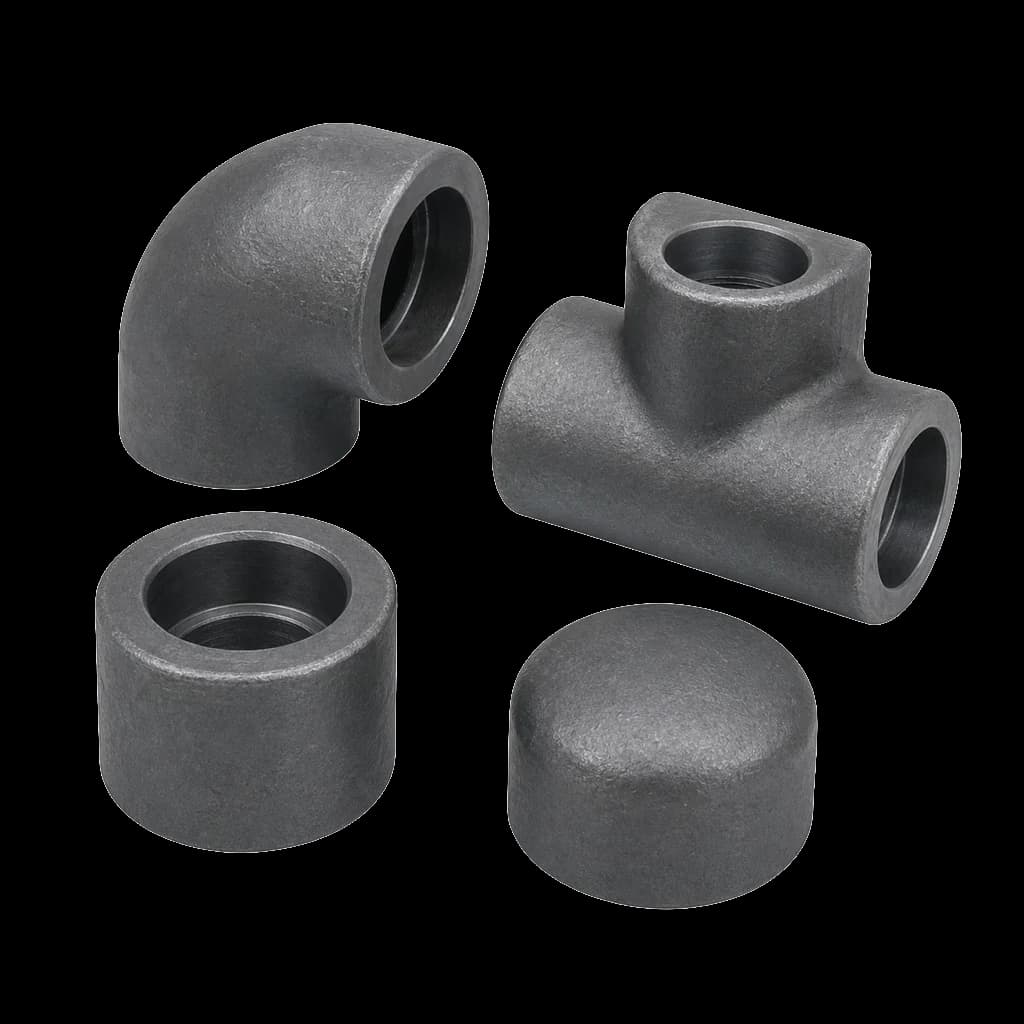
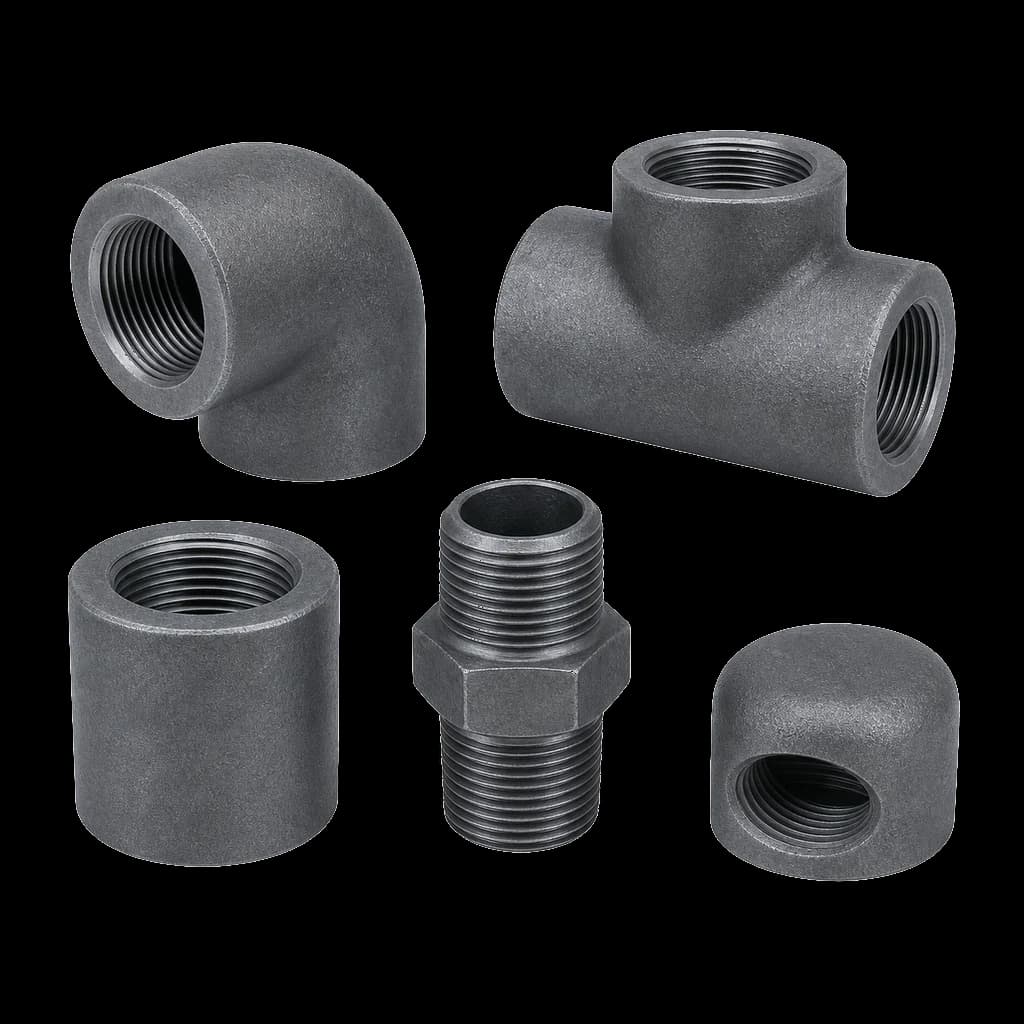
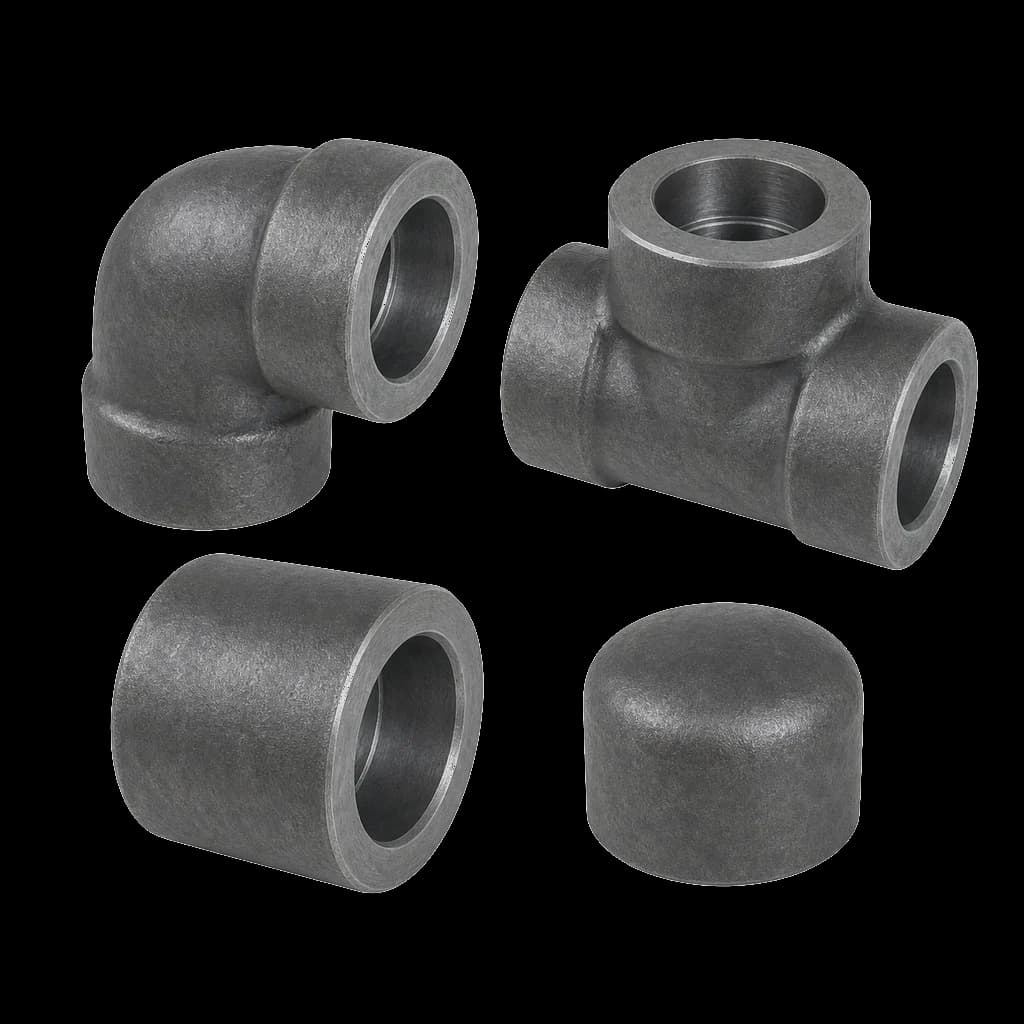
Forged socket-weld and threaded fittings work differently: they are rated by class, and ASME B16.11 ties each class to the pipe wall it was designed to sit alongside. The socket bore accepts the pipe outside diameter, so it takes any schedule of that NPS — but the class must at least match the pipe. Our comparison of ASME B16.11 and IS 4712 forged fittings covers the Indian designations, and the socket weld fittings we supply follow the correlations below.
| Class | End type | Designed to mate with |
|---|---|---|
| Class 2000 | Threaded (NPT) | SCH 80 / XS |
| Class 3000 | Threaded (NPT) | SCH 160 |
| Class 6000 | Threaded (NPT) | XXS |
| Class 3000 | Socket weld | SCH 80 / XS |
| Class 6000 | Socket weld | SCH 160 |
| Class 9000 | Socket weld | XXS |
Valves obey the same discipline. A butt-weld-end valve is bored to a nominated schedule at the factory, so a 6" Class 300 BW gate valve is not a complete part description until the schedule sits beside it — pressure class and wall are separate axes, as our guide to valve class ratings sets out. Screwed and socket-weld valves inherit the B16.11 correlation: a Class 800 forged gate valve with screwed ends is normally paired with SCH 80 or heavier pipe.
Indian standards that do not use schedules
A large part of the Indian market never speaks in schedules at all, and translating between the two systems is where site mismatches happen.
- IS 1239 (Part 1) covers steel tubes up to 150 mm NB in light, medium and heavy classes — colour-banded yellow, blue and red — with thickness stated directly, not as a schedule. CPWD and PWD water-supply specifications call for GI medium class; hydrant and wet-riser mains are written to heavy class. The detail is in our guide to IS 1239 pipes and fittings.
- The outside diameters differ. IS 1239 follows the ISO tube series, so 65 NB is 76.1 mm OD against ASME's 2-1/2" at 73.0 mm, and 150 NB is 165.1 mm against 6" at 168.3 mm — a B16.9 or B16.5 component will not mate in those sizes. 80 NB and 100 NB coincide at 88.9 and 114.3 mm, which is exactly why 65 and 150 catch people out.
- IS 3589 covers steel pipes from 168.3 mm OD upward for water, sewage and gas, again with the wall called out in millimetres. Large-bore water and firewater tenders are normally written this way.
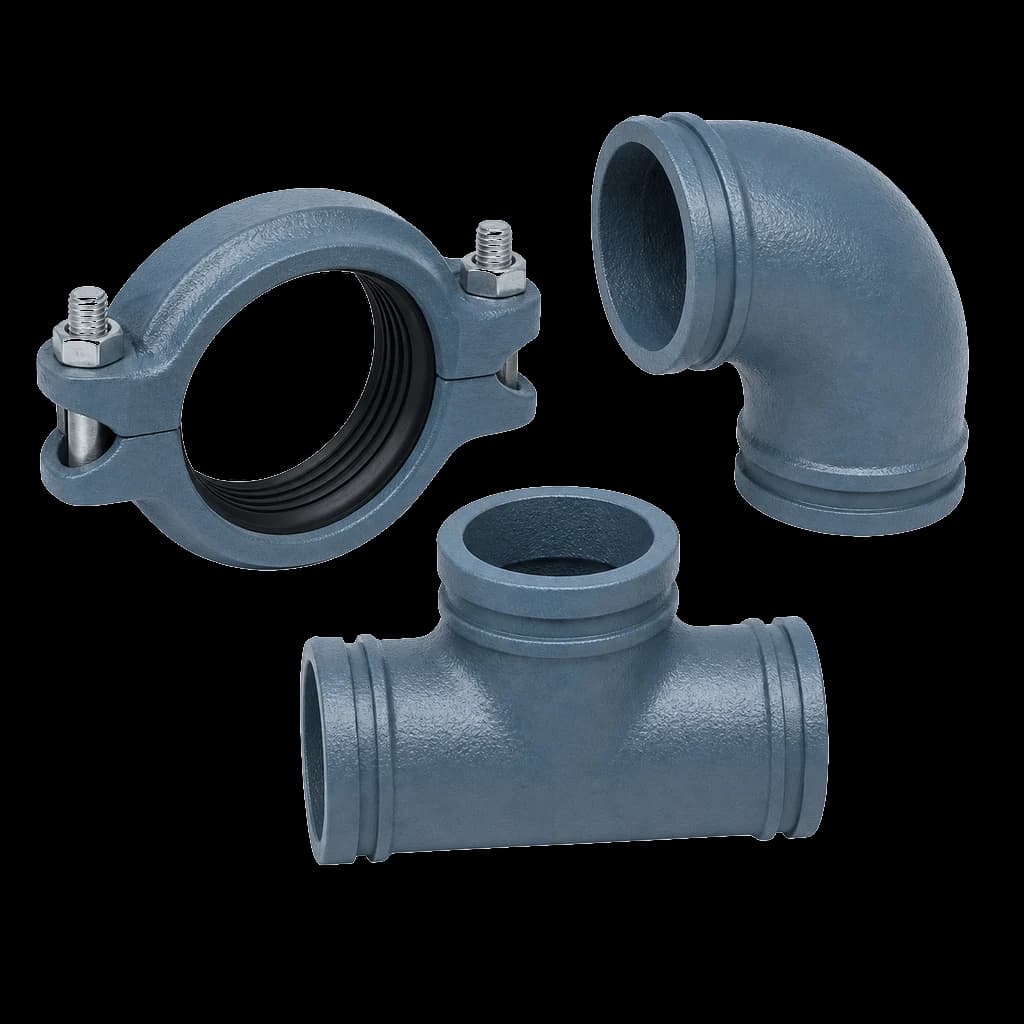
- Threaded and grooved systems — GI, DI and grooved — are specified by class or by the standard they join, which is why our pipe fittings range is catalogued by system rather than by schedule.
Putting the schedule on the enquiry
An enquiry that clears a distributor's desk on the first pass carries all of the following; the same discipline applies to valves, as our guide on how to write a valve RFQ lays out.
- Material specification and grade — ASTM A106 Gr B, A53 Gr B, A312 TP316L, IS 1239 medium class — never just CS or SS.
- Size as NPS or DN, and the schedule for every line item, with the S suffix written explicitly where the pipe is stainless.
- Method of manufacture: seamless, ERW or EFW. It moves both the cost basis and the acceptable NDT regime.
- End preparation: bevelled to ASME B16.25, plain end, or threaded to ASME B1.20.1 (NPT) or IS 554 (BSP). Threads are not interchangeable.
- For fittings: the mating pipe schedule if butt-weld, the class if socket-weld or threaded, and the governing standard — B16.9, B16.11, B16.3 or IS 1239 Part 2.
- Documentation: EN 10204 3.1 or 3.2 mill test certificates, hydro test reports, and IBR Form III-C where the line is boiler-connected.