A spiral wound gasket is four decisions, not one part number: the winding metal, the filler, the ring configuration and the dimensional standard the mating flange was built to. Enquiries routinely specify two of the four — "SS 316 spiral wound with graphite filling, 12 inch Class 300" — and the gasket that reaches site either fails to centre in the bolt circle, buckles inward on the first heat cycle, or oxidises out of the joint inside a year. This is the sequence to settle before a flanged valve or fitting order goes out.
How a spiral wound gasket seals
The gasket is built from a preformed V-profile metal strip wound spirally in alternate plies with a softer filler, spot welded at the start and finish of the winding. The filler does the sealing — it flows into the serrations of the flange face and closes the leak path. The metal strip carries the compressive load, stops the filler being crushed out, and supplies springback — the elastic recovery that holds the joint tight while bolts relax and the flange breathes through thermal cycles. Compressed-fibre sheet has none, which is why spiral wound is the default on hot lines.
Standard winding thickness for piping service is 4.5 mm (0.175 in) nominal, compressed in service to roughly 3.2 mm. That compression is not left to the fitter's judgement: the rings are machined thinner than the winding, bottom out, and act as a mechanical stop against over-compression.
Dimensions, materials, marking and colour coding are set by ASME B16.20, written for flanges to ASME B16.5 and B16.47; in European practice EN 12560-2 covers Class-designated flanges and EN 1514-2 the PN-designated ones. Indian tenders still call up the withdrawn BS 3381, and older refinery specifications still quote API 601, long since folded into B16.20 — re-issue either against B16.20.
Choosing the winding metal
The winding is the corrosion-critical element: its cut edge sits at the gasket bore, in thin section and fully exposed to the fluid. It must match or exceed the corrosion resistance of the wetted body material of the valves and fittings in that line, and survive the design temperature.
| Winding metal | Where it belongs | Ring edge colour |
|---|---|---|
| 304 / 304L stainless | General water, utility steam, clean hydrocarbons — the economy default where nothing aggressive is present | Yellow |
| 316L stainless | Broader chemical resistance and mild chloride exposure; the working default for refinery, CGD and process duty | Green |
| 321 stainless | Cyclic high-temperature service; titanium-stabilised against sensitisation | Turquoise |
| 347 stainless | Stabilised high-temperature hydrocarbon and steam lines where 304 would sensitise | Blue |
| Monel 400 | Seawater and brine, caustic, hydrofluoric acid service | Orange |
| Inconel 600 | Oxidising service above the practical stainless range | Gold |
| Titanium | Wet chlorine, chlorinated brines, seawater and hypochlorite duty | Purple |
The 304-versus-316L argument is rarely about temperature — both grades outlast every common filler. It is about chlorides and matching the body casting. If the line is specified in CF8M, do not put a 304 winding in the joint; it will pit long before the casting shows anything. Duplex windings are made but are not a shelf item in India, so raise availability at enquiry stage.
Choosing the filler
Flexible graphite
Flexible graphite carries the overwhelming majority of industrial joints. It conforms to imperfect flange faces at modest seating stress, is stable from cryogenic temperatures upward, and does not creep the way PTFE does. Its ceiling is oxidation rather than softening: in an air-exposed joint continuous service is generally held to around 450 °C, and considerably higher in steam and other non-oxidising media. Graphite burns back from the outer edge inward, so a joint can look sound and still be losing gasket.
On austenitic stainless piping, purity is a specification item and not a nicety. Insist on a low-halide grade with leachable chloride controlled — commonly to a 50 ppm limit — and ask for the certificate. Cheap graphite with free chlorides against a hot stainless flange face is a chloride stress-corrosion cracking initiator you have paid to install.
PTFE
PTFE is the chemical answer: strong acids, caustics, hypochlorite, oxidisers, and food, dairy and pharmaceutical duty where graphite contamination is unacceptable. It is serviceable from about -200 °C to roughly 260 °C. Its weakness is cold flow — it relaxes under sustained load, so bolt load management matters more than with graphite. B16.20 requires an inner ring on every PTFE-filled spiral wound, in every size and class.
Mica, vermiculite and ceramic
Where the joint can see fire, or temperature past the graphite oxidation limit, mica and vermiculite fillers stay serviceable to around 1000 °C, and ceramic occupies the same niche. All three are less conformable than graphite and demand higher seating stress, so confirm the bolting can deliver it.
- Flexible graphite — the default for steam, thermic fluid, hot hydrocarbon and general utility. Specify purity and the halide limit on austenitic stainless piping.
- PTFE — acids, caustics and hygienic service, always with an inner ring, and on the understanding that it will relax.
- Mica / vermiculite — fire-exposed lines and sustained temperature where graphite would oxidise away.
- Non-asbestos fibre — cold water and low-duty utility work only. It has no business on a hot line, whatever the price advantage.
- Never stack two gaskets to make up a gap, never reuse a spiral wound after a joint break, and never smear jointing compound onto a graphite-filled winding.
Ring styles and the inner ring rule
| Style | Configuration | Where it belongs |
|---|---|---|
| R | Winding only | Tongue-and-groove and male-female facings, where the groove itself locates and radially restrains the winding |
| CG | Winding plus solid metal outer (centring) ring | The workhorse for raised-face flanges: centres the gasket on the bolt circle and acts as the compression stop |
| CGI | Winding plus outer ring plus inner ring | Raised-face flanges at higher class or temperature, and every PTFE-filled joint |
| RIR | Winding plus inner ring only | The same confined facings, where the filler still needs bore-side support — high temperature, or a PTFE fill that mandates the inner ring |
The outer ring does three jobs, and buyers who treat it as packaging get all three wrong: it centres the winding on the bolt circle so the gasket does not sit eccentric under load, it limits compression, and it supports the winding radially against blowout. Carbon steel, usually zinc plated, is standard. Upgrade to 304 or 316 where insulation gets wet, in coastal plants, and anywhere rust staining on the flange OD becomes an inspection observation.
The inner ring is the item most often value-engineered out of a package, and it is the one that fails loudly. Under bolt load the innermost plies of an unsupported winding can buckle radially inward into the bore; the filler then erodes into the flow and the leak surfaces months later. An inner ring prevents that buckling, shields the winding edge from turbulence and heat, and closes the annular gap between gasket bore and pipe bore. B16.20 makes it compulsory more often than buyers expect: on every PTFE-filled gasket, and on flexible-graphite-filled gaskets from NPS 24 up in Classes 150 and 300, NPS 12 up in Class 600, NPS 4 up in Class 900, NPS 3 up in Class 1500 and NPS 2-1/2 up in Class 2500. Below those thresholds it is still the cheapest insurance on the joint. Pressure class ratings explain what the class number actually buys.
Getting the dimensions right
The most expensive ordering error has nothing to do with metallurgy. Up to and including NPS 24, ASME B16.5 fixes flange and gasket dimensions unambiguously. From NPS 26 upward you are in ASME B16.47, which carries two incompatible series — Series A from the old MSS SP-44 and Series B from the old API 605 — with different bolt circles, bolt counts and therefore different gasket outside diameters. "36 inch Class 150 spiral wound" is not a specification; it is half of one. The difference between B16.5 and B16.47 flanges is worth ten minutes before the requisition goes out.
Facing dictates style. Raised face takes CG or CGI. Ring-type joint grooves take a machined octagonal or oval RTJ ring and never a spiral wound. And do not put a spiral wound on a cast-iron flat-faced flange: the seating stress it needs will crack the flange, and those joints belong to full-face soft gaskets. The note on RF, FF and RTJ flange facings covers which combinations are legitimate and which quietly are not.
Bolt load and joint assembly
A spiral wound gasket that leaks is far more often an assembly failure than a product failure, because these gaskets need real seating stress. The legacy gasket factors tabulated in ASME Section VIII Division 1, Mandatory Appendix 2 — suggested values rather than requirements — give m = 3.00 and y = 10,000 psi (roughly 69 MPa) for stainless-wound spiral gaskets. Current practice works from the manufacturer's minimum and maximum seating stress, or EN 13555 data, but the order of magnitude is the message: this joint is tightened to a calculated load, not nipped up until it stops weeping.
Use A193 Gr B7 studs with A194 Gr 2H nuts as the carbon and alloy steel default, and follow ASME PCC-1 practice: inspect and clean the flange faces, lubricate threads and nut bearing faces, then tighten cross-pattern in staged passes at roughly 30%, 60% and 100% of target torque, finishing with a rotational check pass. The nut factor must match the lubricant actually applied: a dry stud needs roughly half again the torque of a lubricated one to reach the same preload, which is how a correctly specified gasket ends up under-seated. On hot lines, either re-torque after the first thermal cycle where the specification permits it, or allow for relaxation in the initial bolt load.
Spiral wound versus kammprofile
A kammprofile — grooved metal gasket — is a solid metal core with concentric machined serrations, faced both sides with a thin graphite or PTFE layer. It seals at lower stress, has no windings to buckle, and tolerates flange rotation and uneven bolt load better; against that it costs more, is made to order rather than stocked, and is scrap once the facing layer is nicked.
Spiral wound stays the default for standard B16.5 and B16.47 flanged piping — published dimensional tables, shelf availability, and a lower cost than any machined alternative. Move to kammprofile when the joint is large-bore with limited bolt load, cycles hard thermally, or has already leaked twice — not on the strength of one bad joint elsewhere in the plant.
Specifying a spiral wound gasket on an RFQ
A complete gasket line item states all four decisions plus documentation. Anything less and the vendor fills the gaps with whatever is cheapest to supply.
- Flange standard, series where B16.47 applies, nominal size, pressure class and facing.
- Style code — R, CG, CGI or RIR — stated explicitly rather than left to "as required".
- Winding metal grade, written as a material designation, not as "SS".
- Filler type, with purity and halide limits where stainless piping is involved.
- Inner ring material, outer ring material and its coating.
- Thickness, only where you need something other than the 4.5 mm standard.
- Marking and colour coding to ASME B16.20, plus material certificates for winding and rings.
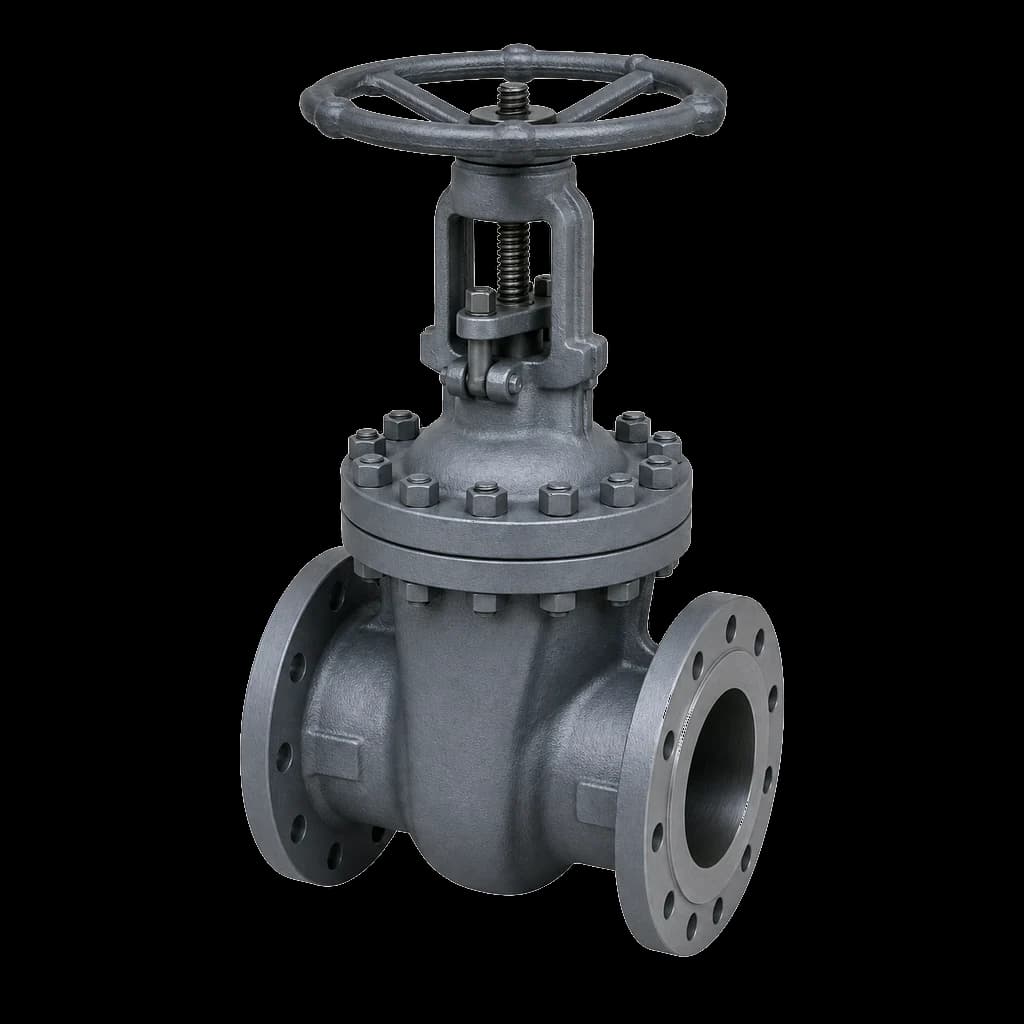
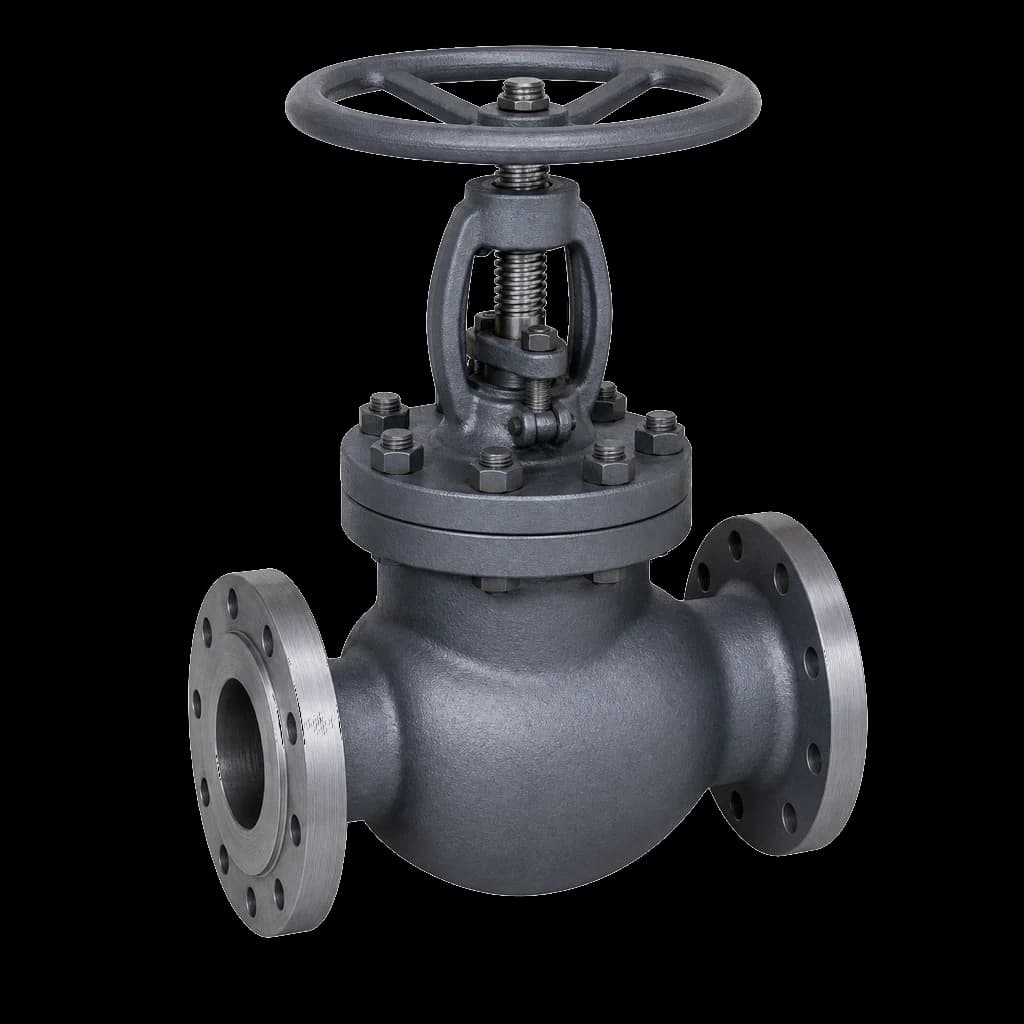
Settled at enquiry stage, one requisition covers the valves, the flanged fittings and the gasket and bolting schedule together. If you are buying flanged cast steel gate valves and globe valves for a Class 300 hydrocarbon header, settle the winding metal against the body casting grade in that conversation, not after the valves land.