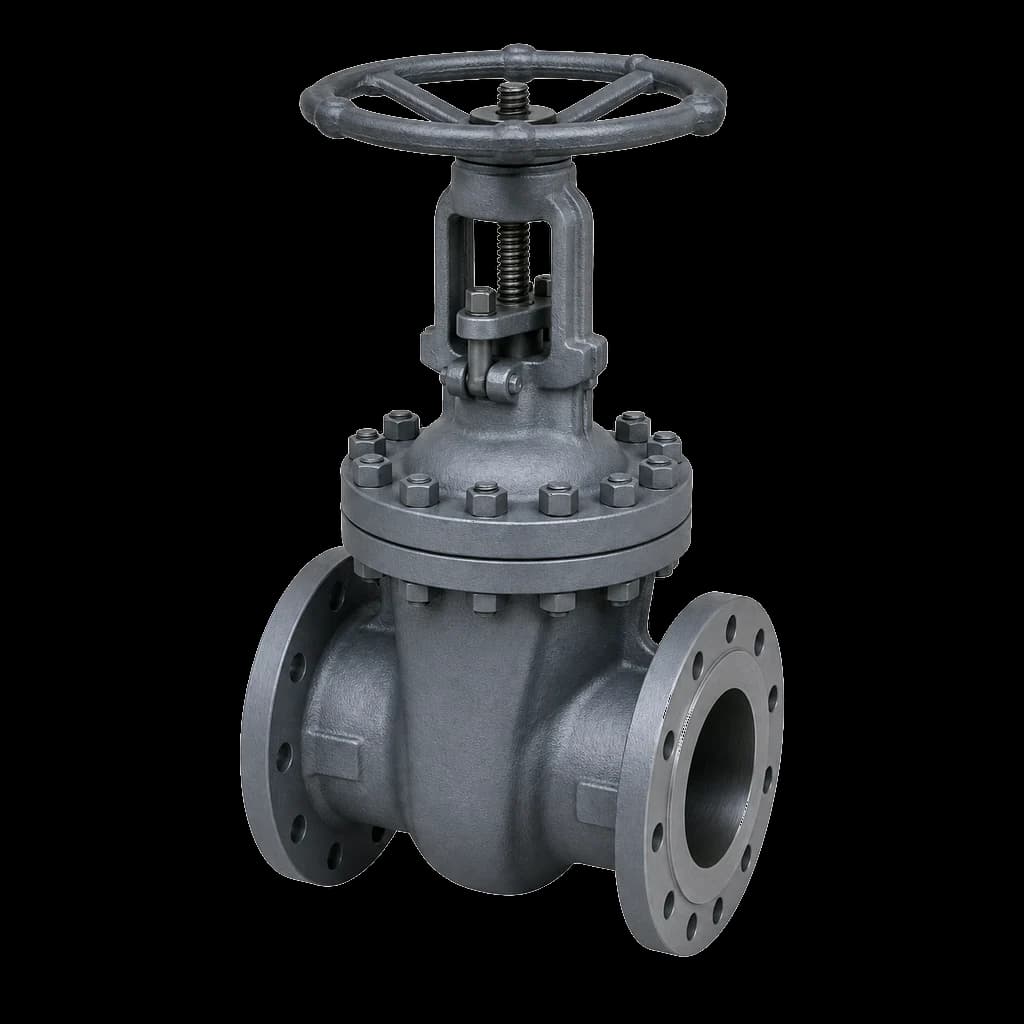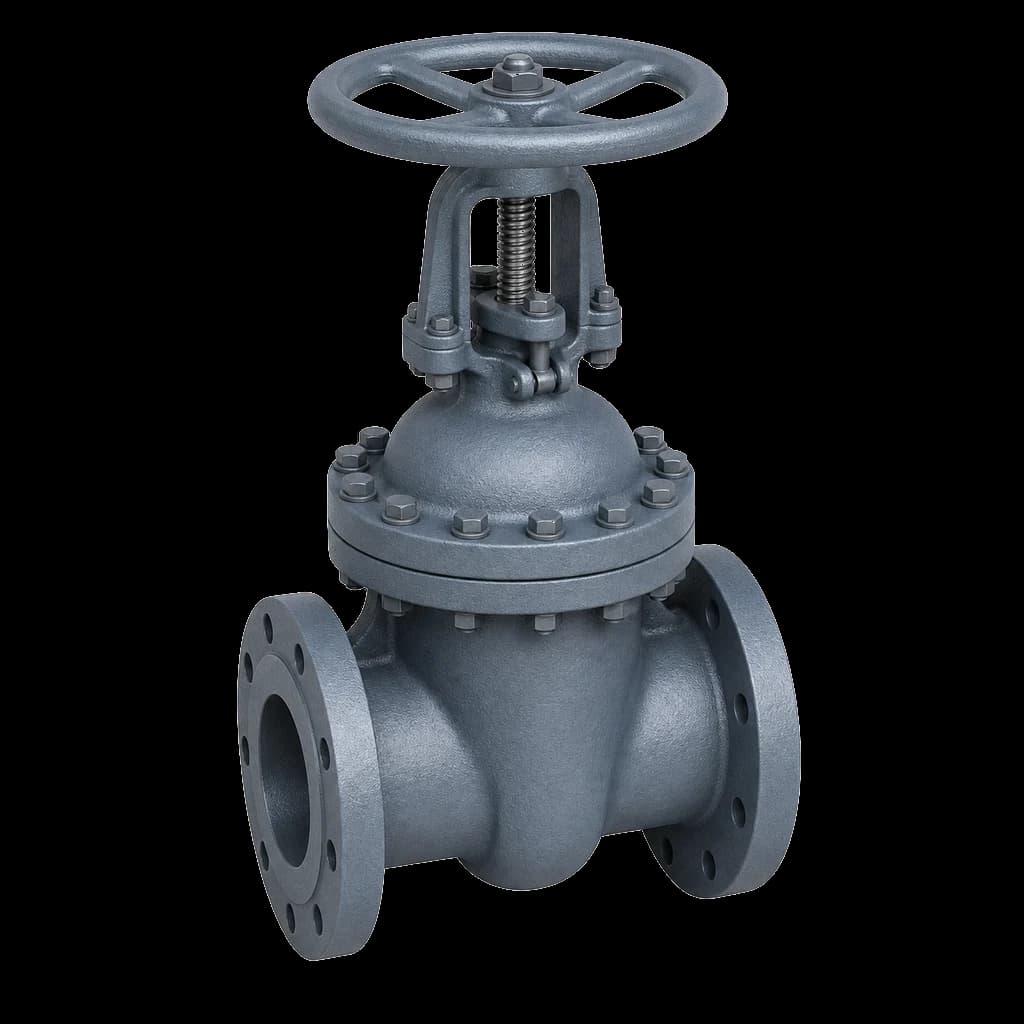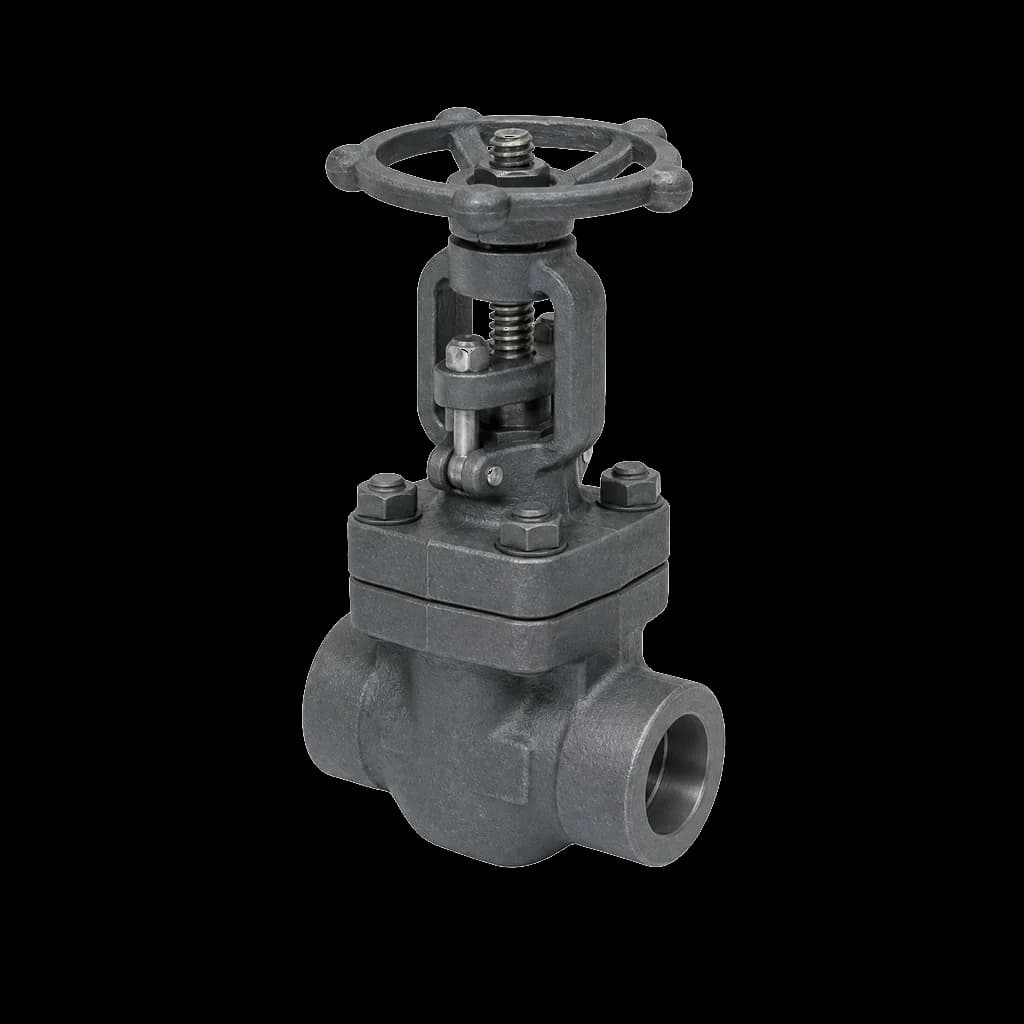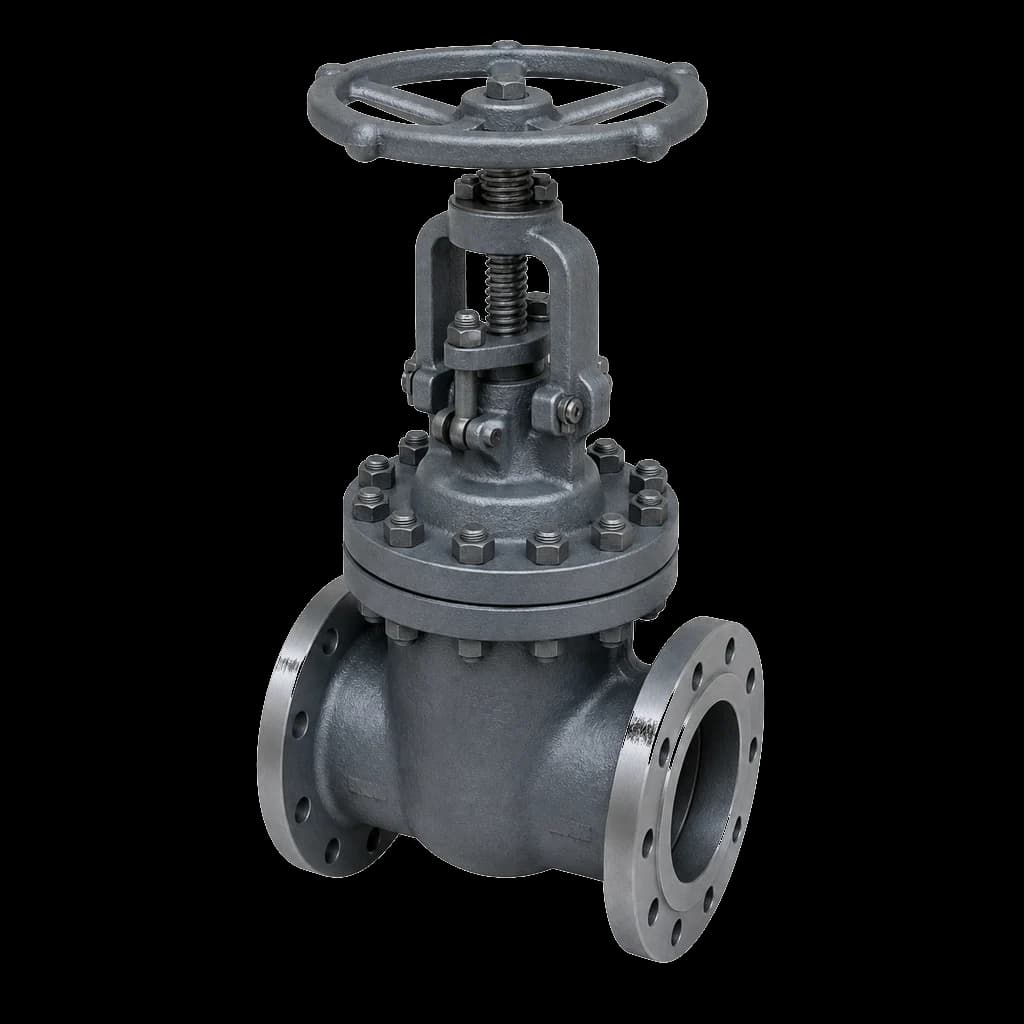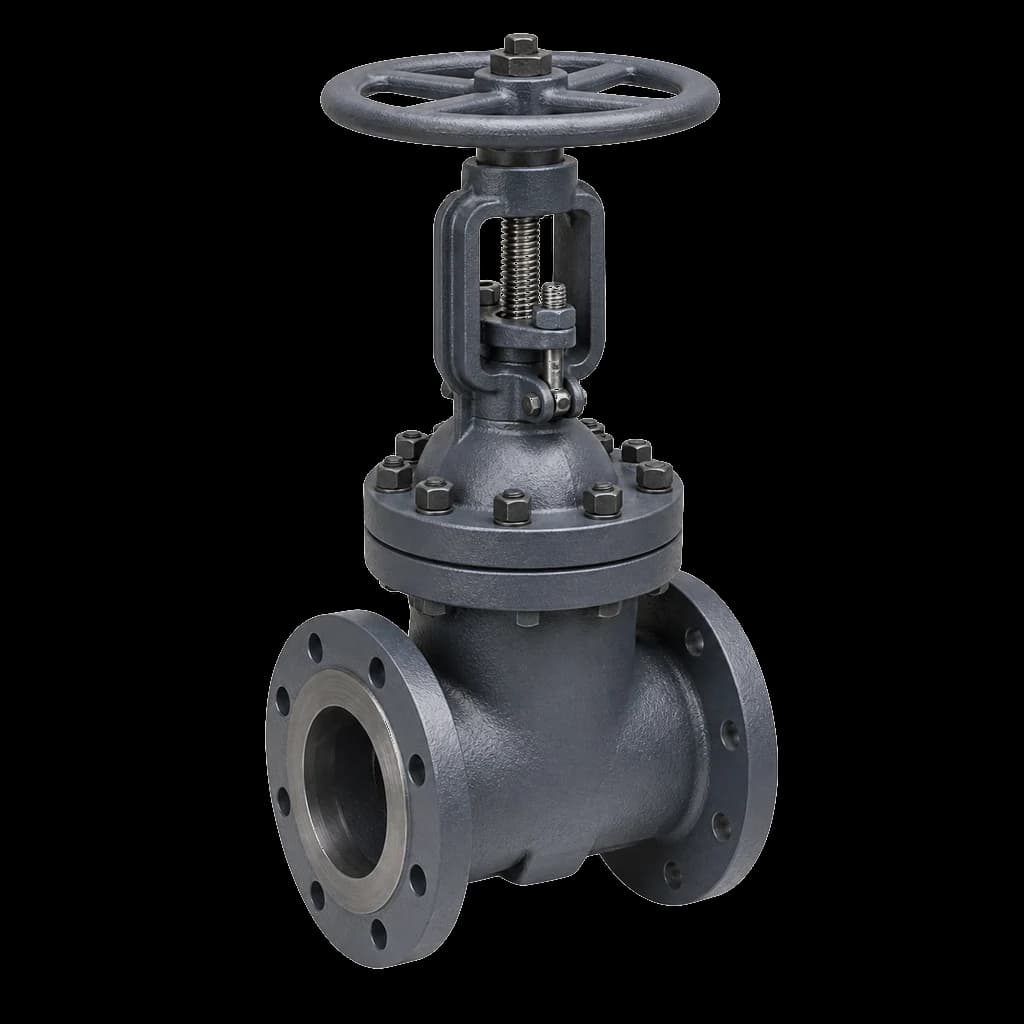
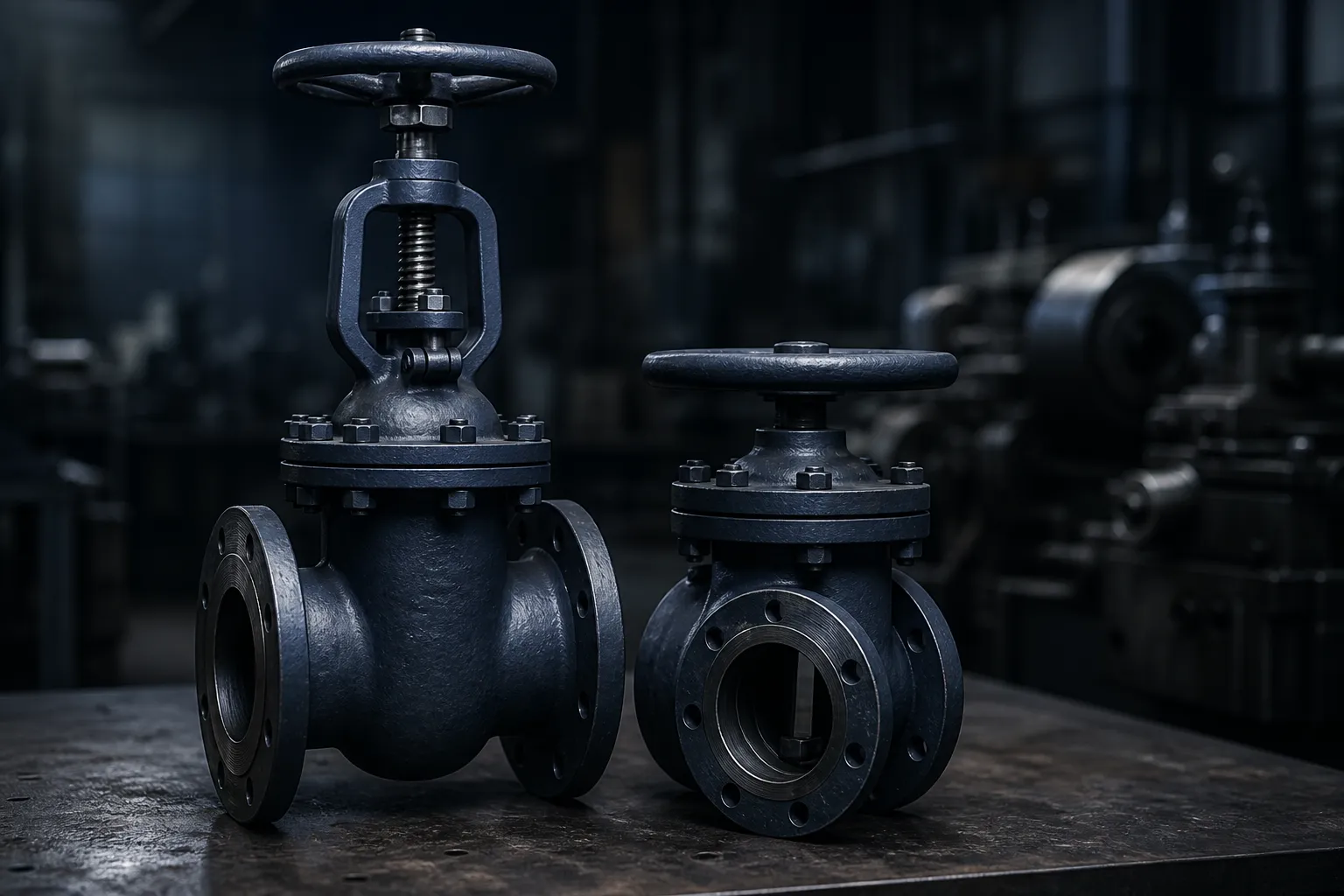
Two gate valves of the same size, class and body material can differ in exactly one respect — whether the stem travels or only turns — and that one difference decides how much vertical clearance the pipe rack needs, whether an operator can read the valve position from the floor, whether the fire consultant signs the drawing, and whether the valve can be buried at all. A rising stem gate valve carries its thread above the gland, outside the wetted volume; a non-rising stem (NRS) valve keeps the thread inside the bonnet, immersed in the line fluid, and moves the gate up a stationary stem. Getting it wrong is rarely caught on the P&ID — it is caught on site, when the handwheel will not clear a beam, or when a hydrant valve cannot be proved open during a witness test.
Three stem arrangements, not two
Catalogues offer "rising" or "non-rising". There are three, and the middle one causes most of the confusion in tender scrutiny.
Outside screw and yoke (OS&Y)
The stem thread sits above the gland, outside the pressure boundary, and engages a yoke nut carried at the top of the yoke. Turning the handwheel turns the yoke nut; the stem does not rotate, it only translates, and it is smooth and unthreaded where it passes through the packing. This is the arrangement required by API 600 for bolted-bonnet steel gate valves, and it is what you get by default in refinery, power, steam and process service across Class 150 to Class 2500.
Inside screw rising stem (ISRS)
Here the thread is inside the bonnet, below the packing, and the handwheel is fixed to the stem — so stem and handwheel rise together. You see it on small copper-alloy valves to IS 778. It is the cheapest of the three and it does indicate position, but it has the worst packing duty of any gate valve: the stem rotates and translates through the gland at once. The thread is wetted, so it is honest only in clean water and air.
Non-rising stem (NRS)
A thrust collar in the bonnet holds the stem at a fixed elevation while it rotates, and the thread it carries engages a stem nut — a bronze or gunmetal nut cast or pinned into the top of the gate. The gate climbs the stem, the handwheel never moves, and the whole thread is immersed. This is the usual arrangement for cast-iron sluice valves to IS 14846, for buried water mains and for anything operated through an extension spindle and surface box.
| Attribute | OS&Y rising stem | Inside screw rising stem | Non-rising stem |
|---|---|---|---|
| Thread location | Outside the pressure boundary | Inside the bonnet, wetted | Inside the bonnet, wetted |
| Handwheel travel | Stays put | Rises with the stem | Stays put |
| Stem motion at the packing | Translation only | Rotation plus translation | Rotation only |
| Vertical space when open | Grows by the stem travel | Grows by the stem travel | No change |
| Position readable by eye | Yes, unambiguous | Yes | No — needs an indicator |
| Suitable for burial | No | No | Yes, the normal choice |
| Typical service | Hydrocarbon, steam, fire, process | Small-bore water and air | Waterworks, effluent, buried mains |
Headroom: the dimension that breaks layouts late
A wedge gate has to lift clear of the bore before the valve is fully open, so the stem travel of a rising stem valve is never less than the nominal bore — in practice a little more, because the wedge is thicker than the seat opening and the design leaves overtravel to the backseat. The working rule is to budget stem travel of roughly 1.1 times the nominal bore, then add the projecting stem end, any stem protector, and the height of a bevel gearbox if the valve is gear operated. On a 24" line the stem alone accounts for some 700 mm of vertical growth that the closed-position GA drawing never showed.
| Size | Nominal bore | Indicative stem travel | Extra headroom for NRS |
|---|---|---|---|
| 2" | DN 50 | ≈ 55–65 mm | None |
| 4" | DN 100 | ≈ 110–125 mm | None |
| 6" | DN 150 | ≈ 165–185 mm | None |
| 12" | DN 300 | ≈ 330–370 mm | None |
| 24" | DN 600 | ≈ 660–730 mm | None |
This is why NRS survives where a rising stem cannot go — a masonry chamber under a road, a congested pump-house gallery, a valve under floor grating. There it is not a compromise but the only construction that fits. On new work, ask for the open-position height up front: it is a five-minute question at datasheet stage and a re-supported spool later.
Packing, backseat and what happens to the thread
Move the thread outside the pressure boundary and three things follow. First, the thread can be inspected, cleaned and greased for the life of the valve; a wetted NRS thread cannot be touched without dismantling the valve. Second, the packing sees pure reciprocating motion instead of a rotating shaft, which is why emission-tested gate valve designs are almost always OS&Y. Third, an OS&Y valve with an integral backseat can have its gland repacked with the valve fully open and backseated — a genuine operational advantage, although many owner and EPC specifications forbid repacking under pressure outright, so read the job spec before promising it to operations.
The penalty is exposure. A bare OS&Y thread in a coastal, cement-dust or fertiliser environment picks up corrosion and abrasive, and a stem left open for two years then closed hard will gall. Specify a stem protector tube outdoors, a stainless stem (A182 F6a or F304/F316, to suit the trim), and a place in the greasing schedule. A wetted NRS thread is lubricated by the water it sits in, which works exactly as long as the water is clean.
Position indication and why fire codes want a rising stem gate valve
An OS&Y valve tells you its position from across the pump room with no instrument and no interpretation, which is why fire protection practice is built around it. Listed indicating valves are required on fire pump suction and discharge and on the control valves of sprinkler and hydrant systems; in most Indian installations that means a UL/FM listed OS&Y gate valve, and fire schedules of quantities routinely write "OS&Y" into the line item rather than "gate valve". Confirm the applicable NFPA edition, the NBC provisions and the insurer's or TAC requirement for the job — but assume OS&Y unless something in writing says otherwise. Our fire-fighting valve guide covers the rest of that package.
The recognised exception is the buried main, where a rising stem is physically impossible. There the standard answer is a non-rising stem gate valve under an indicator post, or a valve box with a listed position indicator — you keep the indication requirement and give up the visible stem. Outside fire service, the same logic applies to any valve feeding an interlock: if you need position proven, buy OS&Y and fit a limit switch to the yoke, or accept that an NRS valve indicates from the gearbox, not the gate.
Where non-rising stem is the right answer
- Buried and chamber-mounted water lines. Cast-iron sluice valves to IS 14846 with an extension spindle, cap top and surface box — the CPWD, PHED and municipal water-supply default. A rising stem here would need a chamber sized for the open stem and would corrode in it.
- Pit-mounted and pump-house valves with no headroom. Where a constant-height stem is the only way to fit the valve into the space.
- Large-bore low-pressure water, effluent and cooling duty at PN 1.0 and PN 1.6, where the cost of a cast-steel OS&Y valve buys nothing the service needs.
- Valves that spend their life open and are operated once a year. Thread wear is a function of cycles, so a valve that never cycles never exercises the NRS weakness.
- Never for hydrocarbon, steam or hot service. A wetted thread in a hydrocarbon or condensate stream is a maintenance item you cannot reach, and NRS designs carry none of the API 600 bolted-bonnet, fire-safe or emission pedigree that those lines demand.
How each one fails
NRS valves fail at the stem nut. The bronze nut in the gate wears, the wetted thread corrodes or fills with grit, and the result is the classic seized sluice valve: the handwheel turns, the gate does not. Eventually the nut strips, and because nothing is visible from outside the first symptom arrives during an emergency isolation. Rising stem valves fail more honestly: a bent stem, a galled yoke nut or a hardened gland all show on a walk-down, and the stem position tells you whether the last operator closed the valve or just stopped when it got heavy.
Both constructions share one failure mode: do not throttle a wedge gate valve. A partly open gate chatters, the seat faces wire-draw, and on an NRS valve the side load goes straight into the stem nut. If the duty needs regulation, that is a globe valve — the trade-offs are set out in our comparison of gate, globe and ball valves.
Writing the line item so you get what you meant
- State the construction explicitly — "OS&Y rising stem, bolted bonnet" or "non-rising stem, inside screw". "Gate valve" alone lets a supplier offer either, and both bids will be technically compliant.
- State the open-position height requirement, or ask for the open GA with the offer.
- For NRS, call out the stem nut material and the stem grade separately from the body — the nut is the wear part, and it is the first thing a cheap offer downgrades.
- For OS&Y outdoors, add the stem protector and confirm the stem material against the trim you specified.
- For fire duty, write the listing requirement into the line item, not into a general note. The listing is what the inspector checks.
- Ask for the EN 10204 3.1 MTC, the hydro and seat test reports and, on IBR lines, Form III-C, at the enquiry stage rather than after despatch.