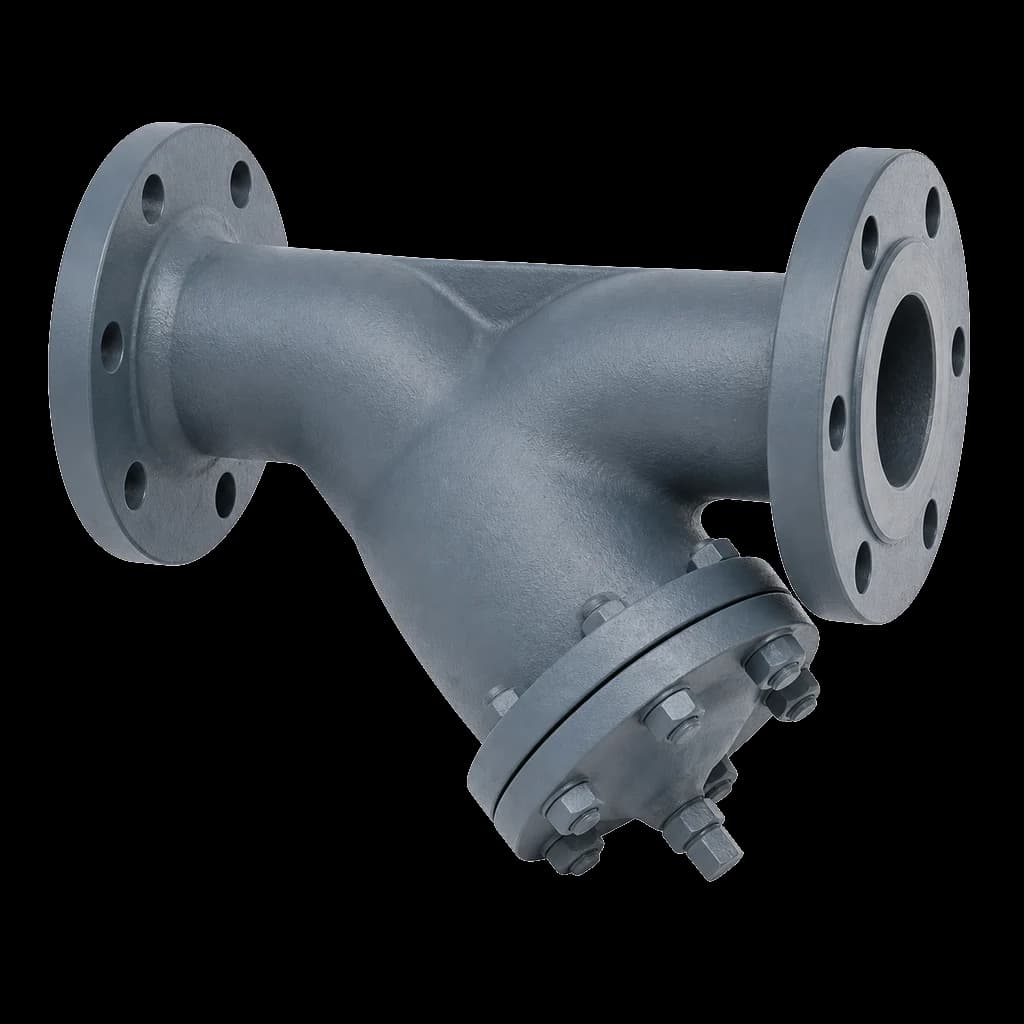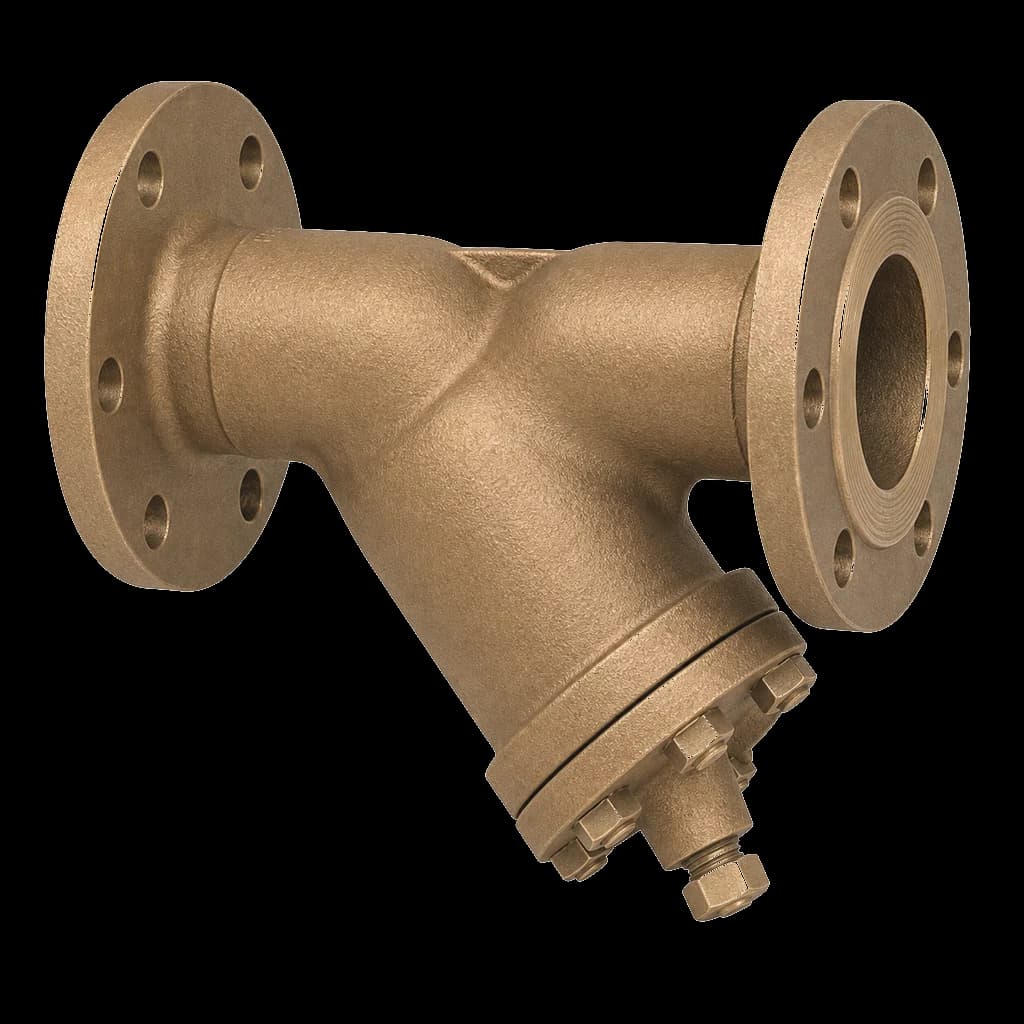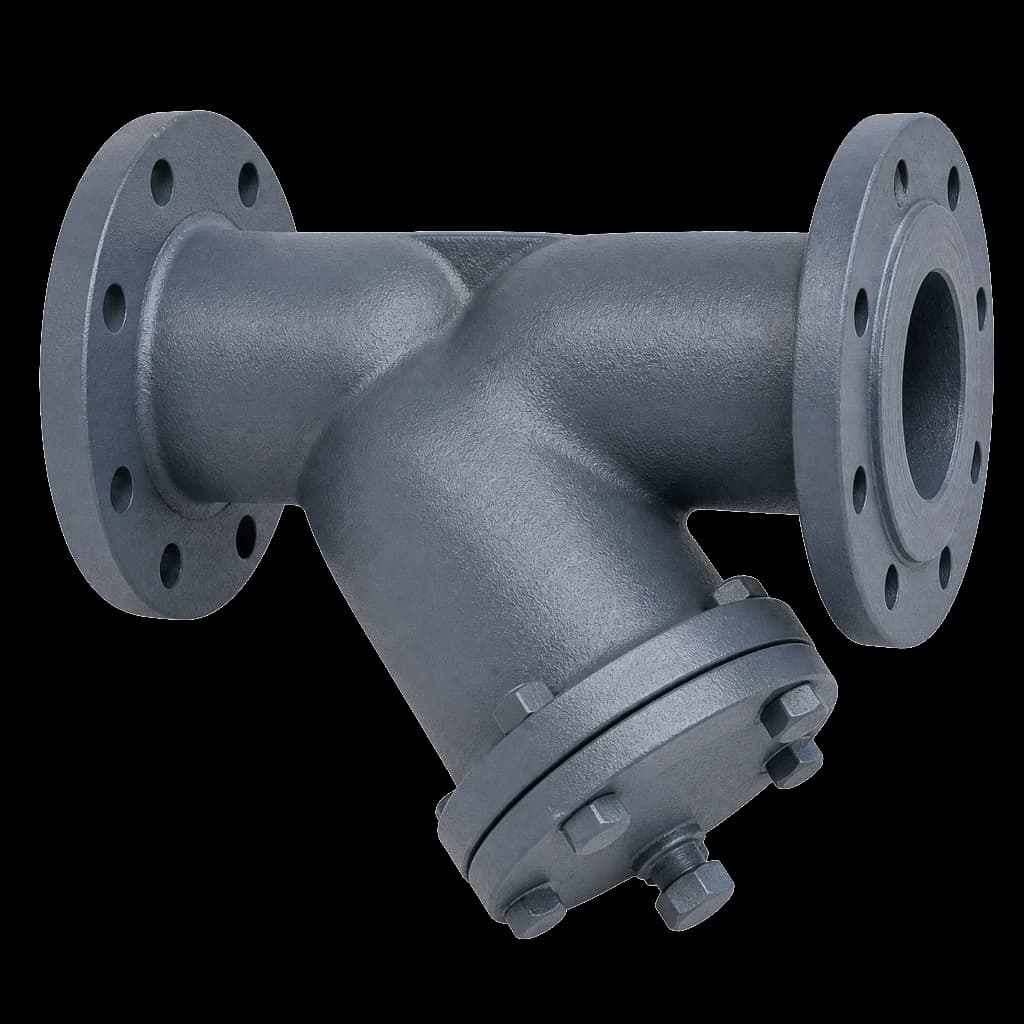
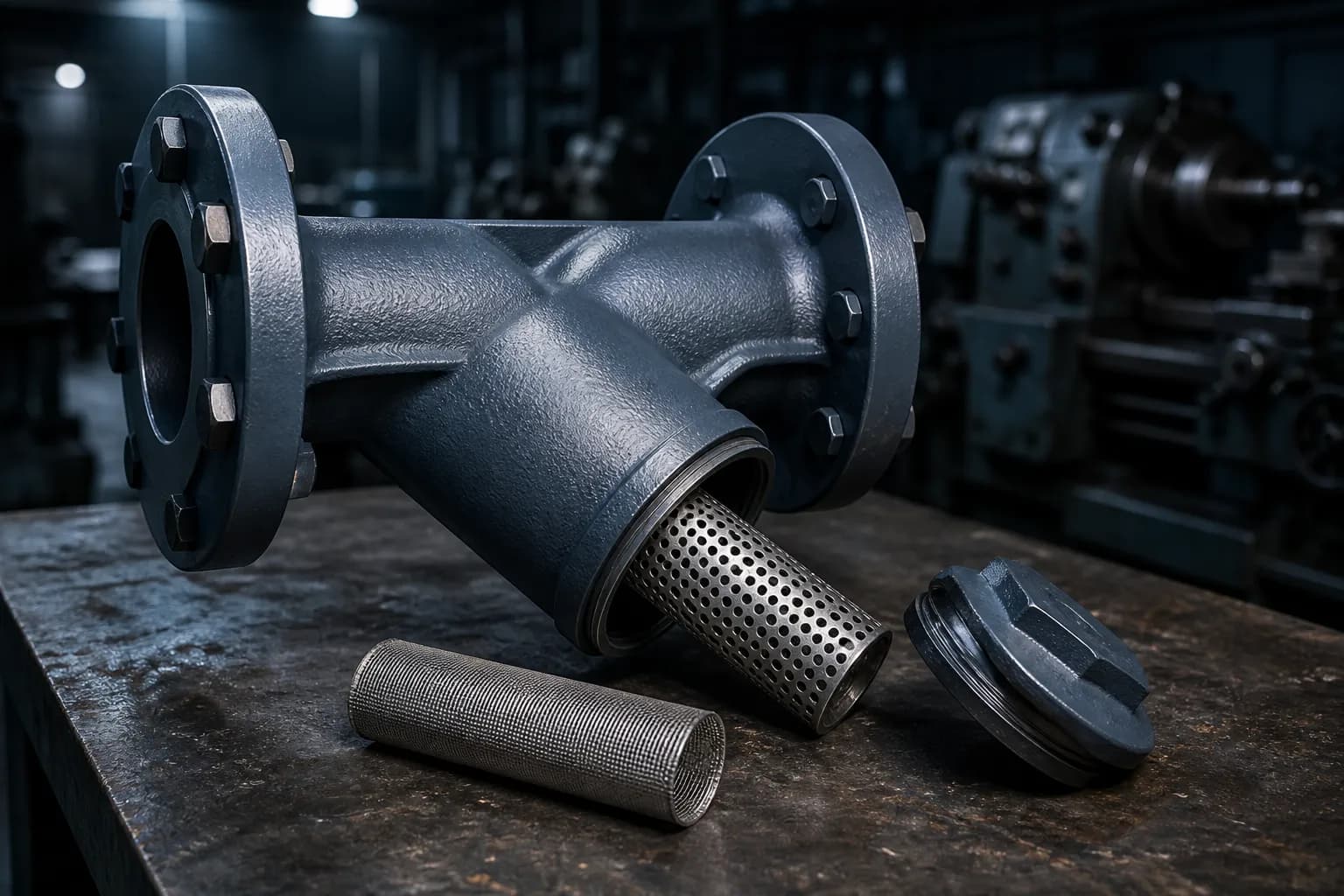
A Y type strainer is the cheapest item on a line list and the one most often copied from the previous job. That is how a fire header ends up behind a 100 mesh screen that blinds solid, and a control valve inlet behind 3 mm perforation. Three numbers decide whether a strainer works: the aperture of the screen, the open area ratio between screen and pipe, and the pressure drop you can live with once that screen is half blocked. Fix those three first; body, ends and blowdown follow from the duty.
What a Y type strainer is actually protecting
A strainer is not a filter. It is a mechanical guard sized to stop what a piping system generates — weld slag, cut gasket, mill scale, PTFE tape, casting sand — from reaching one vulnerable item downstream. Name that item before you name a mesh: a boiler feed pump, a PD flow meter, a thermodynamic trap and a hydrant ring tolerate entirely different things. If nothing downstream is vulnerable, leave the strainer out.
- Steam traps, PRVs and small orifices — passages a millimetre or two across at high velocity. These take the finest screen on the plant; the orifice sets the tolerance.
- Control valves and flow meters — trim clearance and rotor bearings set the aperture. Ask the vendor for a maximum particle size in microns and specify to it.
- Pumps — you are guarding the seal and wear rings, and the strainer sits on the suction, where every millibar comes off available NPSH.
- Heat exchangers and chiller barrels — plate units need a finer screen than shell-and-tube: the plate gap is the limit.
- Fire mains, hydrant rings and raw water headers — coarse perforation only. A screen nobody will clean must fail open, not blind.
Mesh, perforation and microns
Two screen constructions, two numbering systems, and they are not interchangeable. Perforated sheet is quoted by hole diameter — 3.2 mm (1/8"), 1.6 mm (1/16") and 0.8 mm (1/32") are the common punchings. Wire cloth is quoted by mesh count, the openings per linear inch. The trap is that mesh count does not define the hole: aperture depends on wire diameter as much as on count, so 40 mesh in heavy wire opens smaller than 40 mesh in fine wire. Specify the aperture in microns and let the maker choose the cloth. Fine mesh is never used alone: it lines a perforated basket that carries the load.
| Screen designation | Nominal aperture | Typical duty |
|---|---|---|
| 3.2 mm (1/8") perforation | 3200 µm | Fire mains, hydrant rings, raw water pump suction, large-bore headers |
| 1.6 mm (1/16") perforation | 1600 µm | Cooling water, chilled water headers, general utility service |
| 0.8 mm (1/32") perforation | 800 µm | Closed-loop water, condensate return, clean process lines |
| 20 mesh | ~850 µm | HVAC coils, plate heat exchangers, small pump suctions |
| 40 mesh | ~425 µm | Control valve and flow meter inlets |
| 60 mesh | ~250 µm | Fine control trim, pilot and orifice lines |
| 100 mesh | ~150 µm | Steam trap and pressure reducing valve inlets, instrument lines |
| 200 mesh | ~75 µm | Spray nozzles, seal flush, atomising steam |
| 325 mesh | ~45 µm | Analyser take-offs and fine seal-flush duty only |
Treat those as sieve-series nominals and resist the pull to a finer number — every step finer costs open area and shortens the cleaning interval. Specify the coarsest screen the protected equipment will accept: get that limit in microns from the pump, meter or valve vendor and stop there.
Perforation first, mesh only where a micron limit exists
For construction debris and scale — most of what any strainer sees — perforated sheet is the better screen: stiffer, blows down cleanly, does not tear at the seam. Mesh earns its place only where something downstream has a documented micron limit: trap orifices, seal flush, spray nozzles, analyser lines. On new construction, flush through a temporary conical start-up strainer and fit the permanent screen afterwards; commissioning through a fine basket usually ends with it collapsed.
Open area ratio: the number that sizes the screen
Open area ratio is the net free area of the screen divided by the cross-section of the pipe bore. It decides whether the strainer is a guard or a throttle, and tender specifications routinely omit it. Because the Y body holds the screen at an angle to the flow, a good strainer offers several times the pipe area in screen — which is why a screen can lose most of its area before the differential moves.
- Liquids: maker guidance clusters around 2:1 to 4:1. Below about 2:1 there is no fouling margin at all.
- Steam and gas: the multiplier rises, commonly to 6:1 or more, because velocity is far higher for the same mass flow.
- Viscous liquids and heavy debris: higher again, or move to a basket pattern, where screen area is not tied to the Y geometry.
- Catalogue, not assumption: work the printed open area against your actual bore, and put the ratio you require into the enquiry.
What catches people out is the liner. Published open area is normally for the bare perforated basket; add wire cloth and you multiply it by the cloth's own open fraction, roughly a third to a half for market-grade weaves. A basket giving 4:1 in bare 1.6 mm perforation lands near 1.5:1 once a 100 mesh liner goes over it — at which point the strainer is the highest-loss item in the spool. Where a fine liner is unavoidable, go one size up on the body.
Pressure drop, fouling and screen collapse
Clean pressure drop is arithmetic. Makers publish a flow coefficient per size and screen, and for liquids Δp = SG × (Q ÷ K)² — Q in m³/h against Kv for a result in bar, or gpm against Cv for psi, with Kv ≈ 0.86 Cv. That is the day-one number, and it lasts exactly as long as the line stays clean. Design at the dirty drop, not the clean drop: tolerate two to three times the clean differential, and make that figure the cleaning trigger in the O&M manual.
Fit differential pressure tappings, or at least a gauge point either side, on any strainer guarding rotating equipment. On a pump suction the case is stronger: the drop comes straight off NPSH available, and a blinding suction strainer will pull a pump into cavitation long before the discharge gauge shows anything. The mesh-versus-NPSH arithmetic is worked through in pump suction strainer selection.
Then check the collapse rating. Every screen folds at some differential, and what matters is the one the system can impose: if a centrifugal pump keeps running against a blinded screen, the differential approaches the pump's shut-off head, not the process datasheet figure. A collapsed screen is worse than no strainer: it delivers everything it collected in one slug. Where blinding is credible, specify a reinforced screen.
Y pattern, T-basket or duplex
The Y pattern earns its place at pressure and in tight layouts: same rating as the valves either side, short, and it drains. What it lacks is dirt-holding capacity. Where the debris load is heavy and continuous — raw water intakes, cooling tower side streams, sugar and paper mill duty — a T-type or basket strainer holds far more and cleans through a top cover. On a line that can never be shut down, use a duplex with a transfer valve.
Body material, rating and end connections
The body sees the same pressure and temperature as the valves either side, so it is rated on the same basis — PN for waterworks iron, ASME class for steel. Do not let a PN 1.0 cast-iron strainer into a Class 150 steel line because the drilling can be made to fit: the line is now good for 10 bar, not the 19.6 bar its Class 150 carbon steel carries at 38 °C. The rating logic is set out in valve class ratings explained.
| Body material | Typical size and ends | Suited to | Constraint |
|---|---|---|---|
| Leaded tin bronze (IS 318 LTB2) | ½"–2", screwed | Instrument lines, small steam branches, potable and domestic water | Small bore only; check the cold WOG rating before any steam duty |
| Grey cast iron (IS 210 FG 200 / FG 260) | 1½"–20", flanged PN 1.0 | Chilled and condenser water, HVAC risers, raw water mains | Brittle; barred from hydrocarbon and much fire-critical duty by EPC specs |
| Ductile iron (IS 1865 SG 400/15, SG 500/7) | 1½"–20", flanged PN 1.6 | Pump suction and discharge on water mains, WTP and STP headers | Costs more than grey iron; still not a hydrocarbon material |
| Cast carbon steel (ASTM A216 WCB) | 1½"–24", flanged or butt-weld, Class 150–900 | Steam, condensate, hydrocarbon, refinery and power station utility | Needs a corrosion allowance on wet, aerated or intermittent service |
| Cast stainless (ASTM A351 CF8M) | ½"–14", flanged or screwed | DM water, brine, chemical, food and pharmaceutical duty | Chloride stress corrosion still applies; screen grade must match the body |
| Forged steel (ASTM A105) | ½"–2", socket-weld or screwed | Small-bore high-pressure steam and hydrocarbon branches | Screwed and socket-weld ends only; forged Y bodies sit outside most cast strainer ranges |
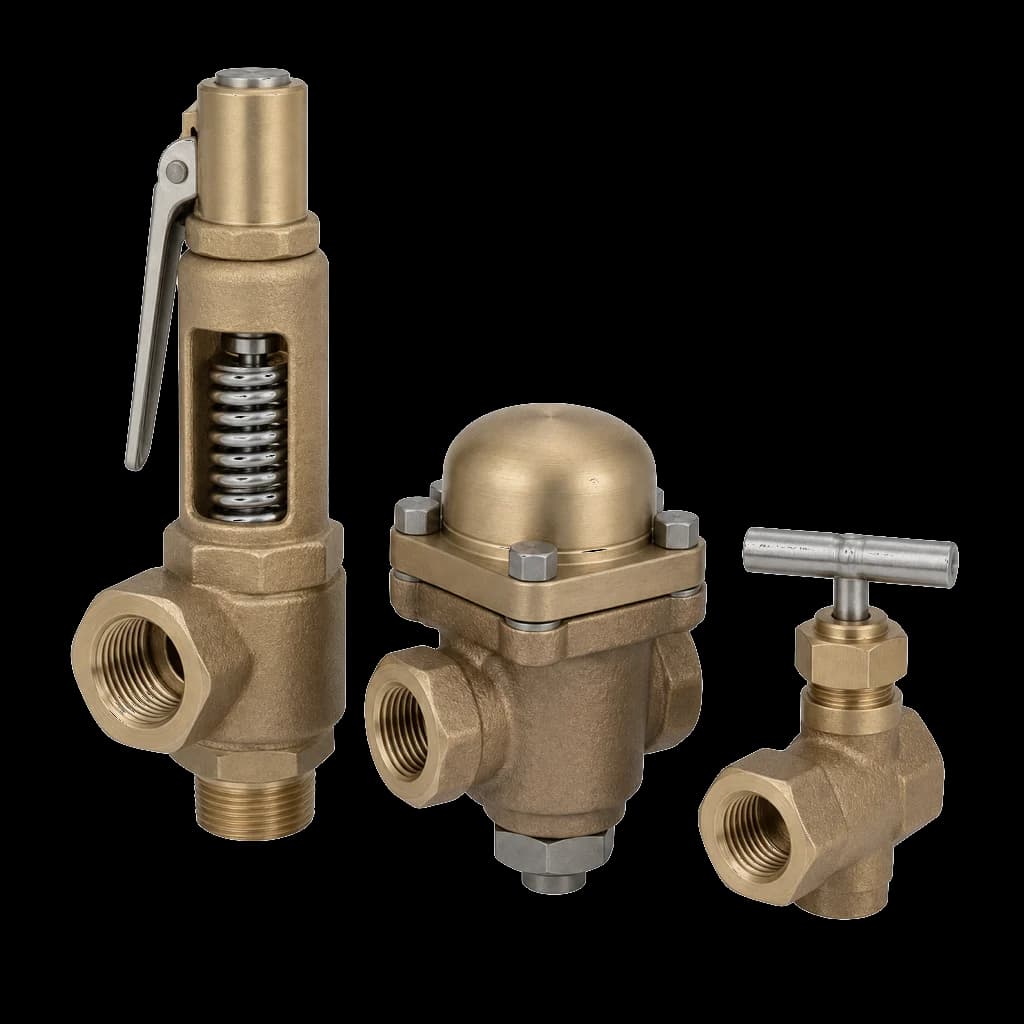
The Indian market splits the same way. Small-bore bronze and stainless screwed strainers for instrument, steam and potable duty come from the Atam strainer range, which also carries moisture separators for steam headers. Flanged Y and T patterns for water mains, WTPs and HVAC service sit in the Kartar range — PN 1.0 in cast iron, PN 1.6 in ductile. Cast steel, stainless and duplex bodies in Class 150 to 900 and up to 24" are ZED Y-strainers. Match the screen grade to the body: a CF8M body with a 304 screen is a specification error.
Orientation, blowdown and access
Orientation is where good strainers get ruined on site. On a horizontal liquid line the pocket points downward, so gravity carries debris into it and the blowdown clears it. On a horizontal steam or gas line rotate the strainer so the pocket lies horizontally to one side: a pocket hanging down on steam fills with condensate, drowns part of the screen and eventually throws a slug of water downstream. In a vertical line the flow must be downward — a Y-strainer in upflow returns its catch to the line. The same rule runs through steam service valve selection.
- Blowdown: specify a valve, not a plug, wherever cleaning is more than occasional. It clears loose sediment; it does not clean a fine liner, which still has to come out.
- Access: the screen withdraws along the axis of the pocket; leave that clearance in the layout or the first cleaning becomes a spool removal.
- Face-to-face is not standardised. ASME B16.10 covers valves, not strainers, and makers differ — get the certified GA drawing before the spool is fabricated.
- Magnetic inserts earn their keep on boiler feed and condensate return, where the fouling is ferrous scale a coarse screen passes straight through.
- Tracing: trace the pocket as well as the line, or it becomes the cold spot where condensate collects.
Specifying a Y strainer in an Indian enquiry
A strainer has no seat, so there is no seat leakage test — a clause demanding API 598 seat testing tells the vendor the spec was pasted from a valve document. Ask instead for a body hydrostatic test at 1.5 times the 38 °C rating, the basis on which valve shells are tested. On PSU and EPC orders expect EN 10204 3.1 certificates for the body casting and, separately, for the screen — the screen certificate is the one most often missing at inspection.
- Size, rating (PN or ASME class), end connection and flange standard — IS 1538 drilling for CI and DI, ASME B16.5 for steel.
- Body and cover grade written out in full, plus gasket and bolting material.
- Screen: material grade, perforation in mm or aperture in microns, whether a mesh liner is required, and the open area ratio expected against the bore.
- Design flow, fluid and temperature, so the vendor returns a calculated clean Δp rather than a catalogue figure.
- Blowdown size, whether a blowdown valve is included, and DP tappings where rotating equipment is guarded.
- Documentation: EN 10204 3.1 MTCs for body and screen, hydrotest report, GA drawing, and IBR Form III-C where the line is boiler-connected. The enquiry format is in how to write a valve RFQ.