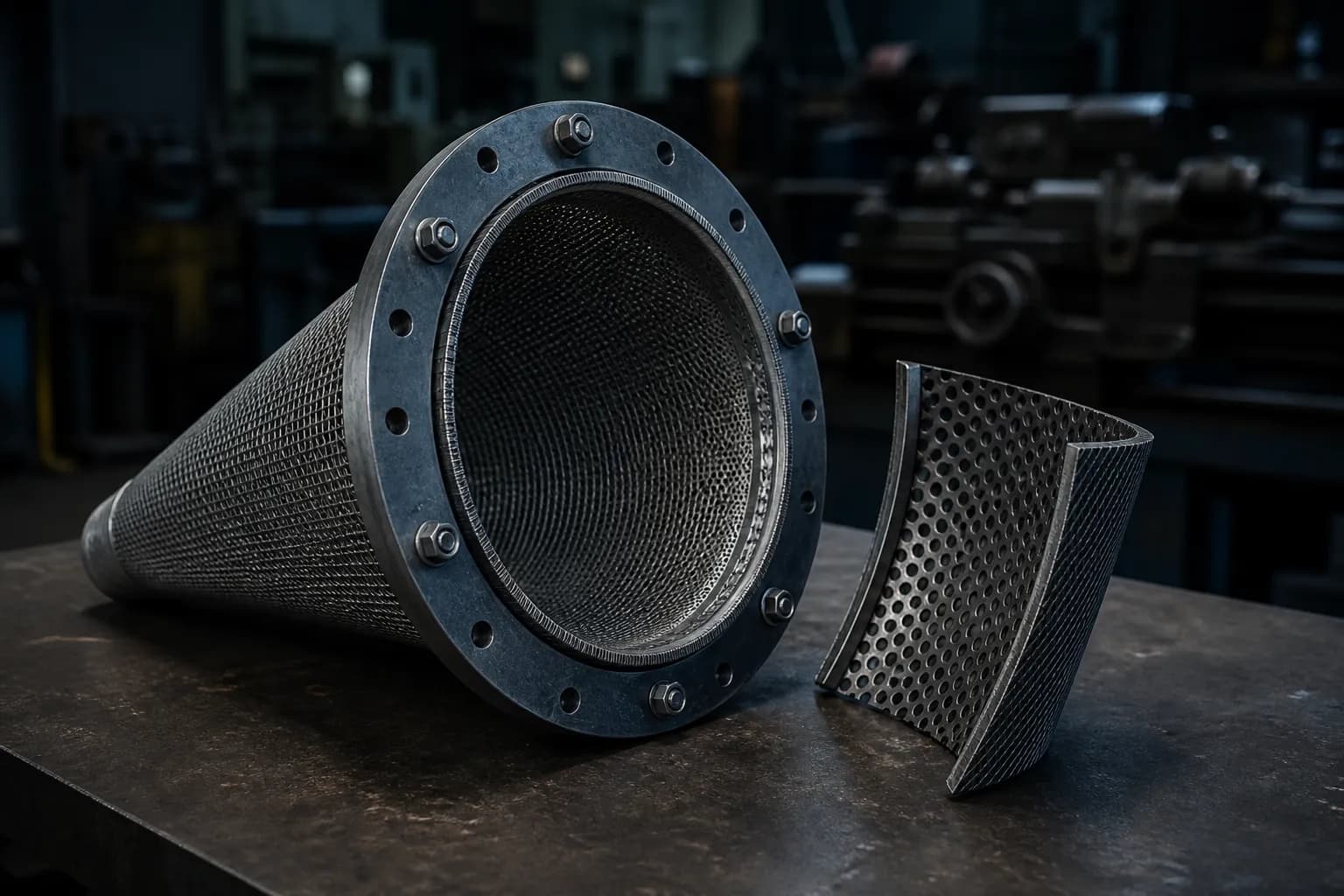
A suction strainer is the last thing between an impeller and everything the erection contractor left in the line — weld spatter, grinding dust, electrode stubs, gasket offcuts, cotton waste, occasionally a spanner. This is also the one screen installed where pressure loss is genuinely expensive: every millibar it consumes comes straight out of available NPSH, and a pump that cavitates from its first hour of running is rarely diagnosed as a strainer problem. Too fine and you starve the pump; too coarse and the impeller ingests exactly what the screen was bought to stop.
Why a suction strainer is not a Y-strainer
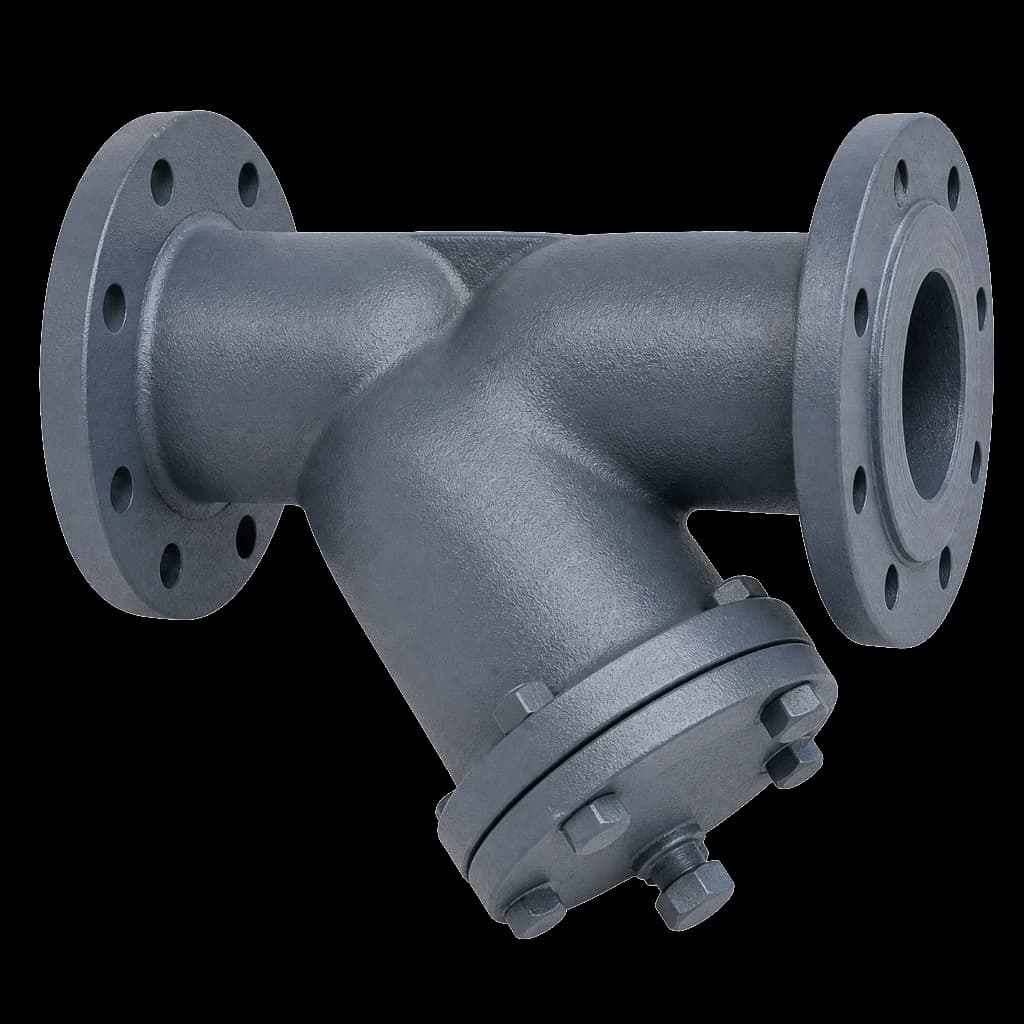
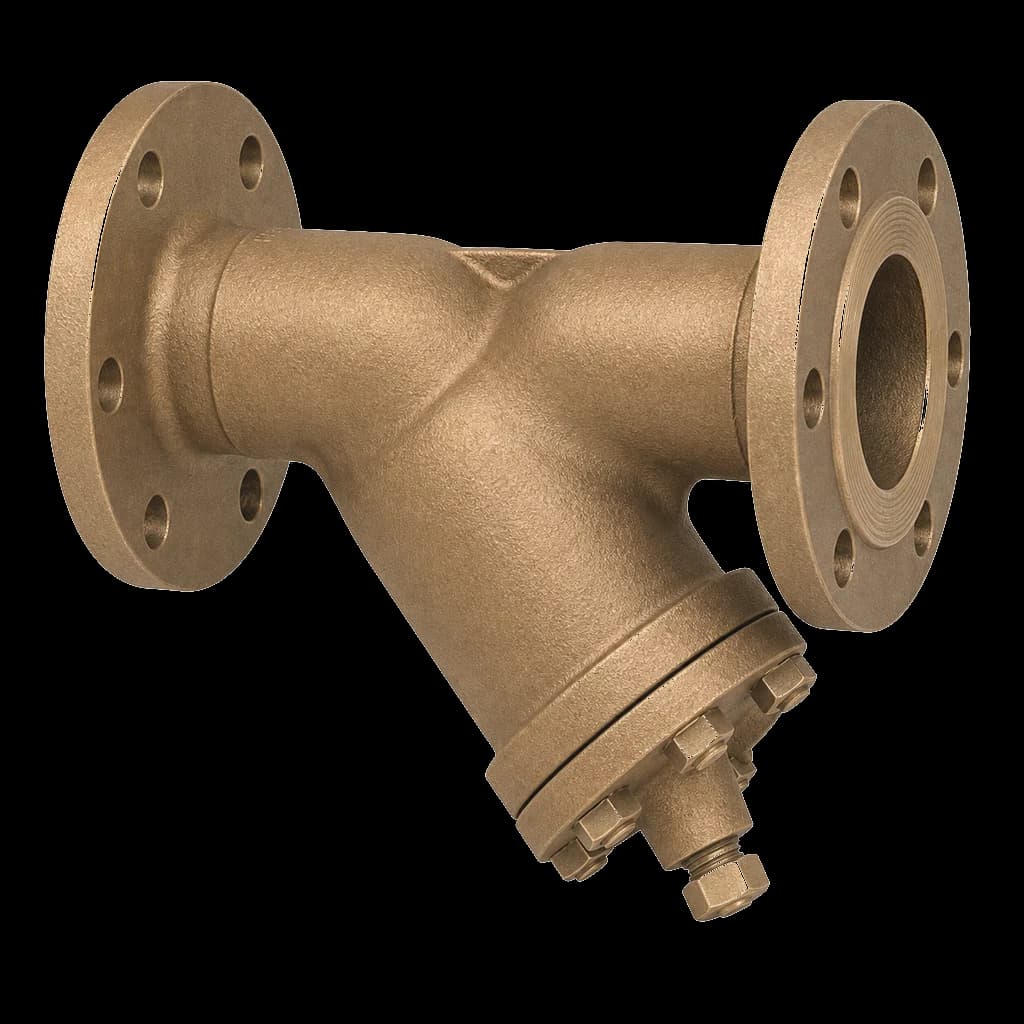
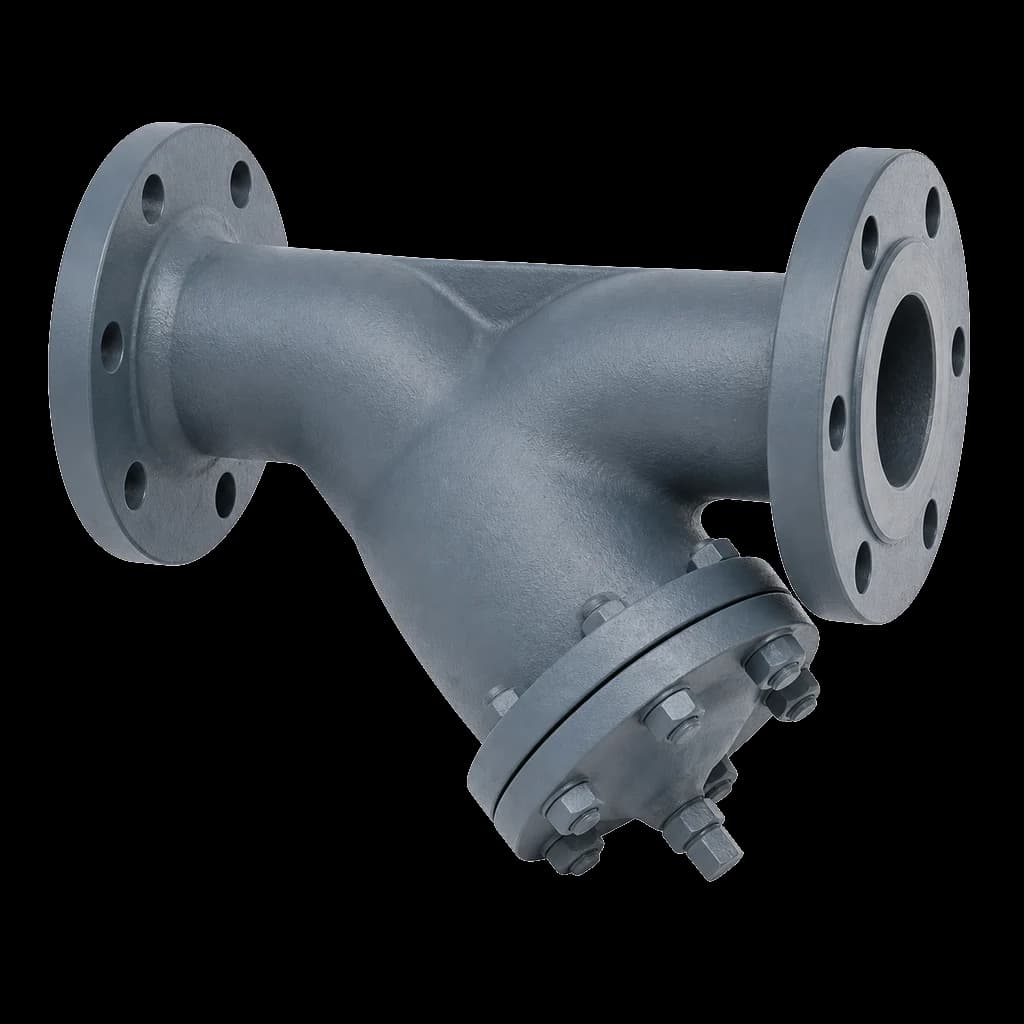
The Y-type strainer is the default in-line screen for steam, gas and pumped discharge lines, and the wrong instinct at a pump suction. Its screen area is modest relative to the line size, which caps the open-area ratio it can offer. The suction line itself imposes rules: no high points where air can collect, eccentric reducers flat side up, velocity around 1 to 2 m/s on water. A Y body with its pocket turned up breaks the first; turned down, it becomes a sediment trap directly upstream of the impeller.
The strainer types that belong at a pump suction
Temporary conical (start-up) strainers
The witch's-hat cone clamped between the suction flange and its mating flange is a commissioning tool: made to your drawing in 304 or 316 cloth over a perforated carcass, trivial against the pump it protects, and meant to come out. Orientation is not optional. The usual basket-type fit points the apex downstream, so flow enters the open base and debris collects inside the cone, with the wire cloth on the dirty face and the perforated carcass behind it — differential pressure then presses the cloth into its support instead of lifting it off. Check the arrow against the installation sheet before the joint is torqued. Reversed, or supplied with no collapse rating, the cone eventually arrives at the impeller in pieces.
Basket and pot strainers
A basket strainer carries a cylindrical element in a vertical pot under a bolted or davit-hinged cover, so the basket lifts straight out without disturbing the pipe. It is the permanent answer wherever cleaning is frequent: raw-water intake, ETP and STP transfer, cooling-tower circulation, DG-set fuel supply. The pot is what buys open area — several times the screen surface of a Y element in the same line size — and the body is often a size or two larger than the line, with reduced end flanges.
Suction diffusers
A suction diffuser combines elbow, strainer and flow straightener in one casting bolted to the pump flange, common in chilled-water plant rooms and tight services pump houses because it saves a metre of straight pipe. That convenience costs NPSH, and the fine start-up insert supplied inside one is routinely left in for years. On suction lift, on hot water, or wherever the margin is thin, do not use one.
| Type | Where it belongs | Watch out for |
|---|---|---|
| Temporary conical | Flushing and initial run-in of a new pump | Collapse rating; left in permanently |
| Basket / pot | Permanent duty on dirty water, effluent, fuel, oil | Open area quoted on the carcass only |
| Duplex / changeover | Lines that cannot stop for cleaning | Venting the standby chamber |
| Suction diffuser | Space-limited HVAC and services pump rooms | NPSH cost; screen never removed |
Mesh, perforation and what the numbers mean
Mesh number counts openings per linear inch, which is not the same as an aperture: the gap left between the wires depends on wire diameter, so 40-mesh cloth from two suppliers can differ measurably in aperture and materially in open area. Specify the aperture in microns alongside the wire diameter, quote the mesh number only as a convenience, and ask for the cloth designation to IS 460 (Part 1) or ASTM E11 in the offer. Screen material is stainless — 304 for water and general service, 316 for chlorides, effluent and coastal sites — even when the body is cast iron. A galvanised or mild-steel screen corrodes, sheds, and becomes the debris.
| Mesh or perforation | Nominal aperture | Typical suction-side duty |
|---|---|---|
| 1/8" perforated plate | 3.2 mm | River and reservoir intakes; sewage and sludge |
| 1/16" perforated plate | 1.6 mm | Clarified water, cooling tower, firewater suction |
| 20 mesh | 850 µm | General cooling water, condensate, boiler feed transfer |
| 40 mesh | 425 µm | Fuel oil, lube oil and hydraulic feed pumps |
| 60 mesh | 250 µm | Fine oil service; start-up screens on close-clearance pumps |
| 100 mesh | 150 µm | Seal-flush and instrument take-offs, with generous open area only |
Pick the aperture from what you are protecting, not from what happens to be in the water. Find the smallest running clearance downstream — wear ring, seal flush port, minimum-flow orifice — and stay comfortably under it; half is the usual working rule. Anything finer is a blockage waiting to happen; anything coarser is decoration.
The two-layer element
Most permanent elements are a perforated carcass lined with wire cloth: the plate carries the collapse load, the cloth does the straining. The two act in series and both cut flow area. A 3 mm plate on 5 mm staggered pitch is about one-third open, and 40-mesh cloth of ordinary wire diameter is roughly a third open too; multiply them and about one-eighth of the gross surface actually passes water. Insist on the net free area of the assembled element, carcass plus liner. A supplier quoting the bare carcass overstates the usable area by close to threefold.
Open-area ratio: the number that decides the job
Open-area ratio is net free screen area divided by the pipe's cross-sectional area. It separates a strainer that is a maintenance chore from one that is a cavitation source, and most quotations leave it out. Practice varies by maker and by EPC standard, so the ratios below are representative rather than mandatory.
| Application | Representative ratio | Comment |
|---|---|---|
| Temporary conical start-up screen | Around 3:1 to 5:1 | Fine mesh, short life, sized to foul heavily before it starves the pump |
| Permanent basket or pot strainer | 4:1 and upward | A larger pot, or a body a size up from the line, is what buys the ratio |
| Suction diffuser | Maker's published figure, cylinder only | The fine start-up insert is extra loss; verify the curve at rated flow |
- Work in net area, not gross. Gross surface times perforation open percentage times liner open percentage is the honest number. Ask for it in writing.
- Size the body, not the line. If the ratio does not come out, the fix is a bigger pot — not a coarser mesh chosen after the pump is ordered.
- Give the element a collapse rating, and ask for reinforcing ribs on large-bore baskets and cones.
- Instrument it. A gauge each side, or a differential gauge, plus a compound gauge on suction lift. A strainer nobody can read is a strainer nobody cleans.
What a suction strainer costs you in NPSH
NPSHa is absolute pressure at the source plus static head, minus vapour pressure, minus every friction loss up to the suction flange. The strainer sits in that last term. NPSHr on the datasheet — NPSH3 under API 610 / ISO 13709 — is the head at which the pump has already lost three per cent of its developed head, so it is a test point, not a safe operating point. The difference between the two is the margin you are spending, and ANSI/HI 9.6.1 is the reference for how much of it to carry. The field mistake is universal: the margin gets sized against a clean strainer.
- Calculate NPSHa twice, clean and fouled. Specifications differ on the fouled case: some assume fifty per cent blocked, others a stated multiple of the clean differential.
- Cold water forgives. Hot condensate, deaerator feed, LPG, ammonia and anything near its vapour pressure do not — there the strainer differential is the whole argument.
- On suction lift the loss adds directly to the lift, at the worst moment: first start, when the screen is catching construction debris.
- A strainer fouling fast in the first weeks is a commissioning finding, not a maintenance one. Log the differential from day one so a trend exists.
The sequence is: fix the aperture from the clearance you are protecting, then buy open area until the fouled differential fits inside the NPSH margin. If it will not fit, the answer is a larger pot, or a coarse permanent screen with a fine element fitted only during flushing. What it is not is a pump ordered against a clean-strainer NPSHa.
Start-up screens and when to pull them out
Every plant with a commissioning history has the impeller photograph. The debris that produces it arrives in the first days of running: flushing water, hydrotest residue, mill scale, whatever survived pickling. Fit the fine cone for flushing and run-in, read the differential daily, clean until two consecutive cleanings come out clean, then decide deliberately — pull it, or fit a permanent basket. The failure nobody plans for is the cone left in by default: it fouls, the differential climbs past its collapse rating, and the screen goes downstream in fragments worse than the dirt it caught.
Pump houses drawing from an open source — sump, canal, reservoir, firewater tank fed with raw water — need screening at the intake as well: a foot valve with an integral strainer on a suction-lift set, or a coarse intake screen ahead of a flooded suction. Foot valve versus NRV at the pump suction works through that choice. In a fire pump house the rule inverts: the suction stays as unobstructed as the code and the certifying authority allow, so the screen is coarse, the open area generous, and the arrangement agreed with the inspecting agency before pipework is fabricated — see the fire fighting valves guide.
Duplex and changeover strainers for continuous duty
Where the pump cannot stop — DG-set and boiler fuel supply, turbine and compressor lube oil, continuous effluent transfer — a single strainer forces a choice between running dirty and shutting down. A duplex strainer puts two chambers under one changeover valve, so one basket is cleaned while the other carries flow. Four things belong in the enquiry: changeover under full flow; a vent and a drain on each chamber, so the standby side is filled and de-aerated before it takes over — switching a suction line onto an air-filled chamber is how a pump is lost; a differential gauge or switch across the pair; and identical elements both sides, so the spare is one part number.
Specifying it so the quote comes back right
- Line size, rating, flange facing and drilling standard — ASME B16.5 Class 150/300, or IS 1538 drilling for cast-iron water lines. Say which; they do not interchange.
- Body material: cast iron for cold water, ductile iron where the line is DI, WCB for steam and hydrocarbons, CF8M for effluent and coastal duty, bronze or gunmetal for potable service.
- Screen material and aperture in microns, wire diameter, and the carcass hole size and pitch.
- The net open-area ratio you require, written into the enquiry rather than left to the bidder.
- Design differential for the element, and the maximum clean differential you accept at rated flow, with a loss curve.
- Fluid, temperature, rated and maximum flow, and the NPSH margin available. A strainer quoted without a flow rate is a guess.
- Cleaning and documentation: cover type, drain and vent sizes, material test certificates, hydro test report, and an element drawing with net free area marked.
In Indian EPC and PSU tendering, suction strainers fall into the gap between the pump package and the piping BOQ — the pump vendor assumes piping supplies them, the piping contractor assumes the pump vendor does, and at commissioning nobody has a spare element. Put them in one scope explicitly, order the spare basket with the strainer, and write the mesh into the enquiry. Our note on writing a valve RFQ that gets a firm quote applies to strainers unchanged.