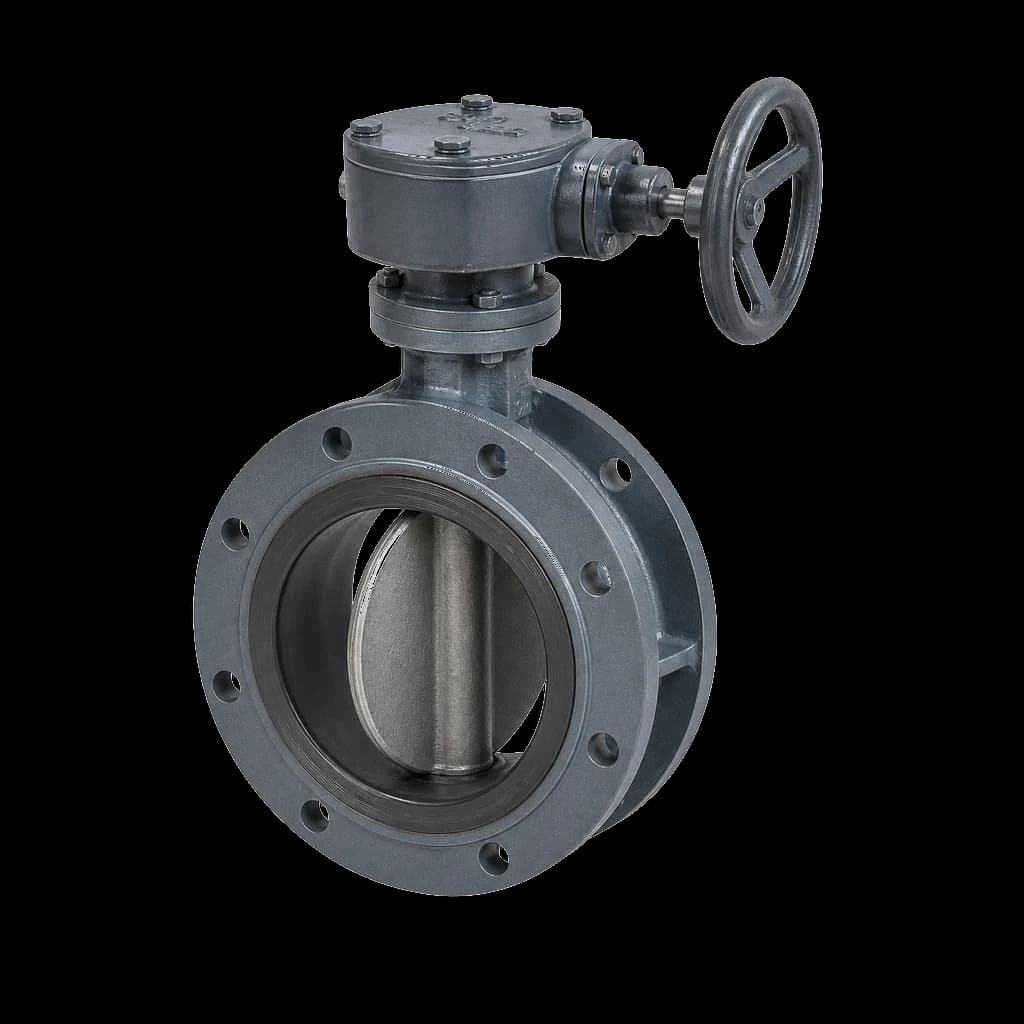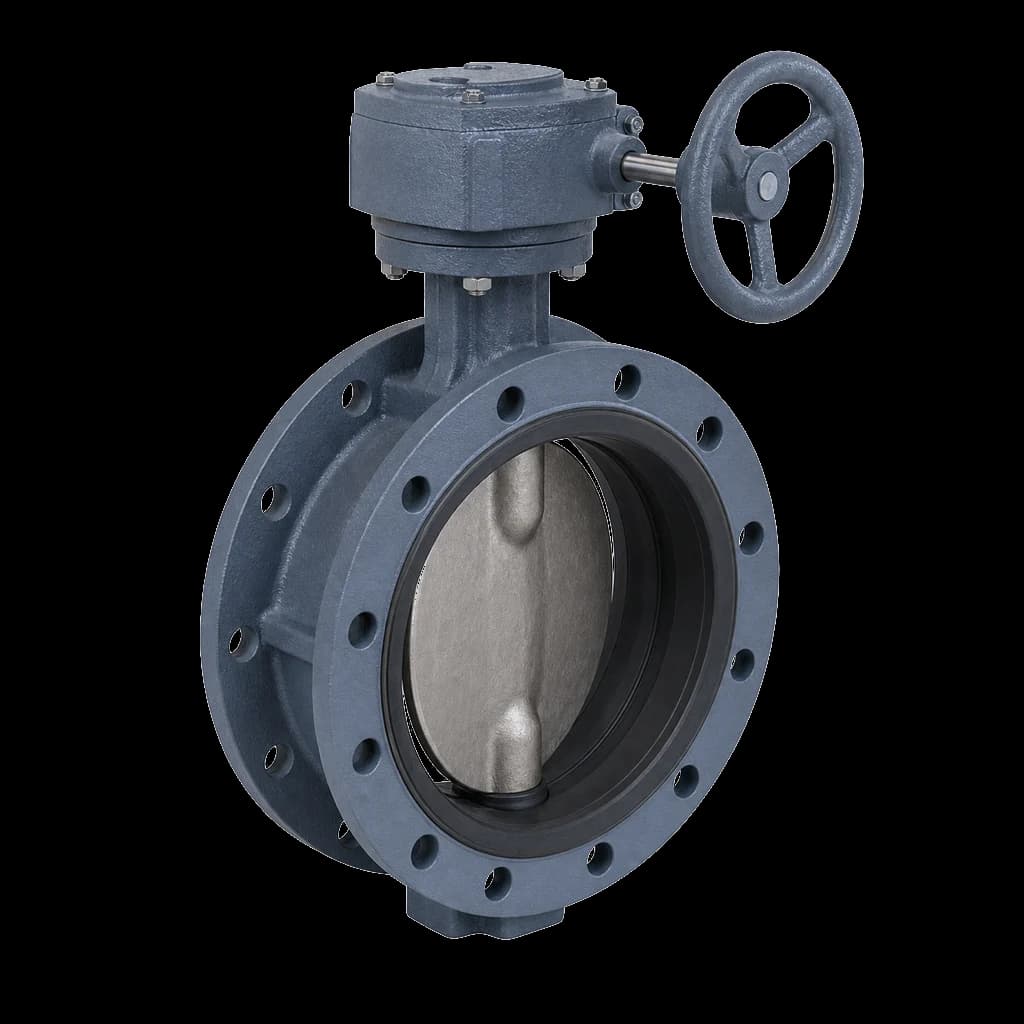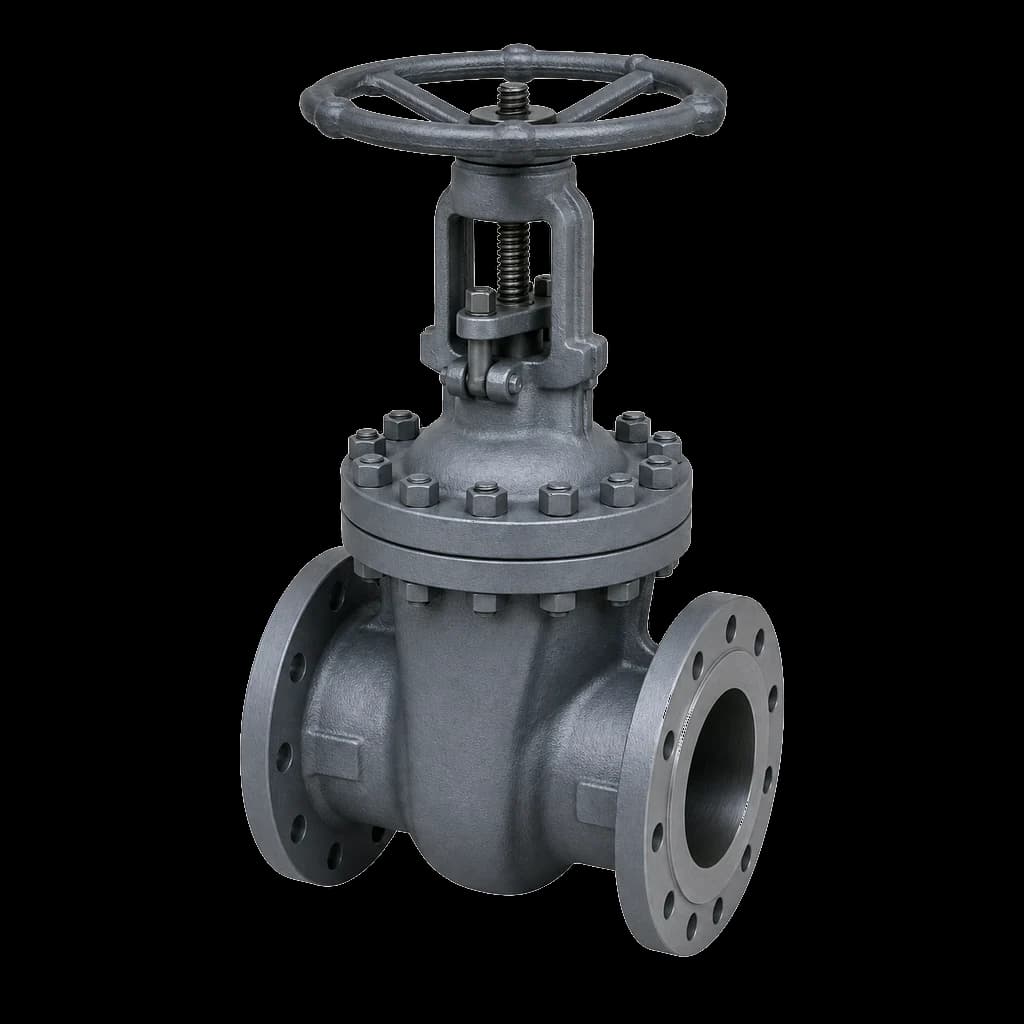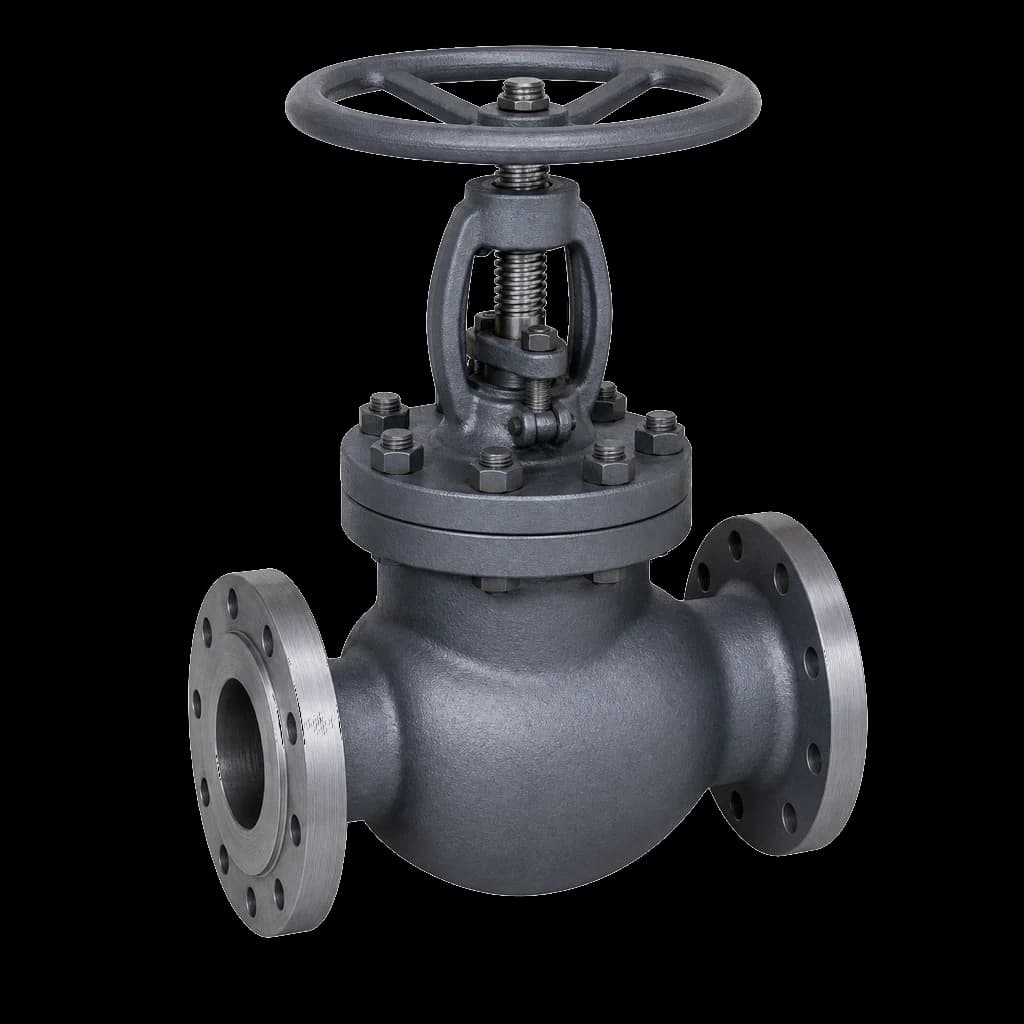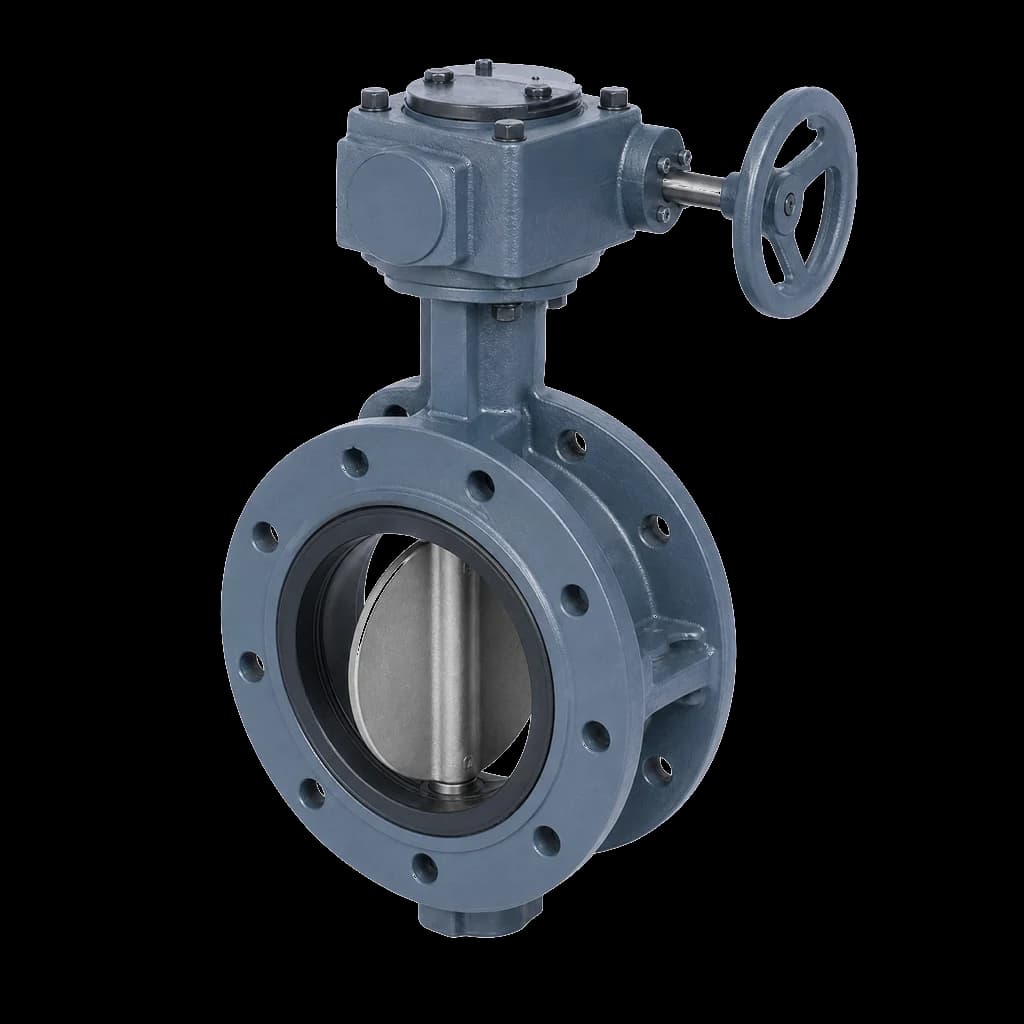
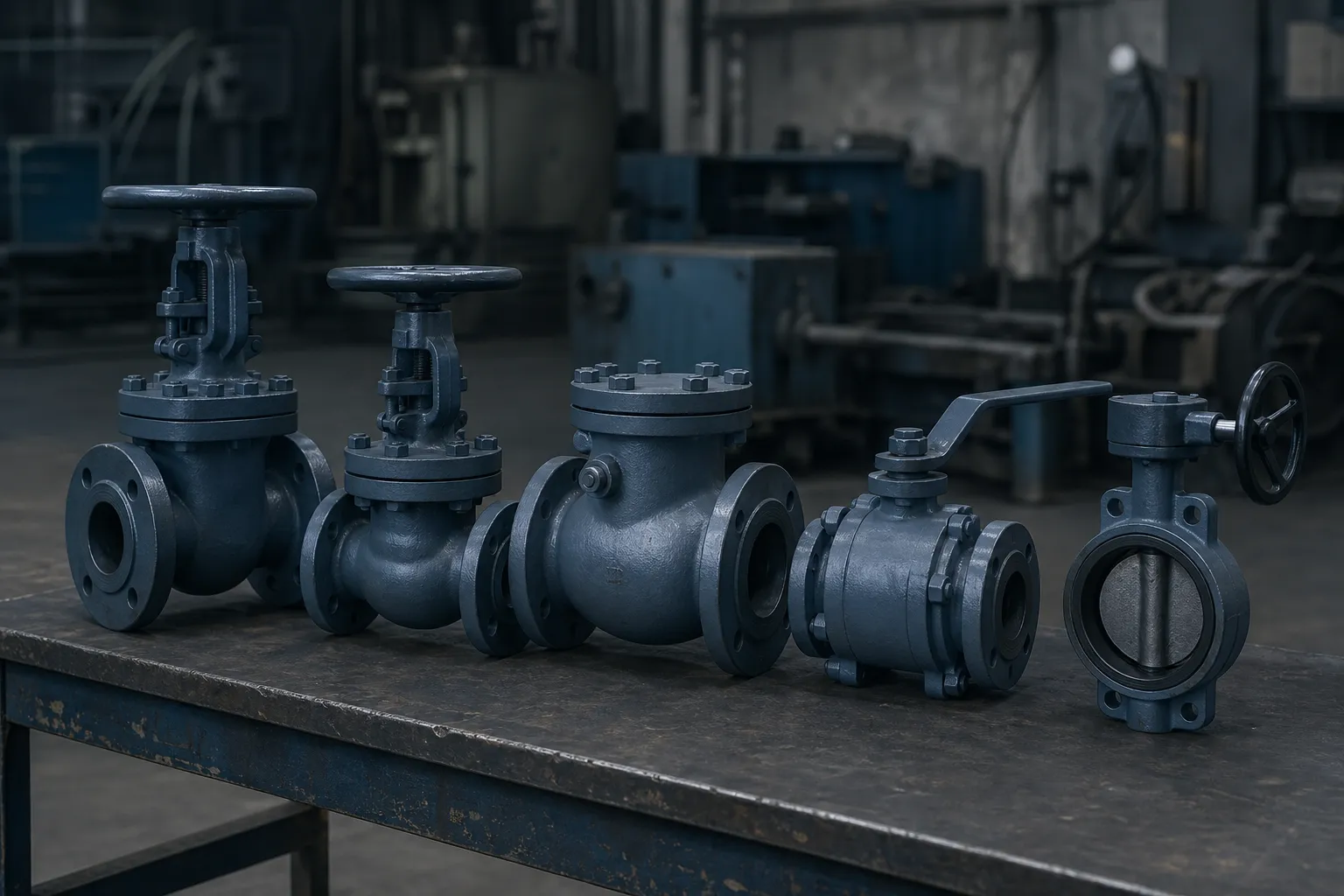
Two lines in an enquiry decide whether a large valve arrives usable, and neither is the body material: operator type and operator size. A gear operated butterfly valve and a gear operated gate valve of the same DN do not take the same gearbox and cannot be swapped on site. The butterfly turns 90 degrees and wants a worm box; the gate turns dozens of revolutions and wants a bevel box. Write the wrong one into a tender and the valve either cannot be closed by hand or cannot be opened at all.
Where the lever stops working
Manual operation is arithmetic, not opinion. Stem torque equals the force at the operator times the radius at which it acts. A 200 mm lever gives roughly 0.2 m of leverage, so a sustainable 360 N pull is about 72 N·m at the stem. Break-to-open torque on a rubber-lined concentric disc climbs steeply with size, because the disc must peel out of an interference-fit liner — and by DN200 at any real dP you are past what one person delivers in one clean movement.
The rim pull rule everyone quotes
MSS SP-91, "Guidelines for Manual Operation of Valves", is the document most specifications lean on, and its shorthand figure is a maximum rim pull of about 360 N (80 lbf) from one operator at the handwheel rim. Project specifications often set a lower figure, so settle which number applies before arguing about handwheel diameter.
- Lever handles on butterfly and ball valves are practical to about DN150. Most Indian brands list the lever as optional at DN200 and go gear-only from DN250.
- Bare handwheels on gate and globe valves get unwieldy past roughly 600 mm diameter. A bigger wheel is not the fix: it fouls adjacent piping and invites cheater bars.
- Cheater bars are the real failure mode. A metre of pipe on a lever puts far more torque through the stem, key and lever boss than any was designed for. Sheared stems on DN200 butterfly valves usually start there.
- Differential pressure, not size, is the trigger. A DN200 butterfly at 1 bar dP may still be leverable; the same valve on a pump discharge at 10 bar is not. Size the operator at the worst dP the valve will ever see, including opening against an empty downstream line at commissioning.
Worm gearboxes: the quarter-turn standard for gear operated butterfly valves
A quarter-turn worm gearbox is a hardened steel worm driving a bronze or aluminium-bronze wheel through a limited 90 degree sector, inside a grease-packed cast iron or ductile iron housing. It is the default above the lever range on butterfly, ball and plug valves, for three reasons.
- It is self-locking. The worm's low lead angle stops flow torque back-driving the input shaft, so the disc holds position with no external latch — which a quarter-turn valve needs, having no stem thread to hold it.
- It carries adjustable travel stops. The open and closed stops set the 90 degrees precisely, so a resilient-seated disc reaches the liner without over-travelling into it. AWWA C504 rubber-seated valves require the operator to carry them.
- It gives fine position resolution. Tens of handwheel turns spread across 90 degrees let the disc be parked at 40 degrees and left there. A throttled butterfly valve should always be geared, never levered.
Check the throttling case separately. Seating and unseating torque usually governs at the ends of travel, but hydrodynamic torque peaks well off the seat — commonly in the 60 to 80 degree open region, depending on disc profile and velocity. For a regulating duty, ask for the torque-versus-angle curve. Disc geometry drives all of it: the butterfly valve types guide sets out where concentric, double-offset and triple-offset discs belong.
Bevel gearboxes: multi-turn gate and globe valves
A rising-stem gate or globe valve turns as many revolutions as the stem lead needs to drive the disc across the port. Fit a quarter-turn worm box and nothing works — the sector runs out. The answer is a multi-turn bevel gearbox: spiral bevel gears turning the input through a right angle, so a vertical stem is driven by a handwheel an operator can reach standing beside the valve. Where the input must stay parallel to the stem, a spur gearbox does the same job.
Bevel ratios run 2:1 to 6:1 in one stage, higher in multi-stage boxes, and that is the whole trade: rim pull divides by the ratio, turns to close multiply by it. A DN300 Class 150 gate valve needing roughly forty turns bare needs well over a hundred through a 3:1 box, which operations notice on a valve cycled every shift; a larger handwheel on a lower ratio is often the better answer. A bevel box is not itself self-locking — the gate valve holds position through its own acme stem thread, which is why it cannot be borrowed for a quarter-turn valve.
- Confirm gearbox rated torque carries a margin over the valve's maximum breakout torque at design dP — 1.25 to 1.5 times is the usual ask.
- Pin down the stem connection: bore, keyway and thread class. A bevel box mated to the wrong stem nut is a scrap item, not a rework item.
- For globe valves, thrust scales with seat area times dP, so a globe is a heavier manual job than a gate of the same size; gearing arrives earlier.
When a gearbox stops being optional
Brands publish different ranges, but Indian tender practice clusters tightly enough to be a useful first pass. Confirm the brand's chart before freezing a bill of materials.
| Valve and class | Lever or bare handwheel | Gear operator normally supplied |
|---|---|---|
| Butterfly, PN 10 / PN 16 / Class 150 | Up to DN150 | DN200 and above |
| Butterfly, high dP or throttling duty | Not recommended | DN100 and above |
| Gate and globe, Class 150 | Up to DN250 | DN300 and above |
| Gate and globe, Class 300 | Up to DN200 | DN250 and above |
| Gate and globe, Class 600 | Up to DN150 | DN200 and above |
| Gate and globe, Class 900 and above | Up to DN100 | DN150 and above |
| CI sluice valve to IS 14846 | Up to DN300 | DN350 and above, or any buried valve |
The second row is the one people miss. Size is a proxy for torque, not a substitute for it: a DN150 valve throttling a high-velocity line outruns a lever long before the size table says so. Gear on duty, not on DN. For the prior question of which body style belongs in the line at all, start from gate vs globe vs ball valves.
Matching the gearbox to the valve
| Valve type | Stem travel | Usual gearbox | Watch out for |
|---|---|---|---|
| Butterfly — concentric or offset | Quarter-turn | Worm, self-locking | Stops set to the liner; torque curve for throttling |
| Ball — floating and trunnion | Quarter-turn | Worm, self-locking | Trunnion torque is lower at size; do not oversize |
| Gate — OS&Y rising stem | Multi-turn | Bevel, or spur for parallel input | Turns to close multiply; stem protector length |
| Globe — T, Y and angle pattern | Multi-turn | Bevel | Highest thrust per DN; gear earlier than gate |
| CI sluice valve, non-rising stem | Multi-turn | Bevel or spur, often cap top | Buried duty needs a sealed, grease-filled housing |
Chainwheels, extended spindles and buried service
Access, not torque, drives the third family of operator. Most plant specifications call for a chain operator once the handwheel centreline sits more than about 2 m above the operating platform, with the chain hanging to roughly 1 m above floor level. The chain is an access device, not a torque multiplier: it lets an operator haul with body weight instead of arm strength, and stems do get twisted off small valves that way. Where torque is the problem, gear the valve and fit the chainwheel to the gearbox handwheel.
- Extended spindles bring the operator up from a valve in a pit or trench. State spindle length from valve centreline to operating floor, guide brackets, and whether a floor stand or surface box terminates it.
- Buried valves in water and CGD networks need a sealed, grease-filled gearbox rated IP68 rather than the IP67 that suits above-ground service, plus cap top, extension spindle and surface box — standard practice on large IS 14846 sluice valves.
- Hot service in steel plants and boiler houses needs the gearbox clear of the body. Ask about a stem extension and the grease temperature rating; ordinary lithium grease migrates out of a box bolted to a hot header.
From handwheel to actuator: mounting pads
Plenty of gear operator enquiries are automation enquiries in disguise: the valve will be motorised later. Get the interface right at purchase and the retrofit is a bolt-on. Quarter-turn valves and their worm boxes use ISO 5211 flanges — F05, F07, F10, F12, F14, F16 upward — with a defined pitch circle and drive square; multi-turn gate and globe valves use ISO 5210. Put the flange designation and stem drive dimensions in the enquiry: a non-standard cast-in pad locks you into one supplier's actuator. The ISO 5211 mounting pad guide carries the dimensional detail.
Specifying the operator in an RFQ
Operator scope is a standing source of post-award variation: tenders say "gear operated" and stop there. Seven lines close the gap.
- Valve type, size, class and body standard — API 600 or IS 14846 for the gate, API 609 or IS 13095 for the butterfly. The API 600 vs API 602 comparison covers which gate standard applies at your size.
- Maximum differential pressure at which the valve must break open, stated separately from line pressure.
- Operator family in words — quarter-turn worm gearbox or multi-turn bevel gearbox — never just "gearbox".
- Handwheel diameter and the maximum rim pull the operator must not exceed.
- Direction to close, position indicator, travel stops, and a locking arrangement if the valve is car-sealed.
- Enclosure protection: IP67 above ground, IP68 buried, submerged or wash-down.
- ISO 5211 or ISO 5210 flange designation, chainwheel, extended spindle length and floor stand where access demands them.
Ask for calculated valve torque and gearbox rated torque as two separate numbers on the offer. A vendor who will not put both on paper has not done the calculation.