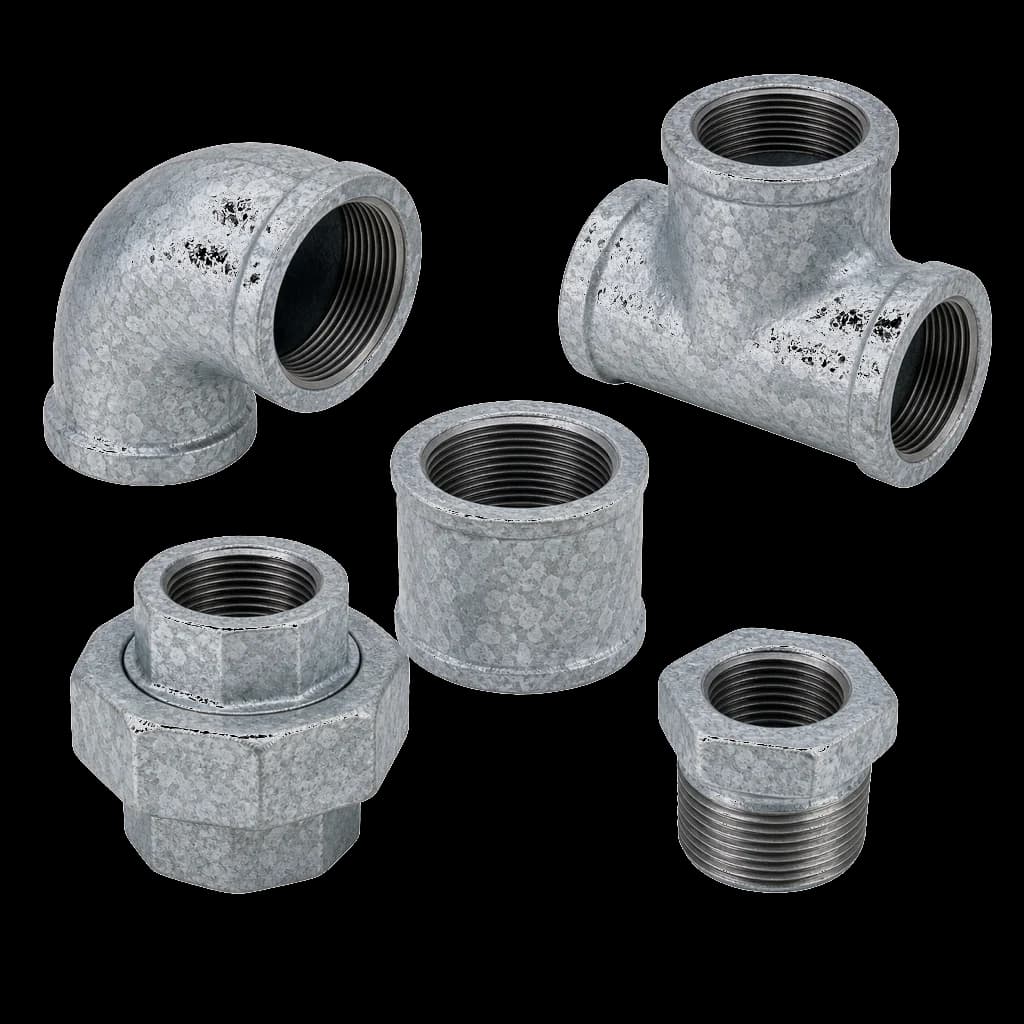
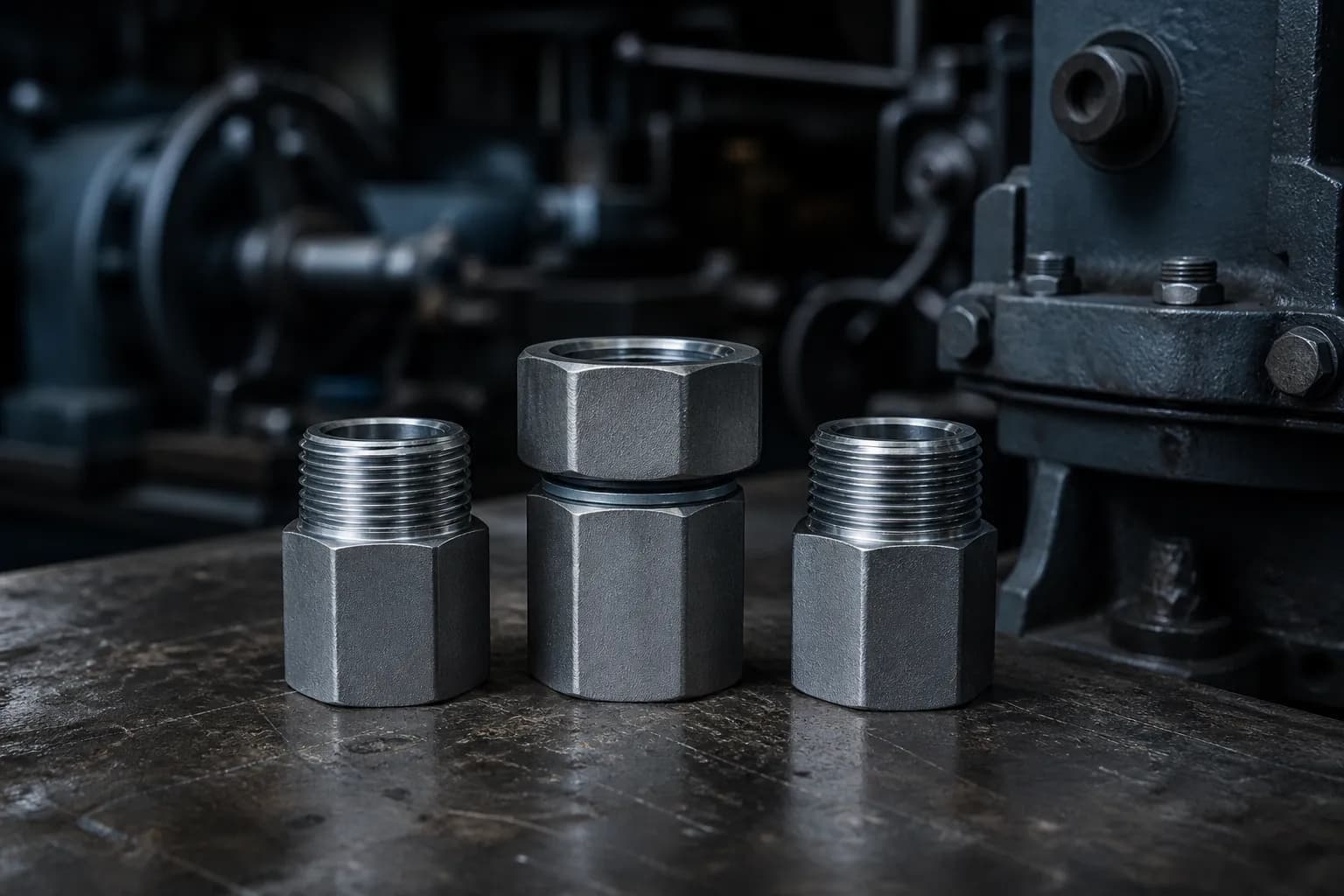
Two pipe threads can share a nominal size, an identical pitch and a pitch diameter two hundredths of a millimetre apart — and still make a joint that weeps for the life of the plant. That is the BSPT vs NPT thread problem: the American 60° taper and the British 55° Whitworth taper start by hand, feel solid on a wrench and never bed down on the flanks. On instrument hook-ups, gas risers and utility headers it causes the leak nobody can account for, precisely because the fitting went in without complaint.
Two families, two flank angles
Almost every screwed connection belongs to one of two families, standardised on opposite sides of the Atlantic and never reconciled. American threads carry a 60° included flank angle with flat, truncated crests and roots; British threads are Whitworth, 55° included, crests and roots rounded to a radius. Both taper at 1 in 16 on diameter, which is why they look interchangeable across a stores counter.
The American family: NPT, NPTF and NPSM
NPT to ASME B1.20.1 dominates oil and gas, refinery and instrument work. Its basic thread height is 0.8 × pitch, and it does not seal by itself: flat crests stand clear of flat roots, leaving a helical path that sealant has to fill. NPTF (ASME B1.20.3, "Dryseal") closes that path by design — crests interfere with roots and crush on assembly — which is why it turns up on hydraulic work. NPSM is the parallel member: a mechanical-joint thread that seals on a gasket or a seat, never on the thread.
The British family: R, Rc, Rp and G
"BSP" on a drawing is a family name, not a specification, and that ambiguity starts as many disputes as the 55/60 split. R is the external taper of ISO 7-1 (IS 554 in India) — what everyone means by BSPT. Rc is its internal counterpart. Rp is an internal parallel thread that ISO 7-1 deliberately allows to take an R male, and it sits inside a great many Indian screwed valve ends. G is ISO 228-1 — BSPP — parallel, and a fastening thread with no sealing pretension. Rp and G share basic dimensions; they differ in tolerance and intent.
BSPT vs NPT thread geometry: 55° against 60°
Flank angle decides the joint. A 5° mismatch puts the flanks in line contact instead of face contact: stress concentrates, the female is wedged open, and a connection that felt sound on the wrench relaxes on the first thermal cycle. Pitch tells the rest of the story — and hides the trap.
| Nominal size | NPT (ASME B1.20.1) | BSP (ISO 7-1 / IS 554) | Pitch, NPT / BSP (mm) | Cross-family fit |
|---|---|---|---|---|
| 1/8" | 27 TPI | 28 TPI | 0.94 / 0.91 | Binds |
| 1/4" | 18 TPI | 19 TPI | 1.41 / 1.34 | Binds |
| 3/8" | 18 TPI | 19 TPI | 1.41 / 1.34 | Binds |
| 1/2" | 14 TPI | 14 TPI | 1.814 / 1.814 | Assembles, then leaks |
| 3/4" | 14 TPI | 14 TPI | 1.814 / 1.814 | Assembles, then leaks |
| 1" to 2" | 11.5 TPI | 11 TPI | 2.21 / 2.31 | Binds |
| 2-1/2" to 6" | 8 TPI | 11 TPI | 3.18 / 2.31 | Binds |
Where the pitches disagree — 1/8", 1/4", 3/8" and every size from 1" up — a cross-family assembly binds within a turn or two and the fitter goes looking for the right part. At 1/2" and 3/4" both standards settled on 14 TPI, and nothing stops the joint going together.
The 1/2" and 3/4" trap
Take a 1/2" NPT male and an Rc 1/2 female. Pitch is identical at 1.814 mm, both tapers are 1 in 16, and at the gauge plane the pitch diameters lie 0.02 mm apart — 19.77 mm against 19.79 mm. It runs in by hand, takes two or three turns on a wrench and stops with a convincing feel.
The joint that results has its flanks in line contact across a mismatched 55°/60° wedge, with a spiral gap that sealant alone bridges. On cold water at low pressure it may hold for years. On steam, on gas, on an instrument tapping, or on 316 threads that gall as the wedge bites, it will not. The signature failure: passed hydrotest, wept after the first hot run, took another half turn, split the female casting. It joins the other avoidable errors in our guide to valve and fitting procurement mistakes.
The 1/2" NPT thread dimensions in mm: pitch 1.814, taper 1 in 16, 60° flanks, 8.1 mm of hand-tight engagement, 13.6 mm of effective thread, major diameter 20.7 mm at the pipe end rising to 21.2 mm at the gauge plane. R 1/2 to ISO 7-1 shares the 1.814 mm pitch but measures 20.955 mm on the major diameter — a quarter of a millimetre under. Only the flank angle separates the two on a stores counter.
Reading the callout before you cut metal
Every ambiguity in an enquiry becomes a site problem later; these symbols leave none.
| Callout | Standard | Form | Where the seal is made |
|---|---|---|---|
| R 1/2 | ISO 7-1 / IS 554 | 55° taper, external | Thread flanks, with sealant |
| Rc 1/2 | ISO 7-1 / IS 554 | 55° taper, internal | Thread flanks, with sealant |
| Rp 1/2 | ISO 7-1 | 55° parallel, internal | Flanks of an R male, with sealant |
| G 1/2 | ISO 228-1 | 55° parallel (BSPP) | Not the thread — bonded washer, O-ring or cone seat |
| 1/2-14 NPT | ASME B1.20.1 | 60° taper | Thread flanks, with sealant |
| 1/2-14 NPTF | ASME B1.20.3 | 60° taper, Dryseal | Crest-to-root interference; sealant optional |
| 1/2-14 NPSM | ASME B1.20.1 | 60° parallel | Not the thread — a gasket or seat |
What mates, what does not, and what only looks like it does
- R male into Rc female — the intended ISO 7-1 taper-to-taper joint, sealed on the flanks with sealant filling the crest-root path.
- R male into Rp female — explicitly allowed by ISO 7-1 and common on Indian screwed valve ends; engagement length and sealant choice matter more here.
- NPT male into NPT female — the default for anything written to API 602, BS 5352 or a hydrocarbon piping spec; an NPT male in an NPTF female works too, though Dryseal only pays NPTF to NPTF.
- NPT into BSP, either direction — never. It assembles at 1/2" and 3/4" and leaks; at every other size it binds and damages both parts, and a damaged female is scrap.
- Imported skids and instrument packages — check every connection. A packing list reading only "BSP" can mean R, Rc, Rp or G, and Japanese drawings still use PT for taper and PF for parallel.
How a taper thread actually seals
A taper thread is an interference fit, not a gasketed joint. Metal meets metal on the flanks, while truncated crests and roots leave a helical clearance — a leak path until something fills it. On steam, gas and hydrocarbon duty the sealant is a specification item, not a fitter's preference.
- PTFE tape — three to four wraps in the direction of tightening, started a thread or two back so shreds cannot migrate into an orifice or a transmitter manifold.
- Anaerobic sealant — better for gas and for instrument work where tape debris is unacceptable; confirm temperature and media approval first.
- Hemp and jointing compound — normal CPWD and PWD practice on GI water lines and acceptable there; it has no place on steam, gas or hydrocarbon service.
- Turns — hand-tight engagement plus two to three turns with a wrench, NPT and BSPT alike. If it needs six, the thread or the sealant is wrong, and more torque splits the female.
- Never back a taper thread off to line up a gauge face or a handle. Break the joint, clean it, re-tape and remake it.
- Seal-welded joints — where the spec calls for seal welding, threads are made up dry: no sealant, because the weld is the seal.
Identifying an unmarked thread at the stores counter
Three checks settle almost every case. Count the pitch with a thread gauge: 27, 18, 11.5 or 8 TPI is American; 28, 19 or 11 TPI is British. Then — the only test that separates 1/2" and 3/4" — offer the 55° and 60° gauge blades to the thread with a light behind and watch where the gaps fall. Last, run a straight edge along the crests: a parallel G or Rp thread shows no wedge, 1 in 16 gives half a millimetre of diameter over 8 mm.
Where the service is gas, steam or hydrocarbon, prove it with plug and ring gauges and record the result: thread gauging belongs in the ITP for screwed fittings and screwed-end valves.
Indian practice, and what to write in the RFQ
Water, fire-fighting and general utility piping on GI tube follows IS 1239 with threads to IS 554, and the malleable patterns to IS 1879 match — that whole world is BSP, and the classes behind it sit in our IS 1239 pipes and fittings guide. Oil, gas, refinery and instrument work follows the American family: forged threaded fittings to ASME B16.11 with NPT ends, compared in our note on ASME B16.11 and IS 4712 forged fittings, small forged valves to API 602 or BS 5352, gauge tappings at 1/2" NPT. Trouble concentrates at the interface: an imported instrument tapped into an IS 1239 utility header, or a package boiler with European trap ends on an NPT plant.
- Write the thread, never the family: "1/2-14 NPT female to ASME B1.20.1" or "Rc 1/2 to ISO 7-1". A line reading "1/2 BSP" invites a wrong delivery.
- State both ends separately when they differ — adaptors, nipples and bushings are where mixed-thread items legitimately exist, and where they get mis-ordered.
- Call out process and instrument connections independently: a needle valve is routinely 1/2" NPT male process by 1/2" NPT female instrument, as covered in our guide to needle valves for gauge and instrument isolation.
- Check where the spec allows screwed joints at all — hydrocarbon specifications confine them to small utility and instrument connections, with socket weld elsewhere.
- Keep one thread family per system boundary. Where a changeover is unavoidable, make it at a single tagged adaptor and mark it on the P&ID.