Stainless steel is not the same thing as sanitary. Plenty of plants have bolted a polished two-piece ball valve onto a milk line, found a biofilm in the cavity behind the seats a year later, and ripped the loop out. A sanitary valve — hygienic valve, in European usage — is defined less by what it has than by what it does not: no crevice in the product zone, no trapped volume, no thread the cleaning solution cannot reach, no elastomer the caustic cycle attacks. Four decisions settle whether it survives a food, dairy or pharma audit: wetted material, surface finish, drainable geometry and the end connection.
What separates a sanitary valve from a stainless industrial valve
Every rule below descends from one requirement: the wetted surface must be cleanable in place, on the plant's standard CIP cycle, without anybody opening the valve. An industrial valve is designed to hold pressure and shut off; a sanitary valve is designed to be cleaned, which is the harder problem.
- No crevices in the product zone. Gaskets sit in controlled-compression grooves so they cannot extrude into the bore; seats are encapsulated, not dropped into a counterbore; fasteners sit outside the wetted boundary.
- Self-draining geometry. The valve must empty by gravity at the line slope — commonly 1:100 on pharma loops. A pocket holding 20 ml of product holds 20 ml of nutrient broth.
- Documented elastomers. Compound certificates to FDA 21 CFR 177.2600 for rubber and 21 CFR 177.1550 for PTFE, plus USP Class VI for parenteral product. "Food grade" on a packing slip is not a certificate.
- Cleanable outside too. Wash-down duty rules out bolt pockets that hold water and brackets that trap hose spray.
Surface finish: Ra 0.8 µm is the number worth arguing about
Product-contact surfaces must be at least as smooth as a No. 4 finish on stainless sheet — the 3-A requirement, which the industry reads as Ra 0.8 µm (32 µin). That is the entry ticket for food and dairy. It is not automatically the right target for pharma, and it is nowhere near the whole story.
Ra is an arithmetic average; it says nothing about the shape of the profile. A belt-polished surface can measure 0.8 µm and still carry folded-over metal, embedded grit and micro-tears that hold soil through a full CIP cycle. Electropolishing removes a controlled skin of metal, rounds the peaks and leaves a chromium-enriched passive layer, which is why pharma specifications call for it even where the mechanical number complies. Put the finish route on the datasheet, not just the number.
| Service | Typical Ra ceiling | Usual route |
|---|---|---|
| Utilities, CIP return, non-product | 1.2 µm (48 µin) or as-drawn | Mill finish or light grind |
| Food and beverage product contact | 0.8 µm (32 µin) | Mechanical polish, 3-A basis |
| Dairy, high-fouling product | 0.6 µm (24 µin) | Finer belt and buff sequence |
| Pharma process, WFI, clean steam | 0.5 µm (20 µin) and finer | Electropolish; ASME BPE SF designation on the PO |
Wetted materials: 316L bodies, and the elastomer that decides the duty
Bodies and wetted metal
316L is the default for product contact: molybdenum handles the chlorides in cleaning acids and municipal water, and the 0.030 % maximum carbon keeps the heat-affected zone from sensitising when the valve is orbital-welded into the line. 304 or CF8 is defensible on non-product duty, but arguing for it on a product line in front of an auditor is a fight you will lose. Cast bodies arrive as CF8M or CF3M; bar-stock and forged bodies polish more predictably, with no sub-surface porosity waiting to open under the belt — see CF8, CF8M and CF3M stainless castings.
Seals, seats and diaphragms
The elastomer, not the body, normally fails first. Select it against the CIP chemistry and the SIP temperature before the product, because cleaning is the harsher duty. The polymer seats inside hygienic ball and butterfly valves follow the trade-offs in the valve seat materials guide.
| Compound | Suits | Fails on | Practical limit |
|---|---|---|---|
| EPDM, peroxide-cured | Hot caustic CIP, clean steam and SIP, most dairy | Fats, edible oils, mineral grease — it swells | Roughly 140-150 °C in steam |
| FKM fluoroelastomer | Fats, edible and essential oils, low-pH product | Hot caustic and live steam — it hardens and crazes | Roughly 200 °C dry |
| VMQ silicone | Wide temperature swings, high-fat and chilled product | Abrasion, tearing, superheated steam | Roughly 200 °C |
| PTFE / TFM | Near-universal chemistry, pharma diaphragms | No elasticity — cold flow means scheduled re-torque | Roughly 200 °C as a seat, less as a diaphragm |
Ball, butterfly or diaphragm: choose on cleanability
Sanitary ball valve
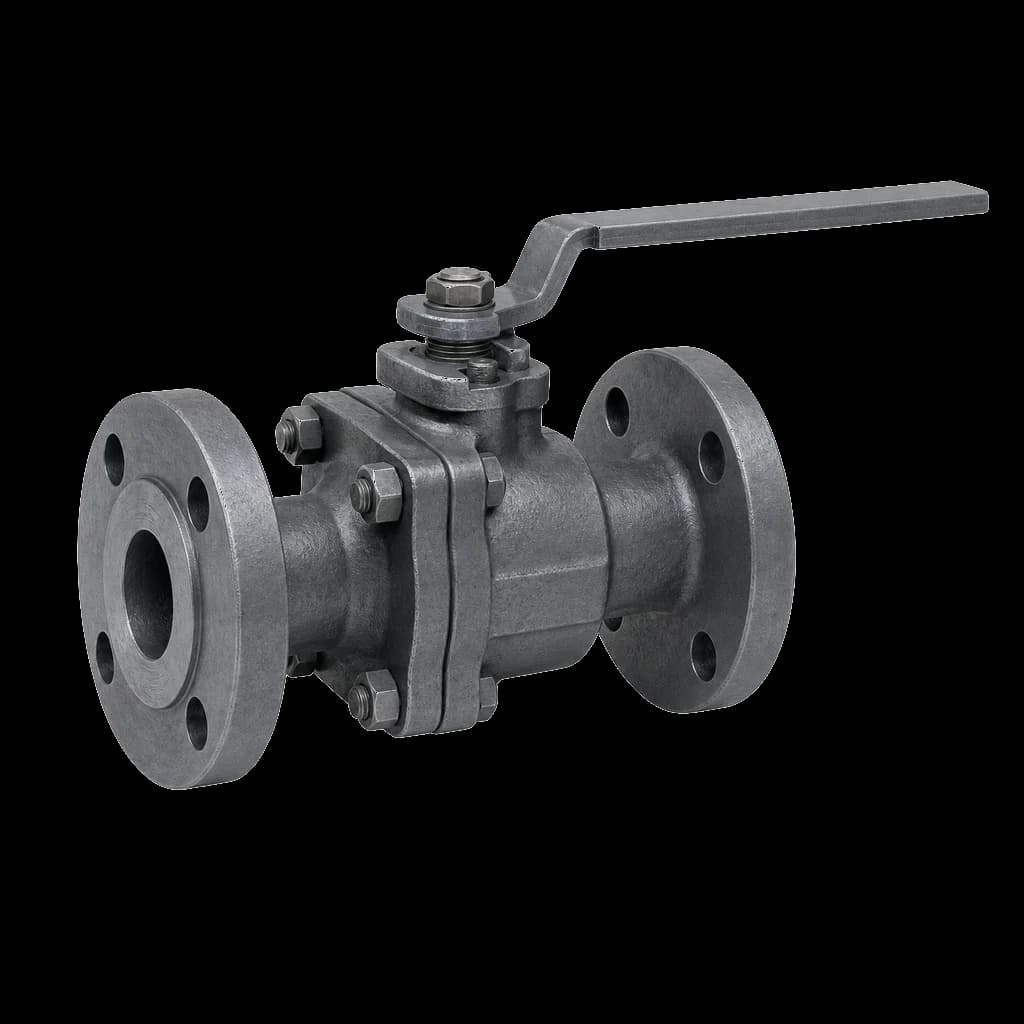
A hygienic ball valve is full-bore, clamp- or weld-ended, with encapsulated seats and a cavity filler closing the volume behind the ball. Built that way and installed with the stem horizontal so the residual cavity drains, it suits clean, low-viscosity liquids on a CIP-able loop — process water, brine, thin syrups, utility duty. A two-piece industrial ball valve in 316 with a screwed end and a loose seat is not a sanitary ball valve, whatever the vendor calls it: it has a cavity, it has a thread, and it will be written up.
Sanitary butterfly valve
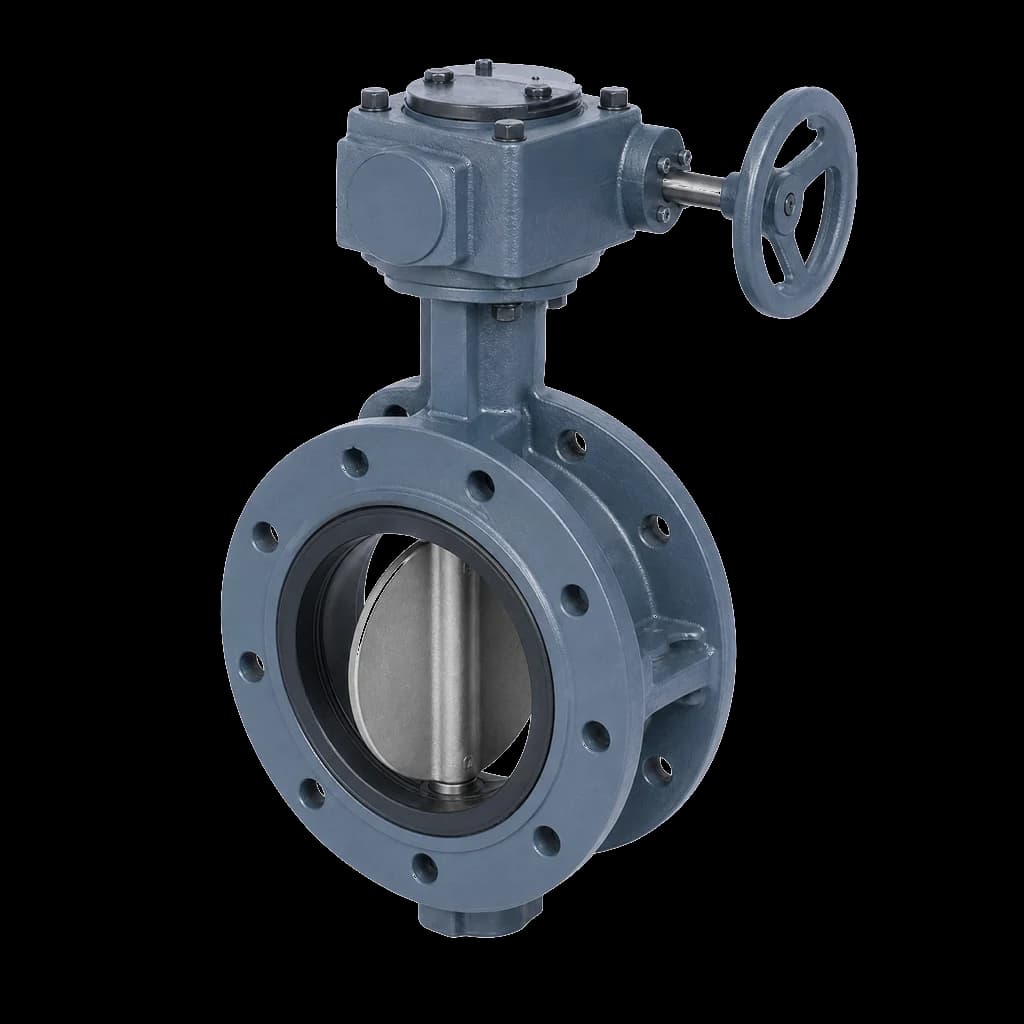
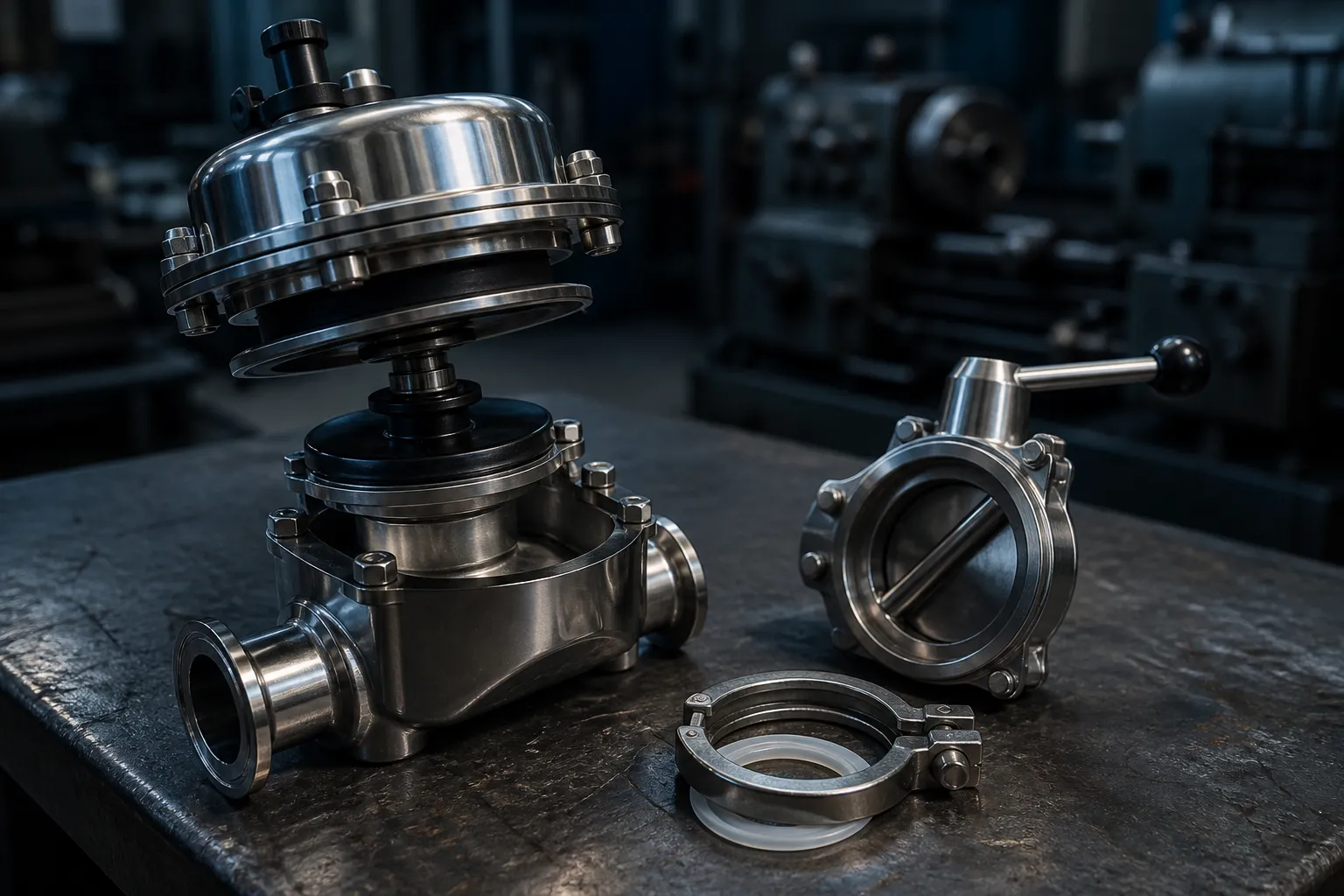
The workhorse of dairy and brewing. A tri-clamp butterfly valve carries a one-piece moulded EPDM or silicone seat that doubles as body gasket and shaft seal, so there is no gland packing and no fastener in the product zone. It is compact, easy to actuate, cleanable in place and the cheapest of the hygienic types. The disc sits in the flow at all times, so it handles fibrous and particulate product poorly, and the seat is a consumable — replace it against a cycle count, not when it starts to weep.
Sanitary diaphragm valve
For sterile pharma process, WFI distribution and clean steam, the weir-type diaphragm valve is usually the only design that passes audit. The diaphragm — EPDM, or PTFE faced onto an EPDM backing cushion — isolates the product from the bonnet and stem, so there is nothing to pack and nothing to lubricate. In a forged zero-static body, correctly sloped, it keeps the branch inside the L/D ≤ 2 dead-leg limit that bioprocess practice treats as the ceiling. The trade-off is maintenance: diaphragms have a defined SIP-cycle life, and reassembly torque must be controlled rather than guessed.
Two more types reach tender lists. Mix-proof double-seat valves separate product from CIP flow in a tank farm with a vented leakage chamber between two independent seats — purpose-built process equipment, not catalogue valves. A sanitary sampling valve is a small aseptic take-off, often with a steam barrier around the seat; specify the port geometry the QC laboratory actually uses, or it gets bypassed.
| Type | Cleanability in place | Best fit | Main limitation |
|---|---|---|---|
| Hygienic ball valve | Good, if cavity-filled and stem-horizontal | Clean liquids, utilities, CIP supply headers | The cavity behind the ball is inherent |
| Hygienic butterfly valve | Very good | Dairy, brewing, general food process lines | Disc always in the flow; seat is a wear part |
| Weir diaphragm valve | Excellent, fully drainable | Sterile pharma, WFI, clean steam | Diaphragm life; pressure and size ceilings |
| Mix-proof double-seat valve | Excellent, seats cleaned independently | Tank farms, CIP and product matrix panels | Cost, complexity, specialist equipment |
End connections: tri-clamp, DIN 11851 and why threads lose
The tri-clamp joint — two ferrules, a moulded gasket in a controlled groove, one clamp — is the default hygienic connection: a flush, crevice-free bore that can be broken for inspection in seconds. Watch the dimensional series: ASME BPE, DIN 32676 and ISO 2852 ferrules are not universally interchangeable, and mixing them is how a gasket ends up protruding into the bore — a crevice with extra steps. Name the series on the enquiry. DIN 11851 unions remain common on Indian dairy plant, and SMS 1145 turns up on imported skids.
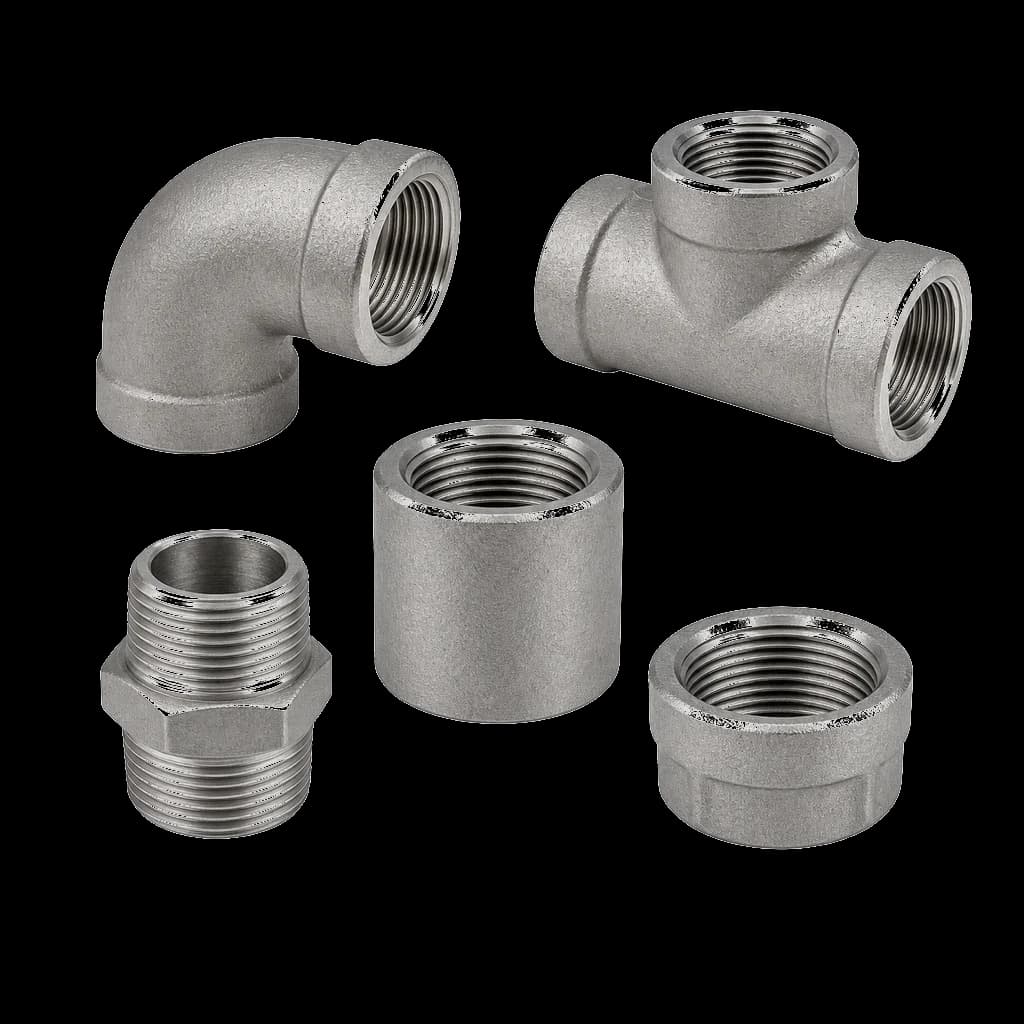
On pharma process lines the connection is usually an orbital butt weld with an inspected, fully penetrated root: no gasket, no crevice, nothing to loosen under thermal cycling. The absolute rule: BSP and NPT pipe threads have a helical crevice that no CIP cycle will ever clean. Threaded and socket-weld stainless fittings belong to the utility, instrument and service scope outside the product zone, and nowhere else.
CIP and SIP: the duty cycle that actually wears the valve out
Nothing the product does damages a hygienic valve the way the cleaning does. A typical CIP recipe runs caustic at roughly 1-2 % NaOH and 60-85 °C, an intermediate rinse, then acid — nitric or phosphoric at around 0.5-2 % and 50-70 °C — before the final rinse. Sterilisation in place adds saturated steam at 121-135 °C for a validated hold. Specify against that cycle first and the product second: an EPDM butterfly seat absorbs thousands of cycles, while the same valve in FKM, chosen because someone saw an oil on the product list, will be hard and crazed within a season.
Three consequences follow. CIP return velocity has to stay high enough to scour — most plants work to about 1.5 m/s — so do not oversize the return leg. Thermal cycling relaxes clamp joints, so re-torquing after the first few SIP cycles is planned maintenance, not evidence of a bad joint. And the steam utility feeding the SIP header deserves the same engineering as the process: a correctly sized reducing station, trapped drip legs and separators where the steam is wet, all covered in the steam service valve guide.
3-A, EHEDG and what Indian buyers actually specify
3-A Sanitary Standards is a US voluntary design standard; a valve carrying the 3-A Symbol has been verified by an independent third party against the standard covering that class of equipment. EHEDG certification is European, granted by testing a real assembly for cleanability against a reference pipe. FDA compliance is neither — it is a statement about materials, and no valve is ever "FDA approved". Establish which of the three a supplier means, and ask for the certificate number.
India has no equivalent national design standard for hygienic valves. A plant is audited against FSSAI's Schedule 4 hygiene and GMP requirements, Schedule M of the Drugs Rules for pharmaceutical premises, and — for export units — the customer's URS or a WHO-GMP inspection. The specification burden falls on the buyer. A dairy tender reading "SS 316 sanitary valve, tri-clamp ends" and nothing more attracts quotes from four different classes of product, and the cheapest wins on paper. Write in the Ra ceiling, the elastomer compound and its certificates, the clamp series and the CIP/SIP duty; our guide to writing a valve RFQ applies the same discipline across the rest of the plant.
The eight lines that make a hygienic valve enquiry biddable
- Service and product: what flows, at what temperature, viscosity and pH, and whether it carries solids, fibre or fat.
- CIP and SIP regime: chemistry, concentration, temperature, hold time and cycles per year.
- Product-contact finish: an Ra ceiling in µm or µin, electropolish or not, and the verification method.
- Wetted materials: body and trim grade, elastomer compound, and the certificates demanded — 21 CFR, USP Class VI, 3-A compound class.
- End connection and series: clamp to ASME BPE, DIN 32676 or ISO 2852; DIN 11851 or SMS union; or butt weld with pipe OD and wall stated.
- Orientation and drainage: line slope, mounting attitude, and whether the valve must drain unaided.
- Actuation: manual or pneumatic, fail position, wash-down ingress rating and position feedback.
- Documentation: EN 10204 3.1 for wetted metal, elastomer compliance certificates, finish records and seat test reports.