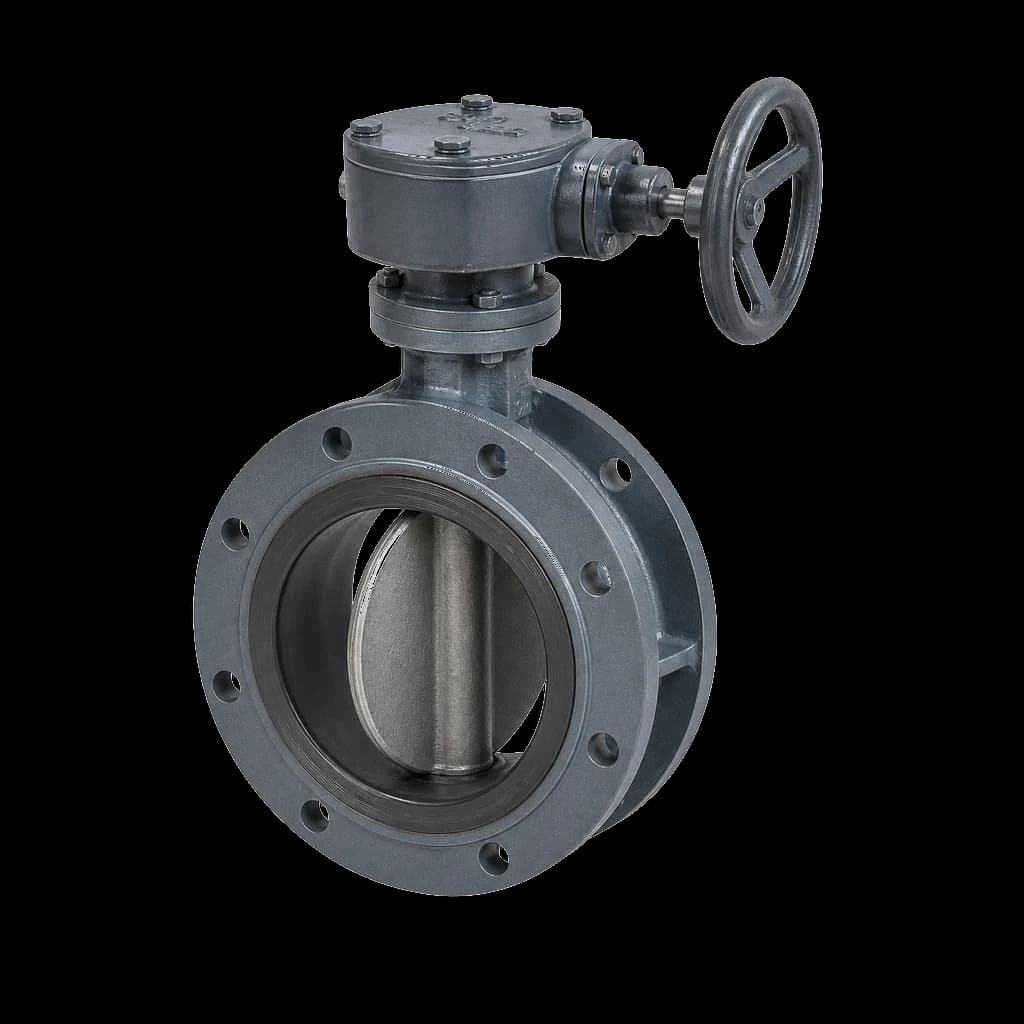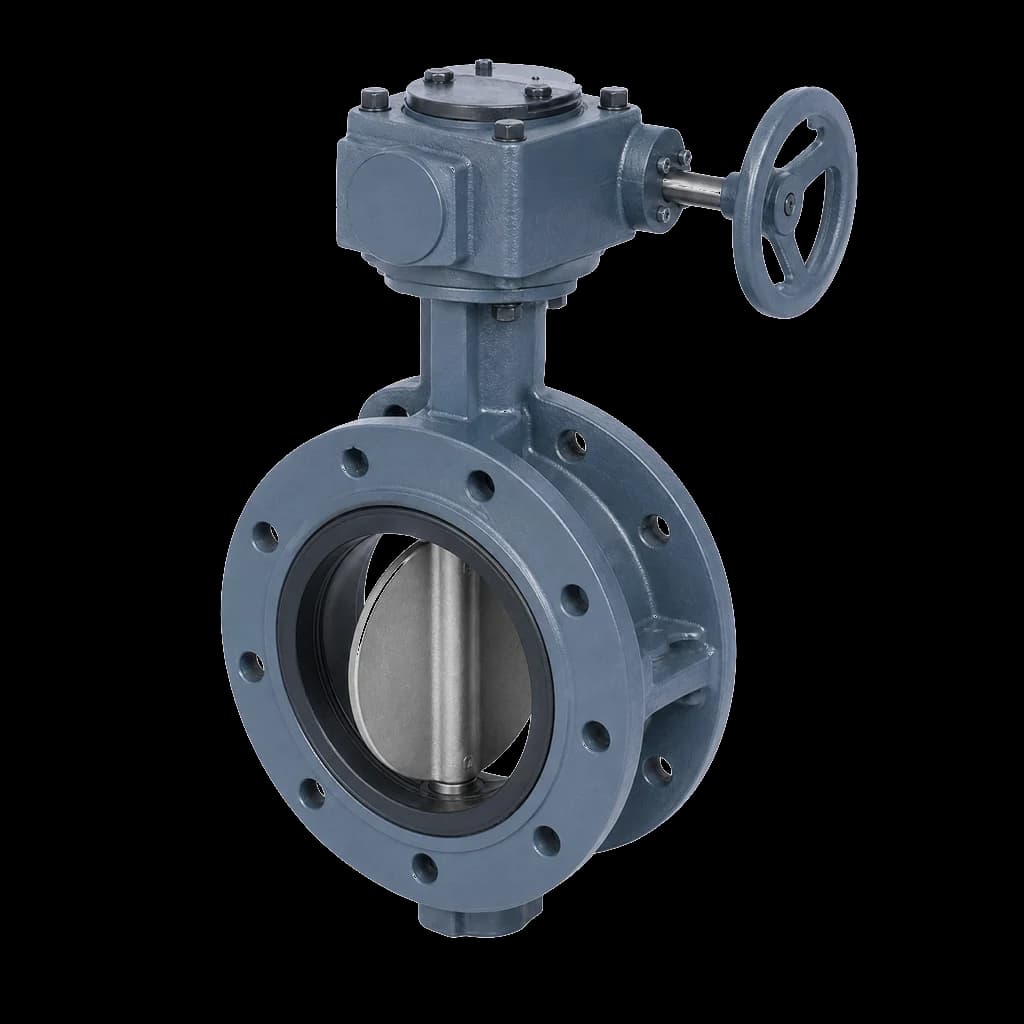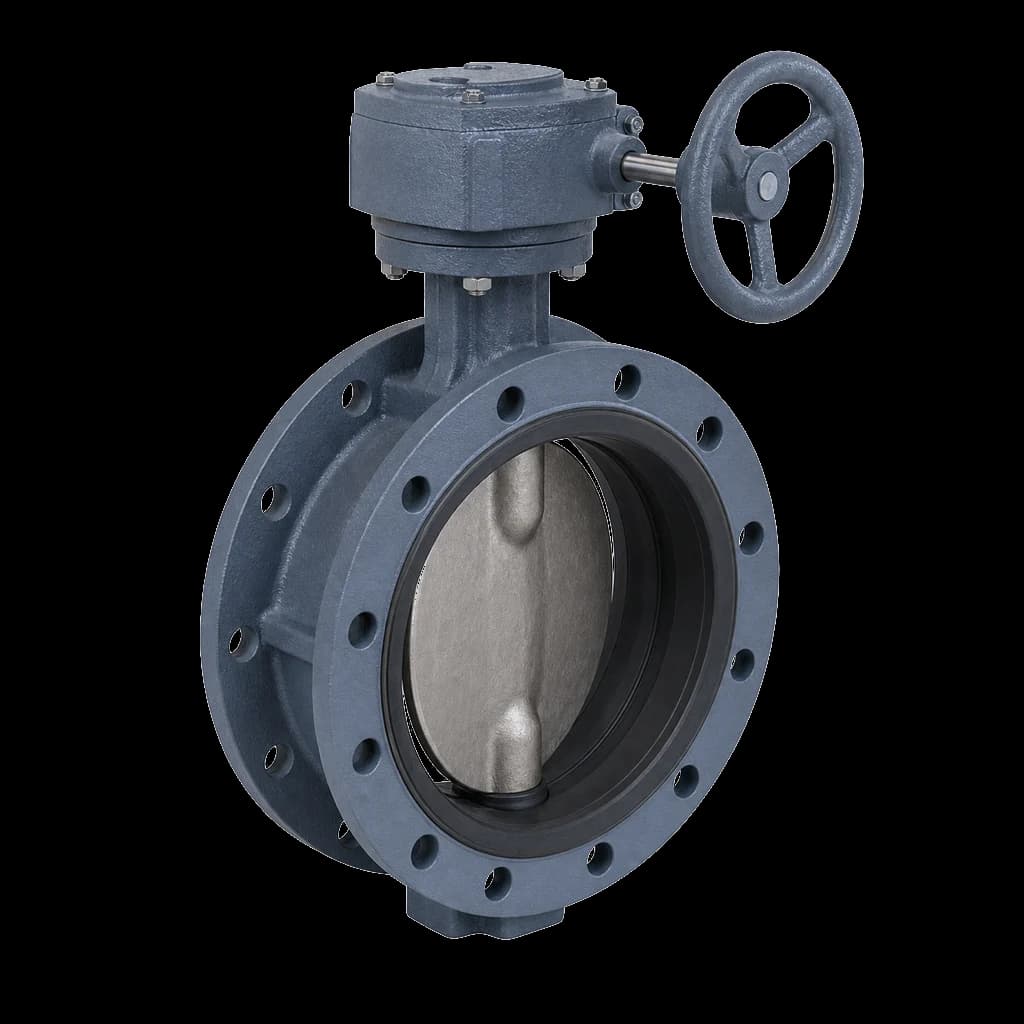
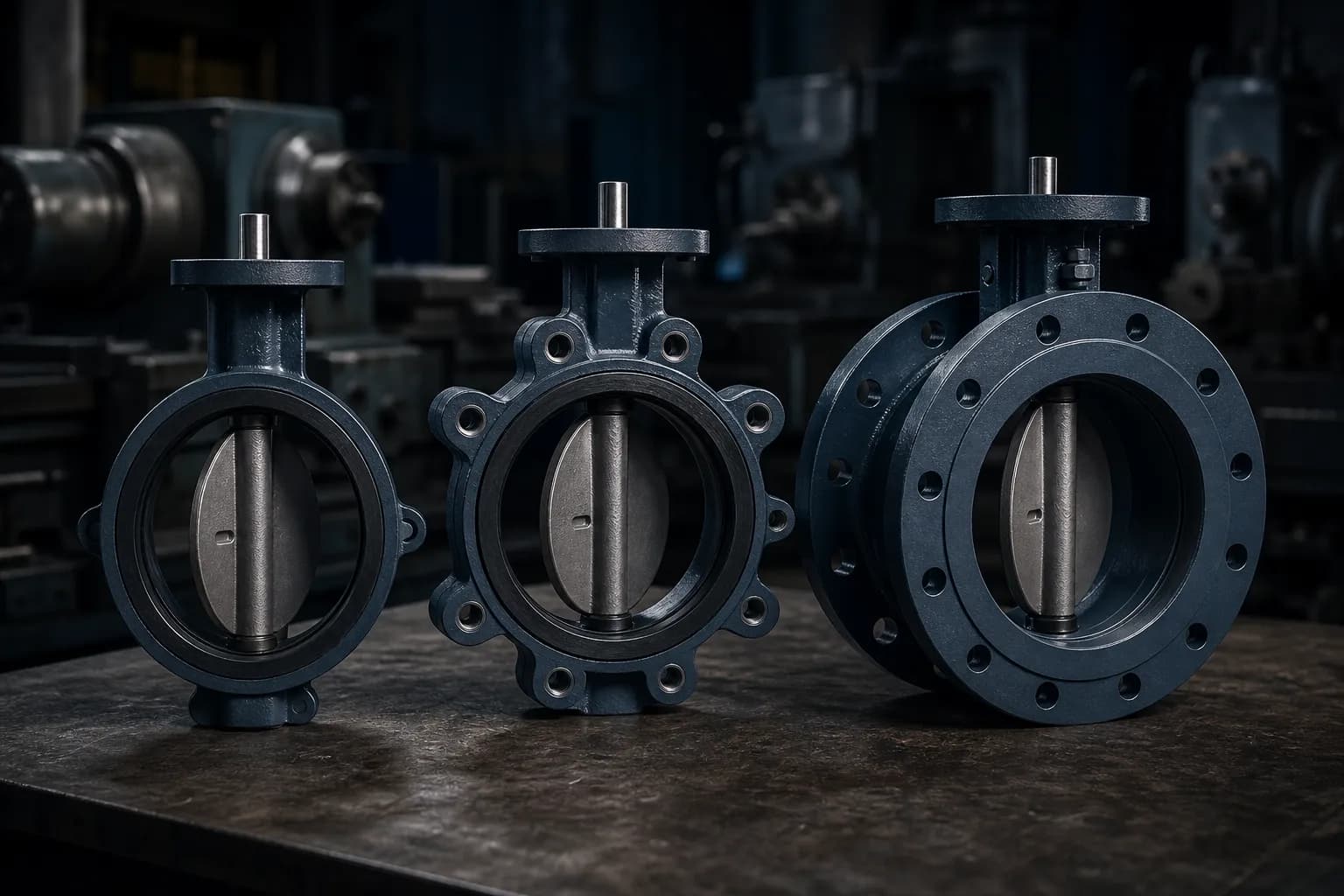
A wafer type butterfly valve, a lug-bodied valve and a double-flanged valve can carry the same disc, shaft and EPDM liner. What changes is how the valve is held in the line — and that decides whether you can strip a downstream spool without draining the header, and whether the valve belongs in a buried chamber. Most enquiries name size, rating and liner and leave body style blank. It is the one field where a wrong assumption costs a shutdown rather than a rework.
Three bodies, one disc
Strip the three down and the wetted parts are usually identical: the same disc casting, shaft, liner and gear operator on the same ISO 5211 pad. Body style is a mounting decision, not a flow decision — disc geometry (concentric, double offset or triple offset) is the separate axis, governing shutoff class, temperature and torque, and covered in concentric vs offset butterfly valve types. Choose the disc from the fluid, the body from what you will one day need to unbolt.
| Attribute | Wafer | Lug | Double flanged |
|---|---|---|---|
| Bolting | Through-bolts clamp it between two flanges | Tapped lugs, each side bolted separately | Integral flanges, bolted like a spool |
| Dead-end service | Not permitted | At the published dead-end rating | At full rating |
| Downstream pipe removal, line live | No | Within the dead-end rating | Yes |
| Size band | To mid bore; rare past DN 600 | As wafer | Whole range; the norm above DN 600 |
| Face-to-face | Short, per API 609 or MSS SP-67 | Short, same as wafer | Long pattern, confirm on drawing |
| Relative cost and weight | Lowest | Higher | Highest |
| Where it earns its place | Mid-line isolation in plant | Branch, take-off, end of line | Buried mains, pump houses, large bore |
Where a wafer type butterfly valve fits
The wafer body is the default in plant piping and deservedly so — the shortest, lightest and cheapest way to put a quarter-turn isolation into a line. Its bolt circle carries no load: the body is sandwiched between two flanges by studs running the whole length of the joint, located by centring holes or by a machined outside diameter that self-centres on the studs.
The dead-end rule
Never specify a wafer valve as the last valve in a line, at a hose point, at a tank drain, or immediately upstream of equipment you expect to remove. It seals on its liner faces against both mating flanges, so with one flange gone the free face has nothing to seal against — and the same studs do both jobs, so slackening the downstream nuts unloads the live upstream face while you are still holding line pressure. If a line will ever be broken downstream, that valve is a lug or a double-flanged body.
Disc projection and pipe bore
In the smaller sizes a concentric disc projects past the body faces when fully open. Check the maker's disc projection figure against the bore on each side before releasing the order: Sch 80 and Sch 160 pipe, rubber- or cement-mortar-lined pipe, reducing flanges and flanges bored for a heavier schedule all shrink the bore the disc must swing into. A disc that fouls jams on first stroke, and the damage lands on the seating edge, so the valve no longer shuts off. At drawing stage the fix is a spacer spool; at commissioning it is a new valve.
Lug bodies: tapped holes and dead-end duty
A lug body carries threaded lugs on the bolt circle, so each flange bolts to the valve independently. That is the whole point: the downstream half of the joint can come off while the upstream half stays clamped and the valve keeps holding. Specify it at pump discharges, strainer take-offs, branch isolations off a live header, and anywhere the isometric shows a spool that will be removed.
- Dead-end rating is not the line rating. Makers publish a separate, lower figure for one-sided service, sometimes valid only with a blind flange bolted to the free side. Get it in writing.
- Cap screw length decides whether the joint clamps. Too long and it bottoms in the blind tapped hole while the flange is still loose; too short and thread engagement is lost. Specify length and grade.
- Watch the thread material. Lugs tapped into grey cast iron have modest thread strength and no tolerance for over-torquing. Torque to the table, not to feel.
- Lugs are not lifting points. At the end of a line the valve carries a blind flange and often an actuator as overhung load. Support it or the adjacent spool separately.
Double-flanged bodies: the large-bore and buried default
A double-flanged valve has integral flanges cast on the body and behaves like a short pipe spool. Bending moment and axial thrust cross the body itself instead of being dumped into through-bolts, and either side can be unbolted at full rating. Above roughly DN 600 that stops being a preference: through-bolt lengths, flange loads and the mass of a wafer body are unmanageable in the field. It is also the waterworks standard, where the valve ties into a ductile iron main and sits undisturbed for decades.
You pay in weight, laying length and price. Material follows duty: grey iron to IS 210 for low-pressure water, ductile iron to IS 1865 or ASTM A536 where the tender wants toughness and a higher rating, cast steel for process lines. Settle it before the drilling table is fixed: the drilling a DI body carries as standard is not always the drilling on the CI fitting it meets — see cast iron vs ductile iron valve bodies.
Flange drilling and face-to-face: the two that bite
A butterfly valve is bought on size, rating and liner, and rejected at site on drilling. It must match the bolt circle, hole count and hole diameter of the flanges already welded or cast into the line, and Indian projects routinely run several drilling families side by side. Name the one that applies on the RFQ line, not in a covering note. Past NPS 24 the question changes character, as ASME B16.5 vs B16.47 flanges sets out.
- ASME B16.5 Class 150 or 300 — process, refinery, CGD and fire lines to NPS 24. State the class: a Class 300 bolt circle will not sit on a Class 150 valve.
- ASME B16.47 Series A or Series B — NPS 26 and above. Different bolt circles at the same nominal size; naming only "B16.47" is incomplete.
- ASME B16.1 Class 125 and B16.42 Class 150 — cast iron and ductile iron flanges, common on pump packages.
- EN 1092-2 PN 10 or PN 16 — EN-specified water and HVAC packages and most European-origin bodies.
- IS 1538 — the workhorse for Indian CI and DI waterworks fittings and valves. Quote the table number; the standard carries more than one drilling.
- BS 10 Table D, E and F — alive in older municipal, PWD and CPWD networks. Tying into an existing main, measure the flange rather than trust the as-built.
Face-to-face is the second trap. Wafer and lug bodies of the same size and rating are usually interchangeable on length — the short pattern of API 609 and MSS SP-67, or the short basic series of ISO 5752 on EN 593 and IS 13095 bodies — so a late swap from wafer to lug rarely disturbs the pipe. A double-flanged body is a long pattern and never a drop-in. Fix the body style before the isometrics are frozen.
Water mains, buried chambers and the sluice valve question
On a raw or treated water main the decision is largely made for you: double-flanged ductile or grey iron, resilient seated, gear operated, drilled to the table the tender names. The reasons are mechanical, not hydraulic: the body has to take pipeline thrust and settlement, the joint has to be breakable from one side, and nobody wants to hunt for full-length through-bolts inside a flooded chamber. Specify a sealed, grease-packed gearbox fit for submersion, and call out extension spindle length, surface box and position indicator — the items that go missing on a supply-only order.
Liner choice is the other half. EPDM is the default for cold and warm water and the elastomer most potable-water clauses expect; nitrile suits oils and some effluents but is no water-main default; and no soft-seated concentric valve belongs on hydrocarbons, steam or fire-safe duty unchecked against the governing standard. Get the seat material onto the test certificate, not only the quotation.
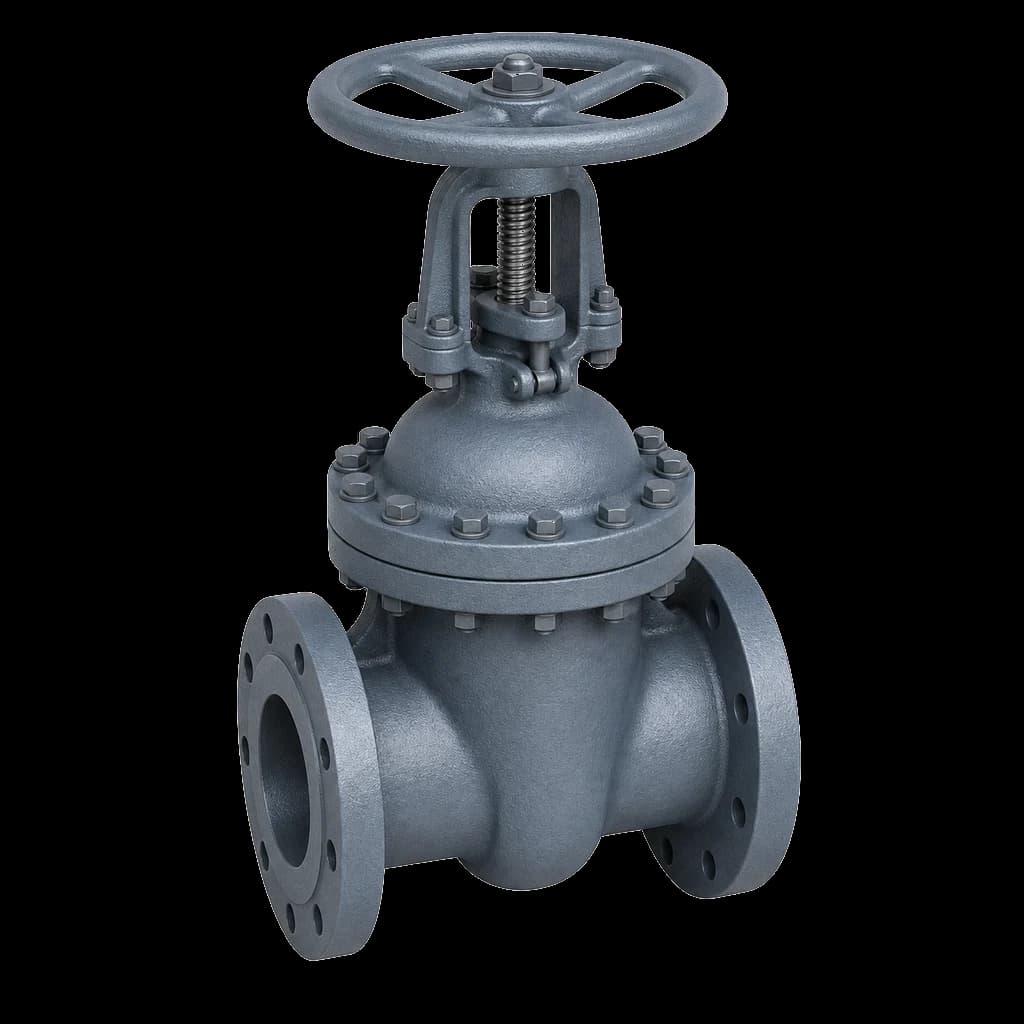
The competing option is a sluice valve, and it is a genuine contest. A butterfly is shorter, lighter and cheaper at large bore and it throttles usefully; a sluice valve to IS 14846 gives full bore, nothing in the flow path, and a design most utilities and PHED schedules have carried for decades — see IS 14846 sluice valves explained. Where the line carries grit, the sluice valve wins; where chamber size and handling dominate, the butterfly wins. VKS supplies both, including resilient-lined cast iron butterfly valves for water treatment schemes.
Specifying a body style without ambiguity
An enquiry that can be quoted correctly on the first pass carries seven fields. Most carry three, and the rest surface one e-mail at a time while the schedule slips.
- Body style — wafer, lug or double flanged — and, if lug, whether dead-end service is required.
- Size and rating, plus the flange drilling standard and table by name.
- Body, disc, shaft and liner materials, each as a grade designation rather than a description.
- Disc geometry: concentric for general water duty, offset where shutoff class, temperature or differential pressure demand it.
- Operation — lever, worm gear, bevel gear or actuator — with pad, extension spindle, surface box and limit switches.
- Service conditions: fluid, design and operating pressure, temperature, and whether the valve throttles or only isolates.
- Documentation: test standard, seat leakage class, EN 10204 3.1 or 3.2 certification, and any third-party inspection.